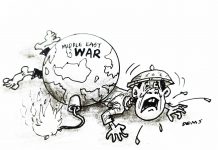
Eastern Visayas must recognize that global conflicts are not just “their problem.” They are ours too, in ways subtle but significant!
When news breaks of escalating conflict between Iran, the United States, and Israel, many in Eastern Visayas might shrug it off as something happening “far away.” After all, the Middle East feels worlds apart from our islands. But distance does not guarantee safety. In today’s interconnected world, wars ripple outward, and even regions like ours—quiet, agricultural, and coastal—can feel the aftershocks.
Eastern Visayas is not immune to global economic tremors. Wars in the Middle East often drive-up oil prices. For a region where transportation fuels fishing boats, jeepneys, and farm machinery, higher fuel costs mean higher food prices and tighter household budgets. Inflation hits hardest in provinces where poverty rates are already high.
Eastern Visayas must recognize that global conflicts are not just “their problem.” They are ours too, in ways subtle but significant. Preparedness means strengthening local economies, diversifying energy sources, and ensuring support systems for OFWs. It also means cultivating awareness—because ignorance is not protection.
The Philippines has long been a strategic ally of the United States. If the conflict escalates, our archipelago could be drawn into military posturing. Bases in Luzon and Mindanao may see heightened activity, and while Eastern Visayas is not a military hub, the fear of spillover—terrorist retaliation.
Wars abroad often trigger refugee crises. While the Philippines may not be the primary destination, our overseas workers in the Middle East are directly at risk. Eastern Visayas has thousands of OFWs whose remittances sustain families here. If they are forced to return suddenly, local economies could suffer.
As the war heats up, the uncertainties of things come to the fore. Maybe we need to be involved by way of preparations and its NOT out of tune with the realities. Harayo man an AWAY HAN GYERA, maapektohan gihap kita!