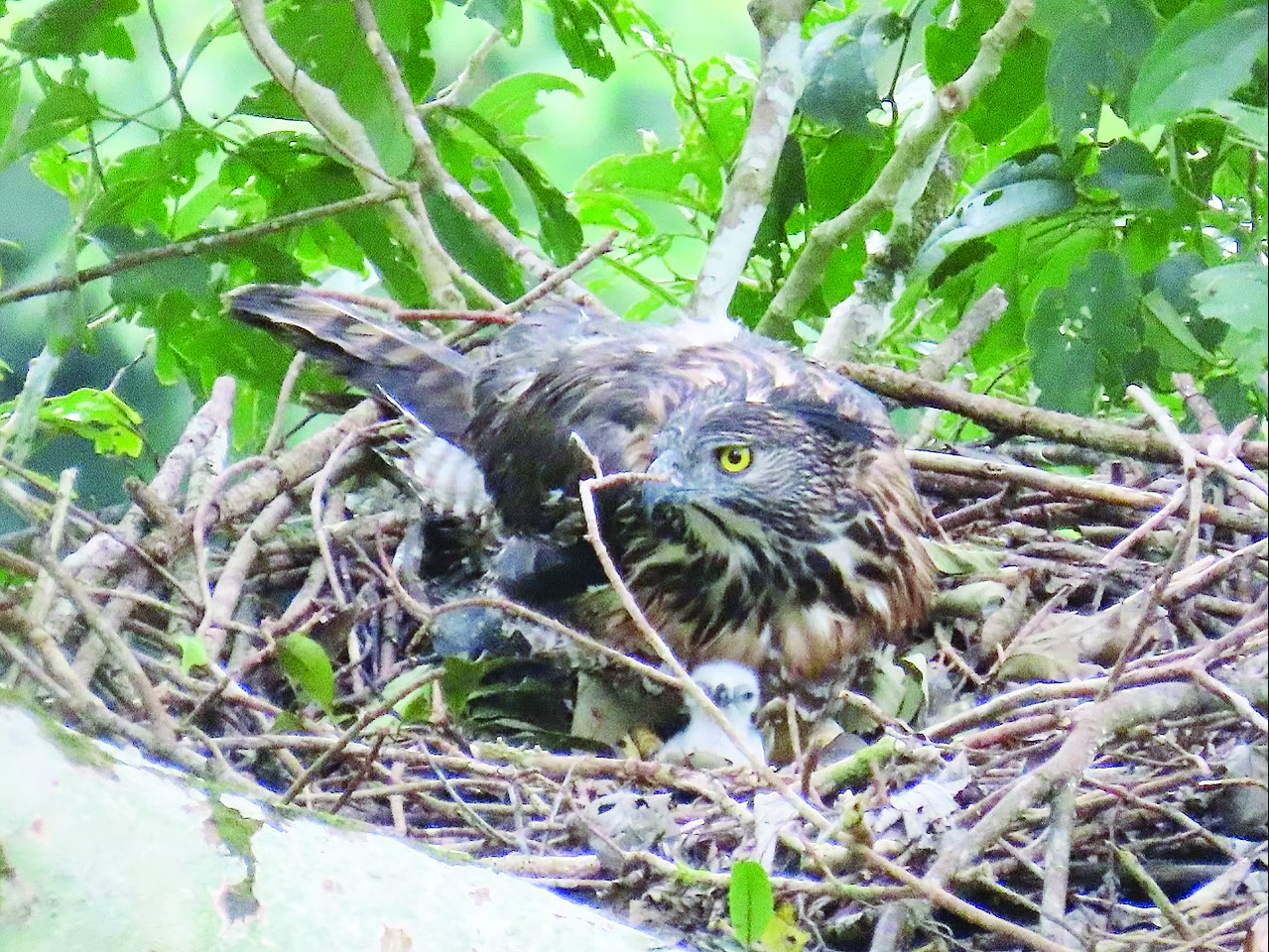
TACLOBAN CITY — A rare South Philippine Hawk-Eagle successfully raised a chick in a forest in Burauen, Leyte, providing conservation researchers with the first documented record of an active nest of the globally endangered raptor on Leyte Island and in Eastern Visayas.
The Philippine Eagle Foundation (PEF) discovered the nest in November 2025 during fieldwork conducted by a team consisting of a biologist, field technician and local forest guards.
The team initially heard a hawk-eagle repeatedly calling from a large native tree locally known as tiga. A second eagle later landed on a nearby tree, prompting the researchers to scan the area with binoculars.
They spotted a large stick nest among the branches and observed one of the birds arranging fresh twigs, indicating that the pair was actively building the nest.
Because nesting birds are particularly sensitive to disturbance, the team left the area and avoided further observation for nearly two months to allow the pair to continue nesting undisturbed.
When researchers returned in January 2026, they found the female incubating a single egg.
The PEF team then began daily monitoring from sunrise to sunset from a camouflaged observation blind designed to minimize disturbance to the birds.
After 41 days of monitoring, the egg hatched on March 2.
Researchers documented the parents’ roles in caring for the chick. The male regularly brought food to the nest, while the female stayed close to the chick, shielding it from rain and heat and protecting it from possible predators.
The female also tore food into smaller pieces for the chick, removed food remains and helped maintain the nest. Both parents were observed bringing fresh leafy branches to the nest.
As the chick grew, researchers observed it standing and walking around the nest and eventually flapping its wings as it prepared for its first flight.
After 76 days of monitoring, the young hawk-eagle successfully fledged on May 17.
PEF said the discovery is significant because it is the first documented active nest of the South Philippine Hawk-Eagle (Nisaetus pinskeri) on Leyte Island and the first recorded active nest of the species in Eastern Visayas.
The observation also enabled researchers to document the species’ complete nesting cycle, from nest construction and egg incubation to hatching and successful fledging.
The South Philippine Hawk-Eagle is found only in parts of the central and southern Philippines. Although the species has long been recorded in Leyte, previous sightings were largely limited to adult birds and juveniles after they had already left their nests.
The new findings could provide valuable information on the species’ breeding behavior and help guide conservation measures, particularly the protection of its remaining forest habitat.
The discovery has already prompted local conservation initiatives.
The Protected Area Management Board of Mahagnao Volcano Natural Park approved four resolutions aimed at protecting the nesting site and the hawk-eagle family.
The local government of Burauen is also preparing an ordinance recognizing the South Philippine Hawk-Eagle as one of the municipality’s flagship species for conservation.
PEF said its research team is preparing scientific papers on the findings, along with evidence-based recommendations for protecting the species.
The foundation also plans to launch later this year the first telemetry study of the South Philippine Hawk-Eagle. The project will involve fitting GPS transmitters to adult birds and the fledgling to determine their territory sizes, forest-use patterns and movements after young birds leave the nest.
PEF said continued research and stronger local conservation measures are essential to protect the globally endangered raptor and the remaining forests on which it depends.
(ROEL T. AMAZONA)