
24.4 C
Tacloban City
March 27, 2026 - Friday | 8:26 AM
Home Blog Page 978

Why do we always have to forgive?

0
FR. ROY CIMAGALA
FR. ROY CIMAGALA

MANY reasons can come to mind to answer that question. One is that Christ himself said so. When asked by Peter how many times one should forgive, he stretched to practically infinite times the suggestion of Peter of 7 times to 70 times 7.

On another occasion, Christ also said that we need to forgive others if we want to be forgiven ourselves. “Forgive and you shall be forgiven,” he said (Lk 6,37) He reiterated this injunction when he said: “For if you will forgive men their offences, your heavenly Father will forgive you also your offences. But if you do not forgive men, neither will your Father forgive you your offences.” (Mt 6,14-15)

It’s clear therefore that we can only be forgiven if we also forgive others. This injunction is meant for everyone, and not only for a few whom we may consider to be religiously inclined.

That’s also why he easily forgave the woman caught in adultery. And to those whom he cured of their illnesses, it was actually the forgiveness of their sins that he was more interested in.

To top it all, Christ allowed himself to die on the cross as a way to forgive all of our sins, and to convert our sins through his resurrection as a way to our own redemption. What he did for us he also expects, nay, commands that we also do for everybody else.

If Christ can offer forgiveness to those who crucified him—and there can be no worse evil than killing Christ who is God—why do we find it hard to offer forgiveness to others?
It is presumed that all of us sin one way or another. That’s why St. John said: “If we say that we have no sin, we deceive ourselves, and the truth is not in us.” (1 Jn 1,8) I am sure that our personal experiences can bear that out easily.

No matter how saintly we try ourselves to be, sin always manages to come in because of our wounded humanity and the many temptations within and around us. As St. John said, we have to contend with three main enemies: our own wounded flesh, the devil and the world corrupted by our own sin.

But the most important reason why we should always forgive is, I believe, the fact that forgiving others likens us with God, with Christ, who is the pattern of our humanity and the savior of our damaged humanity. Forgiving is the ultimate act of love which is the very essence of God and which is also intended for us since we are supposed to be God’s image and likeness.

Thus, we have to learn to be forgiving always of others, no matter how undeserving we feel they are of forgiveness. That’s how God forgave us. He took the initiative. He offered forgiveness and continues to do so if only to bring us back to him.

The awareness of this truth should also help us to develop the attitude to forgive one another as quickly as possible, since that is the only way we can learn to love. When we find it hard to forgive others, it is a clear sign that we are full of ourselves, are self-righteous, proud and vain.

We have to continually check on our attitude towards others because today’s dominant culture is filled precisely by the viruses of self-righteousness, that feeling that we are superior to others, etc. We have to do constant battle against that culture that undermines our duty to be always forgiving.

If rice is life, then its hard to live nowadays

0
CLEMELLE L. MONTALLANA,DM, CESE ASSOCIATE PROFESSOR III
DR. CLEMELLE MONTALLANA

The Carenderia Waitress asks “How many cups of rice, Sir?’, I readily said “Two cups, please!” Later, I complained, “Day, I asked for two cups of rice !”. The waitress answered , “Sir, its two cups, with the same price but with a smaller cup of course! I was not able to respond with this declaration, I just said, “ Give me sabaw /soup! The waitress said, “ No more free soup, Sir, lugi! I simply said, “Ok, give me water then! and I left.

Rice is a staple food for most Filipinos, accounting for more than 30% of their daily calorie intake. It is also a major source of income and livelihood for millions of farmers who produce about 90% of the country’s rice supply. However, in recent years, the rice industry in the Philippines has faced a serious problem: the spiraling and downward spiral of rice prices, supply and high prices. This problem has been caused by a combination of natural and human factors, such as the El Niño phenomenon that affects rainfall patterns and crop yields, the trade restrictions imposed by some rice-exporting countries like India to protect their domestic markets, the hoarding and profiteering activities of some unscrupulous traders who manipulate the supply and demand situation, and the lack of effective government interventions to ensure adequate and affordable rice for all. This problem has had negative consequences for both consumers and producers, as it has increased food insecurity, poverty, inflation, and social unrest in the country. In this essay, I will analyze the causes and effects of this problem, and propose some possible solutions to address it.

One of the main causes of the rice price problem in the Philippines is the El Niño phenomenon, which is a climatic event that occurs every few years and causes abnormal changes in temperature and precipitation patterns across the Pacific Ocean. According to the Philippine Atmospheric, Geophysical and Astronomical Services Administration (PAGASA), the El Niño phenomenon has intensified the Southwest Monsoon and is expected to result in below-normal rainfall towards the end of 2023 in many parts of the country. This has adversely affected the rice production in the Philippines, as rice is a water-intensive crop that requires adequate irrigation. According to the Philippine Statistics Authority (PSA), the rice production in 2023 was estimated at 18.4 million metric tons, which was 2.3% lower than in 2022. The reduced rice output has contributed to a tight supply situation in the domestic market, which has pushed up the prices of rice.

In all, the price of Rice is also a yardstick of government’s effectiveness. But this time as the rice we were buying at 42 per kilo is now pegged at 58 per kilo, this shows we are losing to the cartel of rice hoarders and perhaps , we are not better off with the strategies we are employing.

If living is hinged on the criteria of obtaining rice, and then it is a sky rocketing commodity, then life is really hard nowadays.
US firms interested in modular nuclear reactors for RP

0
Dr. Paciente Cordero

Two US firms, at least, have expressed interest to develop small nuclear reactors for the Philippines, instead of reactivating the long time moth-balled Bataan Nuclear Power Plant (BNPP) in Bataan Province.

The Firms, US-based NuScale Power Corp. and Ultra Safe Nuclear Corp., laid their cards on the issue in a meeting during the recent state visit of President Ferdinand Romualdez Marcos, Jr. To quote Secretary Alfredo Pascual of Department of Trade and Industry (DTI), “there are two potential things that could happen. One is we can order from them (two companies) the supply of the reactor – either the small modular reactor or the micro modular reactor.” Another possibility is for the two companies to set up manufacturing facilities in the country – perceived as two business models/arrangements being targeted.
The two firms briefed the Philippine delegation, thus:

– Ultra Safe technology is not as sensitive to geological movements, meaning it can be used in areas with volcanic activity;

– NuScale technology is sensitive to volcanic or geological movements.
Of the two firms, NuScale was quoted by the Presidential Communication Office (PCO), has plans to conduct a study site to locate a potential site/s in RP.

MY COMMENT:
I have no qualms about re-tapping nuclear power to solve, mitigate the energy shortage of the country, but premised on the sound management of the nuclear reactors and the presence/availability of experts (nuclear physicists, etc.) on site. Also, site selection is critical in setting up future nuclear plant reactors.
ooo000ooo
NEXT TOPIC : “San Miguel honors local Corn buying Program”
SHARE S & T THOUGHTS through E-mail: drpacjr@yahoo.com.

Globe extends roaming credits, free prepaid load to customers in quake-hit Morocco

0

Globe is extending assistance in the form of postpaid roaming credits and free prepaid load to customers in Morocco after a powerful 6.8-magnitude earthquake struck near the ancient city of Marrakech.

This will allow Globe customers to use its roaming services to make or receive calls, and send text messages to all networks while in Morocco. To avail of these free roaming services, customers only need to connect to Globe’s roaming partners Orange and Inwi.
“We wish to provide our customers in Morocco immediate connectivity assistance so they could reach out and communicate with their loved ones during this difficult time,” said Coco Domingo, Globe VP for Postpaid and International Business.

To make a call, dial “+” + country code + area code + telephone number (ex. +63773101212) or dial “+” + country code + mobile number (ex. +639171234567). To send a text, type “+” + country code + mobile number (ex. +639171234567).
To use data roaming, customers may register to a Roam Surf promo via the GlobeOne app or by dialing *143#. Once promo registration is successful, they can start data browsing by turning on mobile data and data roaming on the phone’s settings, and set the network connection to 3G or LTE.

Postpaid customers also have the option to simply turn on their mobile data and data roaming to activate Roam Surf 399–an all-day data roaming service that automatically renews every 24 hours. No registration needed.

According to news reports, so far more than 2,000 people have been killed as the earthquake struck Friday evening. It is one of the strongest temblors to hit the North African country in more than a century, which has left buildings and other infrastructure destroyed.(PR)

NSSDEO completes Oleras Bridge Widening project

0

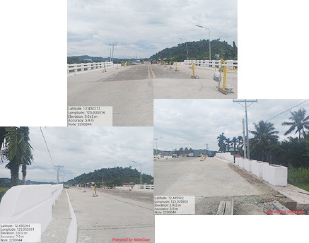
NSSDEO, Brgy. Burabud, Laoang, N. Samar– Oleras Bridge can now accommodate the increasing number of vehicles after the completion of the project Widening of Permanent Bridges, Oleras Br. (B00321SM) along Rawis-Catubig Rd, Laoang, Northern Samar by the Department of Public Works and Highways – Northern Samar Second District Engineering Office (DPWH-NSSDEO), headed by OIC-District Engineer Charlito S. Carlobos and OIC-Assistant District Engineer Atty. Arthur Eric L. Sabong.

The General Appropriations Act (GAA) of 2022 had an allocation of P36 million to widen this 198.24 m2 bridge from two lanes to four lanes. Accordingly, CDU Construction carried out the project’s construction under Contract ID 22II0044, which was completed on May 7, 2023.

To guarantee the public’s safety who will benefit the project, the DPWH-NSSDEO assigned technical professionals to assure that construction work complies with quality standards. In line with this, Project Engineer Filoteo T. Delorino, along with Project Inspector Engr. Vinna Elsa U. Garabel and Resident Engineer Ralph Jemil S. Equiza monitored and supervised the project from the start of the implementation up to its completion, while materials quality assurance was handled by Engr. Ma. Luzyl P. Castillo.

This project now provides rapid delivery of agricultural goods and domestic trading as well as improved access for road users plying Rawis-Catubig Road. Moreover, the increasing number of motorists can now easily traverse the Oleras Bridge due to its widened space area.
(ZYRA JOY J. CHING, PIO STAFF)

U.S. and Philippine governments launch partnership to advance education sector reforms

0

Manila-On September 7, the United States government, through the U.S. Agency for International Development (USAID), signed a Memorandum of Understanding (MOU) with the Second Congressional Commission on Education (EDCOM II) at the Senate of the Philippines to enhance the Philippine government’s capacity to deliver quality education and improve learning outcomes.

The agreement solidifies U.S.-Philippines collaboration on policy research, capacity building, and technical assistance in support of EDCOM II’s objective of assessing, evaluating, and recommending reforms to improve the Philippine education sector.

USAID Mission Director Washburn signed the MOU with EDCOM II Co-Chairpersons Senator Sherwin Gatchalian and Pasig City Representative Roman Romulo. Senator Gatchalian serves as Chairman of the Senate Committee on Basic Education and Vice Chairman of the Senate Committee on Higher, Technical and Vocational Education, while Rep. Romulo is the Chairperson of the House Committee on Basic Education.

“The Memorandum of Understanding underscores the mutual commitment of our two countries to work together to shape the future of Philippine education in order to make it a key driver of prosperity for all Filipinos,” said USAID Philippines Mission Director Ryan Washburn.

Composed of 10 commissioners from the Senate and the House of Representatives, EDCOM II is a national commission that looks at priority areas such as early childhood care and development, basic education, higher education, technical-vocational education and training, and lifelong learning, as well as cross-cutting issues in governance and finance.

“Reforming the Philippine education sector is no easy task that requires the inputs and expertise of advocates and partners. We are grateful to the USAID for steadfastly supporting education programs in the country, and we look forward to their contributions in reviewing and reforming the state of education in the country,” said EDCOM II Co-Chairperson Sen. Sherwin Gatchalian.

“This MOU demonstrates the depth of our countries’ friendship with one another. Access to quality education will unleash the full potential of Filipinos. Thank you to the USAID for its support to enhancing our Philippine education system,” Rep. Romulo said.

USAID shares the Philippines’ goal of making the country competitive in global education and labor markets. Over the past decade, the U.S. government, through USAID, has invested nearly $200 million to strengthen the capacity of Philippine education partners to drive inclusive and sustainable growth.(PR)

Recent Posts

DALMACIO C. GRAFIL
PUBLISHER

ALMA GRAFIL
EDITOR-IN-CHIEF

ROMEO CEBREROS
OFFICE IN-CHARGE

OFFICE
BRGY. SONGCO, BORONGAN CITY

CONTACT NUMBERS
(055) 261 – 3319 | 0955 251 1533 | 0917 771 0320 | 0915 897 7439 | 0921 511 0010

DALMACIO C. GRAFIL
PUBLISHER

RICKY J. BAUTISTA
EDITOR

ALMA GRAFIL
BUS. MANAGER

OFFICE
RIZAL AVENUE, CATBALOGAN
(INFRONT OF FIRE DEPARTMENT, NEAR CITY HALL)

CONTACT NUMBERS
0917 771 0320 | 0915 897 7439 | 0921 511 0010

EMAIL
lsdaily2@yahoo.com

WEBSITE
www.issuu.com/samarweeklyexpress