TACLOBAN CITY– The region’s biggest secondary public school, Leyte National High School, based here, has temporarily suspended its face-to-face classes due to intense heat.
The said school, with more than 9,000 students’ population, has implemented a modified class schedule.
This decision was made to ensure the safety and well-being of students amidst the rising heat index, the school’s information officer Bernie Jude Lamoglar, said in a media interview.
Lamoglar explained that the half-day classes and early dismissal times are designed to keep students out of school when the heat is too intense, ensuring their comfort and focus on their studies.
The region and the rest of the country have been experiencing intense heat for several weeks now, forcing schools to change their mode of classes.
In the region, over 200 schools have adapted to alternative delivery modes.
State universities like the Eastern Visayas State University and the Leyte Normal University in Tacloban City and the University of Eastern Philippines(UEP) have also adopted their mode of classes, including the non-wearing of uniforms.
(MAVEL ANGELA GOMBA, STUDENT INTERN, LEYE NORMAL UNIVERSITY)
TACLOBAN CITY– A magnitude 5.3 earthquake hit the coastal area of southeastern Dolores, Eastern Samar, at around 12:20 AM on Thursday, April 11, 2024, as reported by the Philippine Institute of Seismology and Volcanology (Phivolcs).
The tremor struck at a depth of approximately 25 kilometers, originating from a tectonic source.
The recent earthquake was also felt in nearby areas in Samar and Leyte.
It registered an Instrumental Intensity of III in Can-Avid, Eastern Samar, highlighting the widespread impact of the earthquake.
With its epicenter in Dolores, Eastern Samar, the earthquake raises concerns about the vulnerability of communities to natural disasters.
The Phivolcs, however, said that no damage or aftershocks was monitored by their office. (MISSY G.TUBIANOSA, LNU STUDENT INTERN)
TACLOBAN CITY– The city government here continues to campaign to take beggars off the streets.
This was disclosed by Melinda Sagdullas, focal person of the child and youth welfare program of the City Social Welfare and Development Office (CSWDO).
In particular, Sagdullas cited the Badjaos who are from various parts of the region who come to the city to beg for alms.
She said that most of these Badjaos are physically capable of doing some work but resort to begging for easy money.
Sagdullas lamented that some of them could be violent if they are not given alms.
“They can be aggressive in asking cents for alms. They hit your head, pull out your hair or push you. Some also steal. And some of them pretend to be mentally challenged so that they cannot be put to detention,” she said.
INTERNATIONAL CRUISE. Tour cruise operators from the region joined the Seatrade Cruise Global event in Miami, Florida, USA. (PHOTO COURTESY)
INTERNATIONAL CRUISE. Tour cruise operators from the region joined the Seatrade Cruise Global event in Miami, Florida, USA. (PHOTO COURTESY)
TACLOBAN CITY – Eastern Visayas joined this year’s Seatrade Cruise Global in Miami, Florida, USA which ended on Thursday (April 11).
Seatrade Cruise Global is an annual gathering and the leading cruise industry exhibition and conference and the world’s largest event for cruise line executives and suppliers of cruise services.
This annual event is attended by more than 10,000 individuals from the cruise industry all over the world, and showcasing more than 600 exhibitors from more than 120 countries.
Eastern Visayas has been part of the cruise tourism since 2013 when MV Europa Cruise Line, by German-based Hapag-Lloyd Cruises, visited the island of Kalanggaman in Palompon, Leyte.
From a lone cruise ship destination, the number has increased since then, adding more places in the region in cruise call itineraries, mostly island destinations.
Included in these cruise destinations are Capul and Biri Islands in Northern Samar, Limasawa in Southern Leyte, Cuatro Islas in Leyte, Maripipi and Sambawan Island in Biliran province, and Canigao Island in Leyte province.
Tacloban City and Palo in Leyte, and Padre Burgos in Southern Leyte are also part of cruise destinations.
“We are promoting the existing cruise destination in Eastern Visayas plus two new ones,” DOT Regional Director Karina Rosa Tiopes said when asked how important for the region in participating international cruise events.
Tiopes said that during this event, Philippine cruise tour operators sell local destinations to the cruise companies that make cruise calls in Asia.
Cruise ships that visit the region offer expedition cruises. These have smaller vessels with a capacity of less than 1,000 guests and crew and cater to the high-end market.
“They have guests who are willing to pay for shore excursions that offer authentic immersion activities that allow them to learn and appreciate the culture, heritage, history, way of life, and the natural wonders of a destination. They prefer places that are below the tourist radar,” the tourism official explained.
The arrival of cruise ships not only helps in promoting the region to the international market but also indirectly promotes the region to the local and domestic tourist market.
“This opens a vantage opportunity for the region to develop tour programs and promote destinations that are off the beaten track. Most of these places are hardly visited by even local tourists. However, when cruise ships visit, the local and domestic tourist market becomes curious. Ultimately, they start visiting these places as well,” Tiopes said.
To keep cruise ships continue visiting and making port calls to the region, the tourism department in the region is always on the lookout for new sites to offer for cruise tour companies to market.
Tiopes said that they are not particularly looking for developed beach areas but more on quaint places where foreign guests may rest and enjoy but must also have facilities like comfort rooms. (ROEL T. AMAZONA)
TACLOBAN CITY – The local government unit of Guiuan in Eastern Samar has launched an investigation regarding the complaints from residents of Barangay Bitaugan who accuses a mining company encroaching on their boundary.
Mayor Annaliza Gonzales-Kwan, in a letter addressed to Mines and Geoscience Bureau (MGB) Regional Director Glenn Marcelo Noble, has requested the agency to verify the mining tenement boundary of Emir Mineral Resources (Emir) in Barangay Casuguran on Homonhon Island.
“The residents of Bitaugan claim that Emir’s mining operation is encroaching their barangay area. Hence, the urgency of this request to prevent any violent confrontation,” she said in her April 4, 2024 communication to Noble.
“Moreover, I do not want any mining operation in Barangay Bitaugan because I intend to dedicate this area for agricultural and agro-industrial development,” Mayor Kwan added in her letter.
Mayor Kwan also sent a letter to Emir Mineral Resources Corporation informing the mining company official about her request to MGB-8 for verification of the mining tenement boundary.
“While we await MGB’s verification, I urge your company not to operate in the contested area to avoid further conflict,” her letter to Emir reads.
“Please be informed that I oppose any mining operation in Barangay Bitaugan to ensure the protection and efficient utilization of this area for agricultural and agro-industrial development,” her letter to Emir added.
Both villages of Bitaugan and Casuguran are adjacent to each other though the mining claims of Emir is in Casuguran.
In response to the complaints from Bitaugan residents, the municipal government has dispatched a team to Homonhon Island to conduct a ground investigation and meet with mining companies and barangay officials.
The team, led by Councilor Floriano Bagro, Jr., who heads the committee on environment, and municipal administrator Kinna Kwan, promised to assist the community in addressing the issue and finding sustainable solutions to prevent further harm during their meeting with village officials.
On April 3, several residents of Bitaugan held a rally protesting the operation, alleging that it encroaches on their village, which is not part of the areas approved for mining operation.
Homonhon Island falls under the jurisdiction of Guiuan town. Facing the vast Pacific Ocean, this island has a population of around 4,800 residing in eight villages and boasts a total land area of around 10,000 hectares, larger than the land area of mainland Guiuan.
Known for its historical significance in world navigation as the first area in the country where Ferdinand Magellan’s fleet landed in March 1521, the island is also recognized for its mining operations for nickel and chromite minerals.
Four mining companies currently operate on the island – Emir Mineral Resources Corp., Chromite King Inc., Nickelace Inc., and Mt. Sinai Mining Exploration and Development Corp., with operations primarily in Casuguran and Cagusuan.
These operations also affect the villages of Canawayaun, Pagbabangnan, and Culasi by using the area as their access road.
Aside from Bitaugan, two other villages unaffected by mining are Habag and Inapulangan, although they are not yet accessible by any means of land transport vehicles.
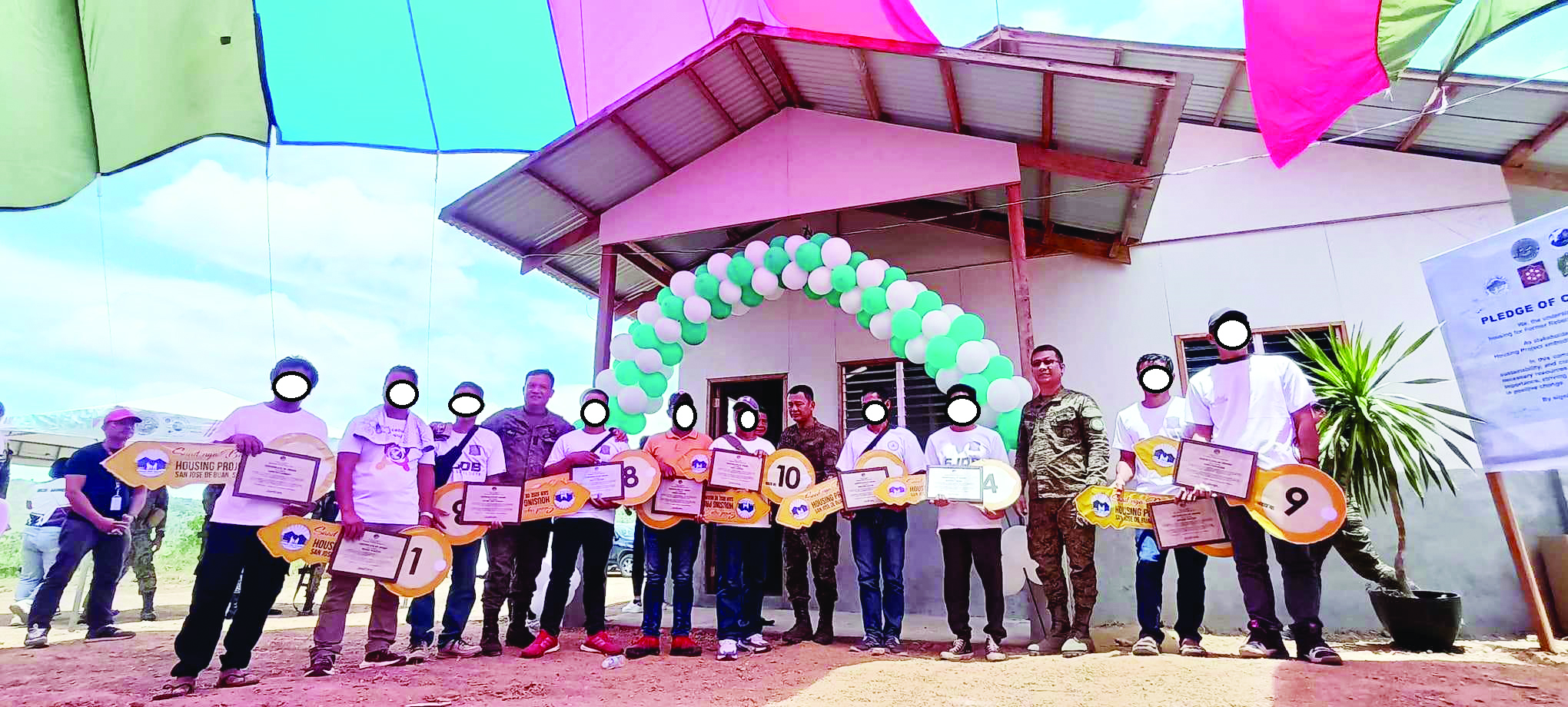
HOUSE OWNERS.Ten rehabilitated members of the New People’s Army received their titles as new house owners under the ‘Saad nga Balay’ program of the municipal government of San Jose de Buan, Samar. The simple turnover, took place on April 5, was witnessed by Army top officials, led by Major Gen. Camilo Ligayo, Governor Sharee Ann Tan, and Senator Robinhood ‘Robin’ Padilla. (ROEL T. AMAZONA)
‘Saad na Balay’
HOUSE OWNERS.Ten rehabilitated members of the New People’s Army received their titles as new house owners under the ‘Saad nga Balay’ program of the municipal government of San Jose de Buan, Samar. The simple turnover, took place on April 5, was witnessed by Army top officials, led by Major Gen. Camilo Ligayo, Governor Sharee Ann Tan, and Senator Robinhood ‘Robin’ Padilla. (ROEL T. AMAZONA)
SAN JOSE DE BUAN, Samar– Ten housing units under the ‘Saad nga Balay’ project were turned over on Friday (April 5) to beneficiaries who are former rebel residents of the town.
Honorio Dacles, a former New People’s Army (NPA) member, was among the beneficiaries who received the housing units.
Dacles joined the communist group in 2018 after facing charges under Republic Act 9262, also known as the Anti-Violence against Women and Their Children Act of 2004, following an altercation with his teenage daughter.
Faced with a criminal case, Dacles decided to leave town and join the communist group. His two sons also joined him in the armed struggle, which lasted for more than two years due to the hardships they encountered while with the NPA.
In 2020, Dacles chose to leave the NPA and return to the fold of the law. He posted bail in court, and later his case was dismissed. His two sons followed suit, leaving the communist group to start living normal lives with their respective families.
Since surrendering, Dacles has received various forms of assistance from the government, with the housing project under the Saad nga Balay being the most significant.
“Maraming salamat sa tulong ng gobyerno na binigay sa amin dahil kami galing sa bundok, naghirap ng ilang taon pero sa ngayon na nandito na kami, maraming salamat sa mga binigay ng tulong ng gobyerno,” Dacles said during the turnover program.
He then urged his former comrades to surrender and enjoy the benefits being given to former rebels who decided to return to the fold of the law.
The turnover ceremony was attended by Senator Robinhood Ferdinand Padilla, Samar Governor Sharee Ann Tan, 801st Brigade Commander BGen Lenard Lelina, LtCol Francis Rugayan, Mayor Joaquin Elizalde, Office of Civil Defense Regional Director Lord Byron Torrecarion, and Technical Education Skills Development Authority Regional Director Gamaleil Vicente Jr.
The Saad nga Balay project, worth P4 million, is funded by the provincial government and the local government unit of San Jose de Buan, with 16 houses to be constructed, 10 of which have been completed and turned over to the initial list of beneficiaries.
“Mula sa mga peacebuilders ng San Jose De Buan, ipinapaabot namin ang aming taos-pusong pasasalamat. Ang inyong mga tulong na ibinigay sa amin ay hindi mawawala at hindi namin makakalimutan” Tito Labong, who is also a former rebel and president of the San Jose de Buan Peacebuilder.
“Ang aming maipapangako sa inyo, habang buhay pa kami, hanggang sa ano ang aming magagawa, tutulong at tutulong kami sa gobyerno upang umunlad, magkaroon ng kapayapaan ang San Jose De Buan kasama na ang buong Pilipinas,,” he added.
Labong then urged active rebel members to leave the armed struggle and formally surrender to the government and benefit from programs aimed at helping them become active members of normal communities.
During the program, Sen. Padilla announced that he would be donating funds for the construction of an additional housing unit after being informed that one beneficiary was added to the original 16 former rebel beneficiaries.
“This is the real solution to the problem. We have a government that works; all we need to do is help our government work efficiently,” the senator said.
Padilla then lauded Governor Tan’s administration for funding the project, which demonstrates the government’s commitment to advocating for change.
In her message, Gov. Tan shared good news with the former rebels in San Jose de Buan, announcing that the Department of Environment and Natural Resources (DENR) would be hiring 10 individuals from their group to be trained as forest rangers.
“From FR or former rebels, you will now become FR or forest rangers because some areas of San Jose de Buan are within the protected area,” the governor announced.
The DENR issued a gratuitous special use permit as the 3.4 hectare of used for the housing program was identified by the municipal government as a timberland.
B/Gen Lelina, one of the brains behind the conceptualization of Saad nga Balay, hopes that this will be replicated by other local government units.
Replicating the Gawad Kalinga concept of building housing units through “bayanihan,” BGen Lelina said that they are glad that more government agencies and non-government organizations have signified their support.
The latest on the list to signify support includes the National Housing Authority, and Habitat for Humanity, and Philippine Amusement and Gaming Corp. (Pagcor).
The Saad nga Balay project for San Jose de Buan began planning in 2022, with groundbreaking held in August of last year. (ROEL T. AMAZONA)