TACLOBAN CITY – Plans have been laid for the construction of the PHP5.05 billion bridge in Liloan, Southern Leyte to replace a 47-year-old existing bridge within the nautical highway that links Luzon to Mindanao.
The proposed bridge traversing Panaon Strait connects Panaon Island to Leyte Island and involves the construction of a 230-meter cable-stayed main bridge, a 146-meter approach bridge, and a 345-meter approach road, which will replace the dilapidated Liloan Bridge.
Financed by the Export-Import Bank of Korea (Eximbank) and the Philippine government, the whole project is up for completion in six years.
“There is a need for a new bridge construction as the existing Liloan Bridge connecting the two islands, which was opened in 1977, has been experiencing rapid deterioration over the course of decades of usage and losing its capacity to accommodate the current traffic volume,” the Department of Public Works and Highways (DPWH) said in its project briefer sent to the Regional Development Council (RDC).
The RDC reported that Korean experts held a feasibility study from July 29, 2022, to September 27, 2023, also funded by Eximbank.
The bridge forms part of the nautical highway that connects the islands of Luzon, Samar, Leyte, and Mindanao. By 2030, it is expected that the bridge will have an annual daily traffic of 5,711.
The bridge leads to Liloan and Benit ports, which host regular Southern Leyte-Surigao trips.(SARWELL Q. MENIANO/PNA)
TACLOBAN CITY – Developing the Babatngon port into a regional transshipment hub will soon proceed with the favorable outcome of technical and economic studies, the Regional Development Council (RDC) reported on Wednesday, July 10.
Citing the results of a feasibility study, the RDC said the Philippine Ports Authority (PPA) will finally begin constructing the PHP934.206 million port in Babatngon, Leyte, a town next to this city.
In a statement, the RDC said the project was found to be technically feasible and economically viable based on the feasibility study conducted by the Gammacon Builders, Inc., as presented by the PPA to the region’s highest policy-making body.
Study results showed that the proposed port has an economic internal rate of return of 60.52 percent, surpassing the 10 percent threshold prescribed by the National Economic and Development Authority (NEDA).
“It also revealed that among three options, there were limitations observed in the Tacloban port site and the existing Babatngon port in the town center. The study recommended the construction of the New Babatngon Port in a new location since it is located in Carigara Bay,” the RDC said.
The proposed port in Bacong village and District 1 of Babatngon has a wide available backup area for the development of the seaport. It has a deep harbor and no marine sanctuary area nearby. There are also no informal settlers in the area.
The site is directly adjacent to the existing national road, which is proposed for development into a six-lane national road, according to RDC.
“This new development in the sea transport sector of the region will ensure that inter-island shipping remains a viable option for transporting people and cargo, thereby contributing to the attainment of an expanded and upgraded infrastructure as espoused in the Eastern Visayas Regional Development Plan 2023-2028,” the council added.
Once completed, vessel operation costs will be reduced because vessel calls from the existing constrained Tacloban Port will be diverted to the new Babatngon Port, which has a shorter travel distance from points of origin.
Passengers on board originating from Cebu en route to Samar will also save on transport costs. The Cebu-Babatngon-Samar route is also found to be more economical compared to the present Cebu-Ormoc-Samar route.
The Babatngon Port has long been eyed as the Eastern Visayas Regional Transshipment Hub, but it was only in 2023 that the said port earned the nod for the conduct of a feasibility study and the formulation of master plans.
The study evaluated the technical viability of proposed short-term developments and determined the long- and short-term direction of the development of the ports.
Endorsed by the RDC in 2017, the study started in July 2023 and was completed in May 2024.
The contract to build the port was already awarded to Ormoc-based MAC Builders Corporation last May 29.
The RDC, through the Regional Project Monitoring Committee, vowed to regularly monitor the progress of the project to ensure its timely completion.
The RDC has endorsed the feasibility study and formulation of the master plan in 2017.
The Babatngon Port is a complementary project to the proposed second San Juanico Bridge that would link Babatngon town to Sta. Rita, Samar.
Babatngon town is located in the northern part of Leyte and is just 22 kilometers north of this city.
For decades, the town’s port has been eyed by experts as a regional hub, considering the difficulty of big ships reaching the regional capital.
Large Tacloban-bound vessels must traverse the narrow San Juanico Strait separating Samar and Leyte Islands to reach Tacloban. (SARWELL Q. MENIANO/PNA)
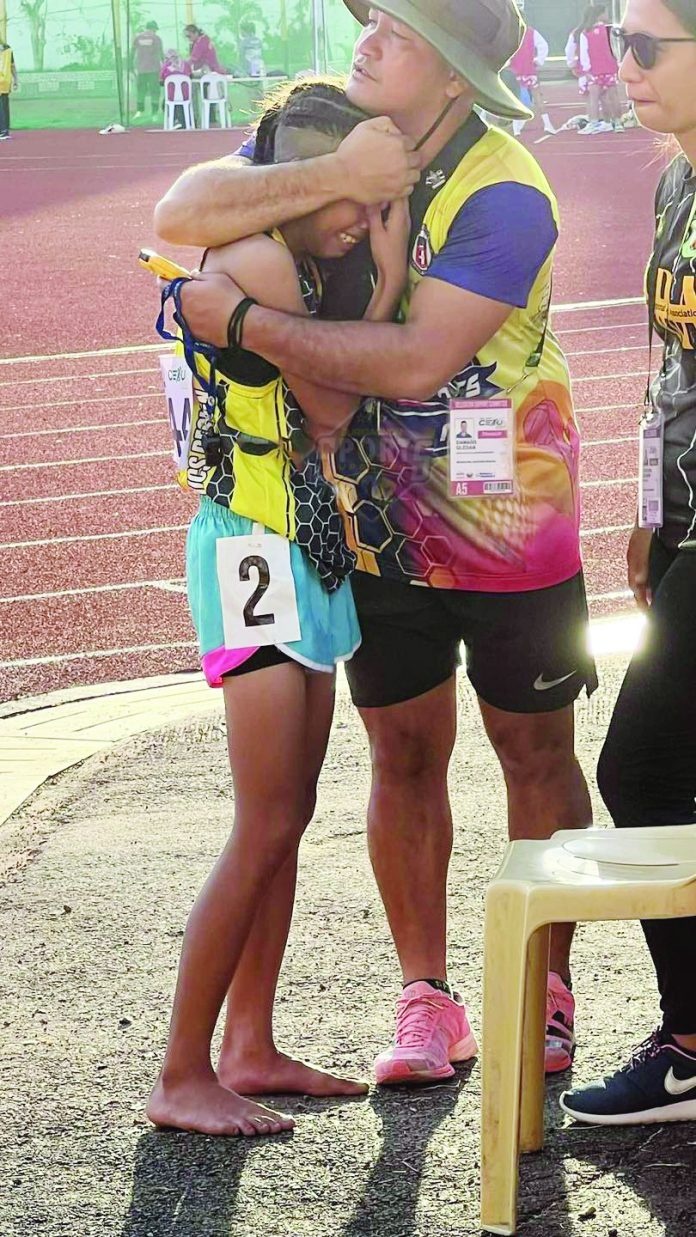
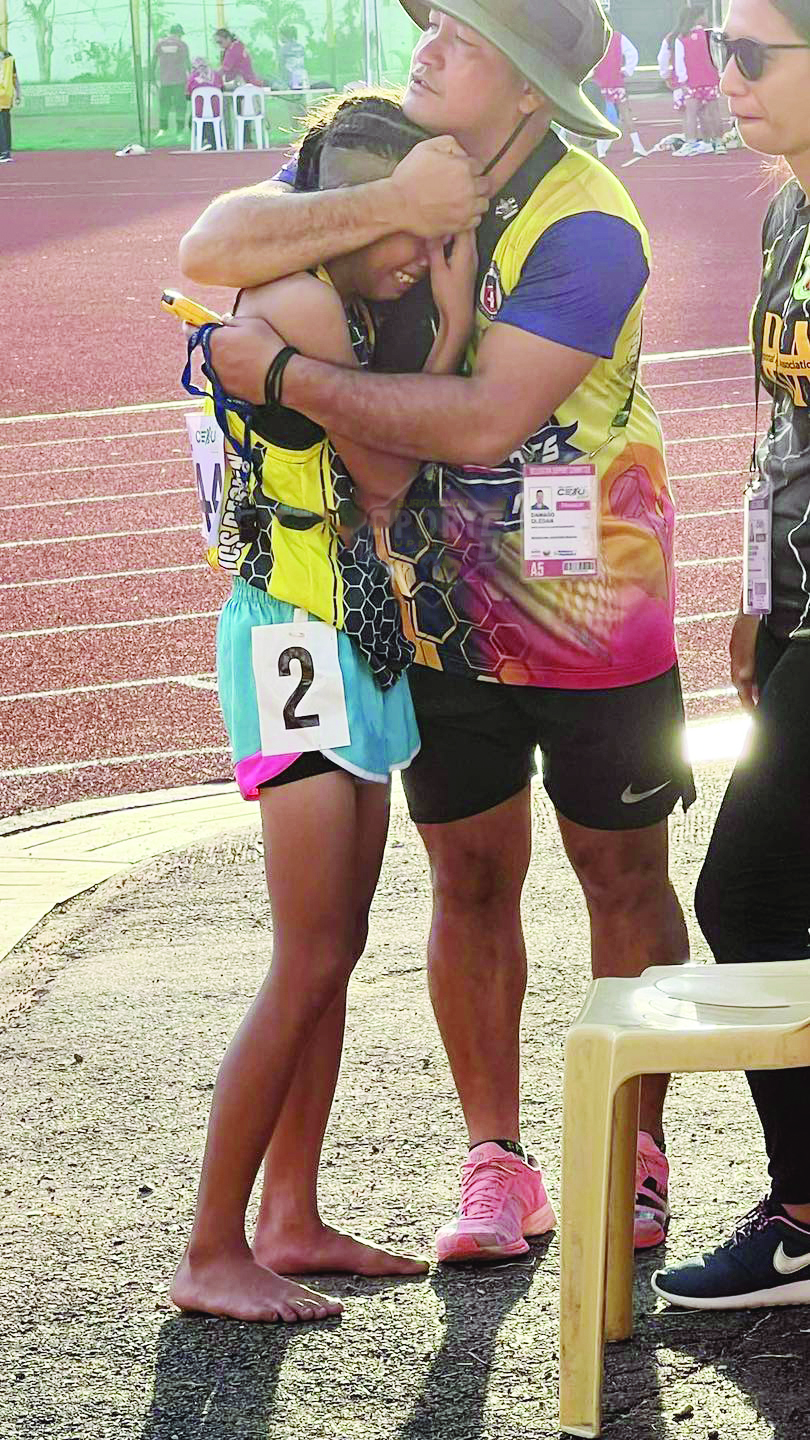
EVRAA’S FIRST MEDAL.Chrishia Mae Tajarros, a 13-year-old Grade 7 student from Matag-ob, Leyte, earned Eastern Visayas its first medal at the ongoing Palarong Pambansa in Cebu City on Thursday, July 11. Chrishia won the silver medal in the 3,000 meters (secondary) girls’ event, running barefoot.
(Surigaonon Sports Updates)
EVRAA’S FIRST MEDAL.Chrishia Mae Tajarros, a 13-year-old Grade 7 student from Matag-ob, Leyte, earned Eastern Visayas its first medal at the ongoing Palarong Pambansa in Cebu City on Thursday, July 11. Chrishia won the silver medal in the 3,000 meters (secondary) girls’ event, running barefoot. (Surigaonon Sports Updates)
Among them were teachers, cops, OFWs
TACLOBAN CITY – At least 20 victims of an online money-making scheme went to the Criminal Investigation and Detection Group (CIDG) provincial office in Naval, Biliran, on Monday, July 8, to file a complaint against the suspect behind the illegal scheme.
One of the complainants, Jean Cabillan, a teacher at a public high school in the town, claimed to have lost more than P270,000 to the suspect, whom she identified only as ‘Anne,’ a former student of hers.
“To be honest, I was encouraged by her promise of a big payback, which is why I was duped into joining her online paluwagan,” Cabillan said in a phone interview.
A paluwagan is a system of alternating borrowing from a fund to which all participants contribute.
Cabillan said she started contributing P30,000 last February with a promise of a P50,000 payback.
Although she did not receive any returns, she continued to participate, making eight more payments until May. In total, she paid the suspect P278,000 through online transactions.
“It came to a point where I had to pawn my jewelry just to give her money,” she added.
Last month, when Cabillan asked her former student to return her money, she received nothing, prompting her to file a complaint for estafa.
“I want to get my money back and see her behind bars. She did not only dupe me but also my sister, mother, and some overseas workers from our town of Cabucgayan,” she said.
Cabillan revealed that several of her co-teachers also fell prey to the online money-lending scheme but remained silent due to concerns about their security and the embarrassment of being deceived.
She is calling on other victims to come forward and join her in filing a complaint against the suspect, who is reportedly in hiding.
This call was echoed by Police Captain Herbert Mendoza, head of the CIDG in Biliran province.
Mendoza said they have received 20 complaints involving a total amount of more than P4 million.
He said they plan to file charges of large-scale estafa against the suspect and her cohorts, considering the substantial amount involved and the number of victims.
“We are calling all the victims of this pyramiding scheme to come out and report this to their nearest police station or our office. Don’t be afraid; we will help you,” he said in an interview.
Mendoza added that they would coordinate with other agencies to ensure the suspect cannot escape.
“We will coordinate with other government agencies to legally prevent her from fleeing. I heard she has a relative living in Australia, where she could possibly flee,” he said.
Mendoza also mentioned seeking help from the Anti-Money Laundering Council to freeze the accounts of the suspect and her cohorts.
Alarmed by the incident, Mayor Gemma Adobo has called on all barangay leaders and the victims for a meeting to discuss possible actions against the suspect.
The suspect and her cohorts have reportedly been operating their online paluwagan for the past two years.
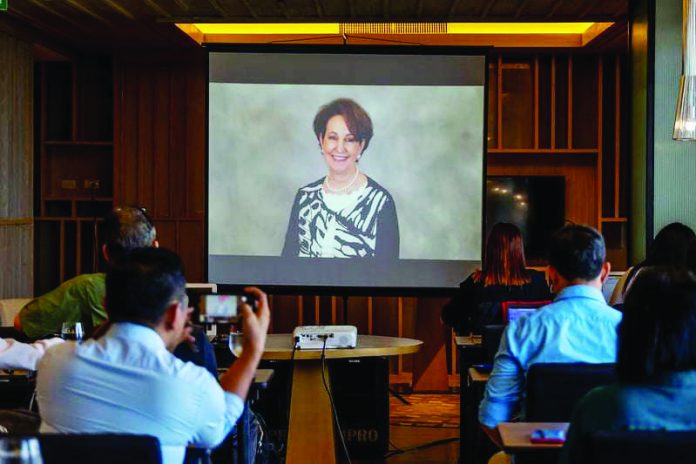
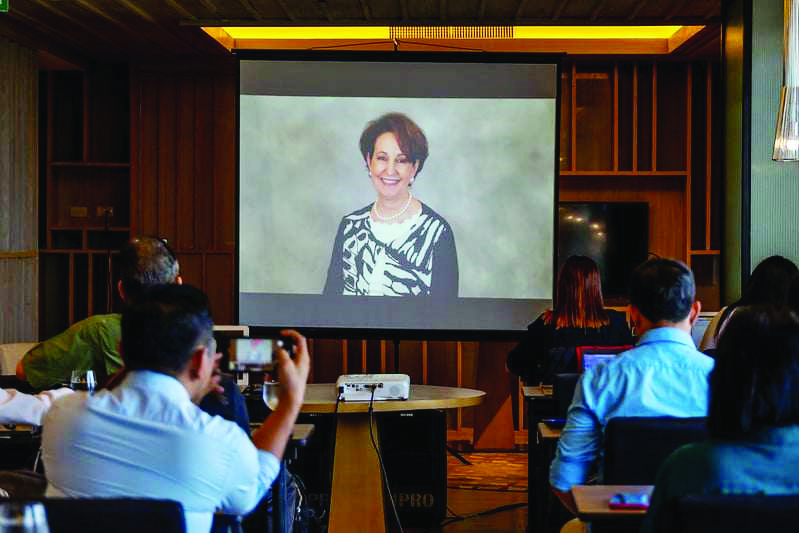
US-PH RELATIONS. US Ambassador to the Philippines, MaryKay Carlson, said that her country is with the Philippines in the transition towards renewable energy to help fight on climate change. The US Embassy conducted its 16th annual media seminar on July 8 to 9 with energy security as the main theme.
(US EMBASSY TO THE PHILIPPINES)
Part of the US-PH relations
US-PH RELATIONS. US Ambassador to the Philippines, MaryKay Carlson, said that her country is with the Philippines in the transition towards renewable energy to help fight on climate change. The US Embassy conducted its 16th annual media seminar on July 8 to 9 with energy security as the main theme. (US EMBASSY TO THE PHILIPPINES)
ILOILO CITY– More than 20 journalists across the country attended a two-day media seminar sponsored by the US Embassy in the Philippines which delved into the theme of energy security.
The annual seminar, now on its 16th year, was held from July 8 to 9.
In her opening address, MaryKay Carlson, the U.S. Ambassador to the Philippines, highlighted the critical nature of energy security to both economic prosperity and national security.
Drawing parallels between the energy challenges faced by both the Philippines and the US, Carlson emphasized the shared commitment to addressing high energy costs, grid reliability issues, and the transition to renewable energy.
“In line with the Biden-Harris Administration’s Inflation Reduction Act (IRA), the United States is making unprecedented investments to modernize our electric grid and accelerate the clean energy transition. This positions us well to meet our emissions targets under the Paris Agreement,” the ambassador, who delivered her remark through online, said.
She lauded the Philippines’ efforts under President Ferdinand Marcos, Jr. to cut greenhouse gas emissions by 75% by 2030 and boost the renewable energy mix to 50% by 2040, reaffirming U.S. support for these ambitious goals.
One of the significant milestones in U.S.-Philippine energy cooperation is the civil nuclear cooperation agreement, also known as the 123 Agreement, signed in November 2023 which took effect on July 2.
The agreement is seen to enhance the cooperation between the two countries on clean energy and energy security, the US State Department said in a separate press statement.
It also provides a legal framework for allowing American companies to export nuclear material, equipment, and components to another country.
“(Also, it will) strengthen our long-term bilateral diplomatic and economic relationships,” it said.
The US State Department also said that the 123 Agreement ‘is anchored on a mutual commitment to nuclear nonproliferation.’
In her speech, Ambassador Carlson also underscored the crucial role of journalists in educating the public on technical subjects like energy and holding stakeholders accountable.
She reaffirmed the Embassy’s commitment to supporting a free and independent press through initiatives like the media seminar. (JOEY A. GABIETA)
ORMOC CITY-A bus conductor and a barangay councilor were killed during a head-on collision of their driven motorcycles at about 6:30 pm on Friday, July 5, along a national highway in Barangay Guinob-an, Lawaan, Eastern Samar.
The fatalities were identified as alias “Carl”, 38, married, bus conductor, and resident of Brgy. Betaog, Lawaan and alias “Rick”, 55, single, barangay kagawad and a resident of Brgy 04 Poblacion of the same municipality.
The police said that both fatalities were driving a single motorcycle with the bus driver driving a Yamaha Aerox 155, color black & gray, with no plate number, while the village official was driving a Honda XRM 125, color black & white, bearing plate number HA56540.
Case investigator Police Staff Sergeant Rommel Bagunas in an interview disclosed that both motorcycles were travelling in opposite directions.
He said that the Yamaha Aerox was traveling going to Brgy. Bulosaw, while the motorcycle driven by the village official was traveling coming from Brgy. Bulosaw, and on its way to the town proper where he resides.
However, upon reaching the hilly portion of the highway and maneuvering to a curve, the Yamaha Aerox encroached on the lane of the Honda XRM resulting in a head-on collision.
The impact brought the two drivers to the concrete pavement causing severe injuries in different parts of their bodies.
The rescue team from the local government who responded to the place of the incident immediately brought the two victims to Albino M. Duran Memorial Hospital in Balangiga, also in Eastern Samar for immediate medical treatment but were pronounced dead on arrival by their attending. (ROBERT DEJON)
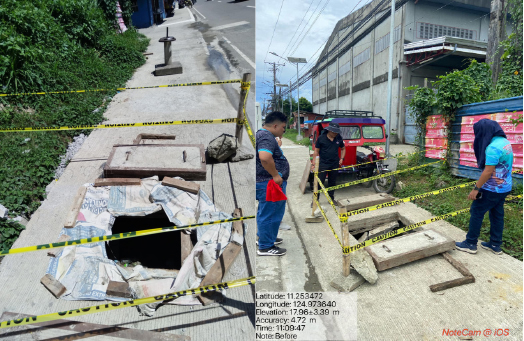
IMMEDIATE RESPONSE. The Tacloban City District Engineering Office (TCDEO) swiftly addressed a safety concern in Brgy. 74 Hollywood, Tacloban City, after a concerned citizen reported a broken manhole cover via Facebook on July 4, 2024. (TCDEO)
IMMEDIATE RESPONSE. The Tacloban City District Engineering Office (TCDEO) swiftly addressed a safety concern in Brgy. 74 Hollywood, Tacloban City, after a concerned citizen reported a broken manhole cover via Facebook on July 4, 2024. (TCDEO)
TACLOBAN CITY-The Tacloban City District Engineering Office (TCDEO) swiftly addressed a safety concern in Brgy. 74 Hollywood, Tacloban City, after a concerned citizen reported a broken manhole cover via Facebook on July 4, 2024.
Upon receiving the report, TCDEO promptly dispatched a repair team led by Engr. Rhea M. Perez, Chief of the Construction Section. The team repaired the broken manhole cover on the same day to mitigate any potential hazards to the community.
Currently, the manhole is undergoing a seasoning process to ensure its strength and durability before the final installation of the cover. In the meantime, caution tapes have been placed around the manhole to prevent accidents and protect residents from falling into the open manhole.
“Upon learning about the broken manhole cover through a concerned citizen’s post on Facebook, we immediately took action to repair it. I personally oversaw the repair process to ensure it was done swiftly and effectively. We encourage residents to continue reporting such issues so we can address them promptly and maintain the safety of our public infrastructure.” Engr. Perez said in a statement. (PUBLIC INFORMATION UNIT)