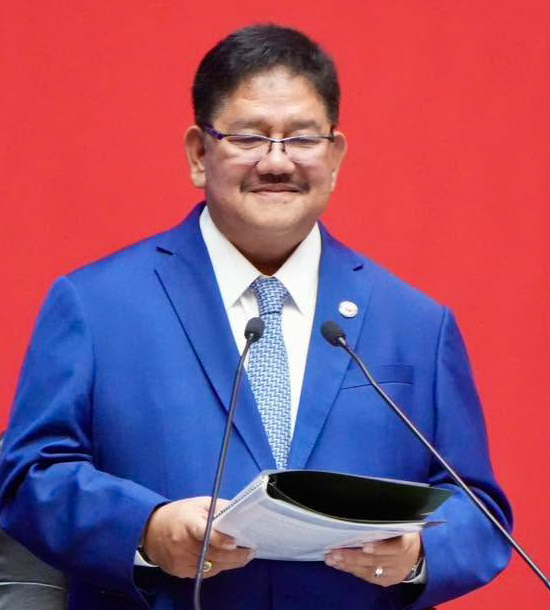
DEFENDS FILIPINO DIGNITY. House Minority Leader Marcelino “Nonoy” Libanan condemns a China Daily opinion video portraying Filipinos as monkeys, saying disagreements over the West Philippine Sea should never be used to demean the Filipino people. (Photo Courtesy
DEFENDS FILIPINO DIGNITY. House Minority Leader Marcelino “Nonoy” Libanan condemns a China Daily opinion video portraying Filipinos as monkeys, saying disagreements over the West Philippine Sea should never be used to demean the Filipino people. (Photo Courtesy
TACLOBAN CITY — House Minority Leader Marcelino “Nonoy” Libanan has condemned a China Daily opinion video portraying Filipinos as monkeys, saying the depiction is an unacceptable insult that could further strain relations between the Philippines and China.
In a statement Monday, July 20, Libanan said disagreements over the West Philippine Sea should not be used to attack the dignity of the Filipino people.
“A civilization secure in its convictions has no need to demean another people,” Libanan said, adding that a state-owned publication resorting to insults instead of reasoned argument only weakens its position.
“There is simply no justification for a foreign state-owned publication to portray an entire nation in such a contemptuous manner,” he said.
Libanan of the 4Ps party-list group said the video and related editorial cartoons do not promote understanding or dialogue but instead risk fueling resentment between Filipinos and Chinese people who have long shared ties through commerce, education, cultural exchange, and family relationships.
The Department of Foreign Affairs has lodged a formal protest and called for the withdrawal of the China Daily AI-generated opinion video and related editorial cartoons.
“The Filipino people are not props in a propaganda narrative. We are a sovereign people whose dignity is not open to caricature,” Libanan said.
He added that maritime disputes should be addressed through diplomacy and international law, not through campaigns that demean an entire nation.
The China Daily is an English-language newspaper owned by the Chinese government and is widely regarded as a platform for presenting Beijing’s policies and perspectives to an international audience.
Newly appointed DPWH Leyte 2nd District Engineer Engr. Leandro Visorde is welcomed by personnel of the Leyte 2nd District Engineering Office as he assumes leadership of the district office and outlines his commitment to sustaining best practices and improving public service delivery.(Photo Courtesy)
Newly appointed DPWH Leyte 2nd District Engineer Engr. Leandro Visorde is welcomed by personnel of the Leyte 2nd District Engineering Office as he assumes leadership of the district office and outlines his commitment to sustaining best practices and improving public service delivery.(Photo Courtesy)
TACLOBAN CITY — Newly appointed Department of Public Works and Highways (DPWH) Leyte 2nd District Engineer Leandro Visorde has vowed to sustain the district office’s existing best practices while pursuing improvements in its infrastructure programs and public service delivery.
Visorde formally assumed his post at the DPWH Leyte 2nd District Engineering Office, where he was welcomed by Officer-in-Charge Assistant District Engineer Sharon Agustin, section chiefs, unit heads, and employees.
Following the welcome ceremony, Visorde immediately convened a coordination meeting with section chiefs and unit heads to review the district office’s ongoing programs, accomplishments, and operational concerns.
Officials presented updates on infrastructure projects, financial and administrative performance, procurement activities, maintenance programs, planning and design initiatives, and other priority undertakings.
The briefing provided Visorde with an overview of the office’s current operations and helped identify areas that require continued attention and improvement.
“As I assume the role of District Engineer, I am committed to sustaining the good systems and best practices that have contributed to the success of our office while continuously pursuing improvements in areas where we can perform even better,” Visorde said.
He also emphasized the importance of professionalism, teamwork, transparency, and accountability in achieving the office’s objectives.
Visorde urged employees to uphold hard work, professionalism, and punctuality, which he said are essential to delivering quality public service.
He also encouraged employees to promptly raise concerns and operational issues so these could be addressed through timely and effective solutions.
Visorde said open communication, collaboration, mutual respect, and accountability would be important in strengthening the district office’s ability to address challenges and sustain its performance.
Under his leadership, the DPWH Leyte 2nd District Engineering Office aims to strengthen coordination and partnerships, improve organizational performance, and continue implementing infrastructure projects and services supporting development in Leyte’s second congressional district.
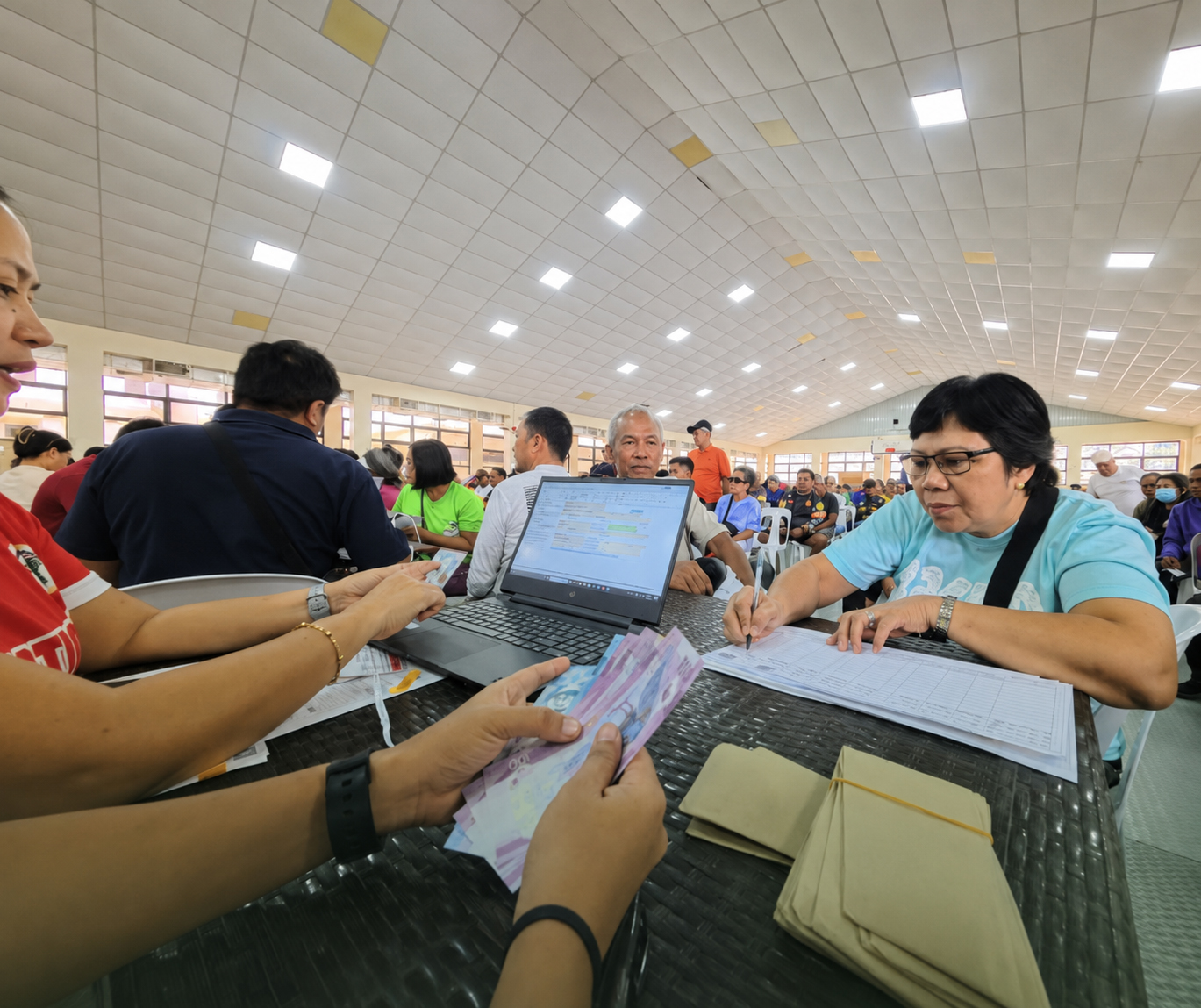
CASH AID. DSWD Eastern Visayas Regional Director Grace Subong hands over initial cash assistance to a beneficiary during the regional rollout of the government’s UPLIFT program in Eastern Visayas. The program’s initial phase covers 17,219 beneficiaries from 12 cities and municipalities across the region. (ROEL T. AMAZONA)
CASH AID. DSWD Eastern Visayas Regional Director Grace Subong hands over initial cash assistance to a beneficiary during the regional rollout of the government’s UPLIFT program in Eastern Visayas. The program’s initial phase covers 17,219 beneficiaries from 12 cities and municipalities across the region. (ROEL T. AMAZONA)
TACLOBAN CITY — A total of 17,219 poor and low-income households in Eastern Visayas are set to receive initial cash assistance under a national government program designed to help families cope with rising living costs, particularly higher fuel and energy prices.
The Department of Social Welfare and Development (DSWD) Eastern Visayas launched Monday, July 20, the regional rollout of the Unified Package for Livelihoods, Industry, Food, and Transport (UPLIFT) program, with beneficiaries from 12 cities and municipalities receiving the initial tranche of assistance.
Among the beneficiaries was Napoleon Escalona of Barangay Cabalawan, Tacloban City, who said the P2,000 cash assistance would help his family purchase food and other basic necessities.
“P2,000 is a big help. We can now buy rice and other necessities, especially now that the children have returned to school,” Escalona said.
He urged fellow beneficiaries to use the assistance wisely and prioritize their families’ basic needs rather than spend the money on non-essential items.
Escalona also expressed hope that the program would eventually be expanded to include more families in need of government assistance.
Another beneficiary, 63-year-old Francisco Ocenar of Aeroville, Barangay 106, Sto. Niño, Tacloban City, said he would use the cash aid primarily for the education and daily needs of his five grandchildren.
“This is for my grandchildren who are studying because we are having a difficult time in life. We will use it for food, especially for the children,” Ocenar said.
DSWD Eastern Visayas Regional Director Grace Subong, meanwhile, assured the public that the list of beneficiaries was based on validated data from authorized national government agencies and was not prepared by local government units (LGUs).
Subong said the program uses data from partner agencies, including the Philippine Statistics Authority (PSA), which identifies households classified as poor, near-poor, and those above the poverty threshold.
“As you may have noticed, our data came directly from the PSA. Not a single piece of data came from local government officials,” Subong said.
She clarified that the role of LGUs is limited to informing residents about the program and helping disseminate information about the cash assistance.
“What our LGUs do is simply inform the public that this program is available and disseminate information about it,” she added.
The DSWD also uses data from the Social Security System to identify low-income earners who may qualify for assistance.
Subong said the regional launch represents the initial phase of the UPLIFT program, allowing the DSWD to ensure its smooth implementation before expanding the distribution to other municipalities in Eastern Visayas.
The national government allocated P86.095 million for the initial rollout, which covers 17,219 beneficiaries, or 20 percent of the region’s target recipients.
Qualified beneficiaries will receive P2,000 in monthly assistance from July to December under the program. Members of the Pantawid Pamilyang Pilipino Program and beneficiaries of the Walang Gutom Program will also receive a one-time cash assistance.
The UPLIFT program is a national government initiative that provides emergency financial assistance to poor, near-poor, and low-income households affected by rising fuel and energy costs.
Aside from Tacloban City, cash payouts are also being conducted in other areas across Eastern Visayas.
Ormoc City has the highest allocation for the initial rollout, with 3,831 beneficiaries and a total payout of P19.155 million. It is followed by Calbayog City, with 2,833 beneficiaries and P14.165 million in assistance.
Other recipient areas are Alangalang, Leyte, with 1,886 beneficiaries and P9.43 million; Baybay City, 1,562 beneficiaries and P7.81 million; Villaba, Leyte, 1,488 beneficiaries and P7.44 million; Catbalogan City, 1,221 beneficiaries and P6.105 million; Borongan City, 957 beneficiaries and P4.785 million; Catarman, Northern Samar, 904 beneficiaries and P4.52 million; Sogod, Southern Leyte, 340 beneficiaries and P1.7 million; Maasin City, 261 beneficiaries and P1.205 million; and Naval, Biliran, 222 beneficiaries and P1.11 million.
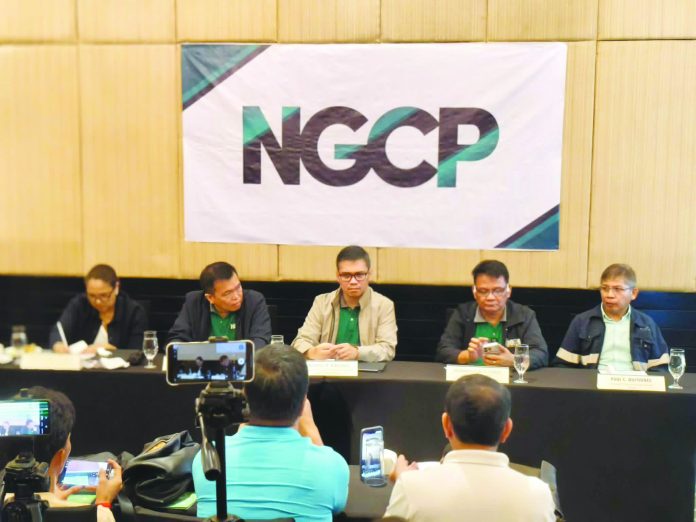
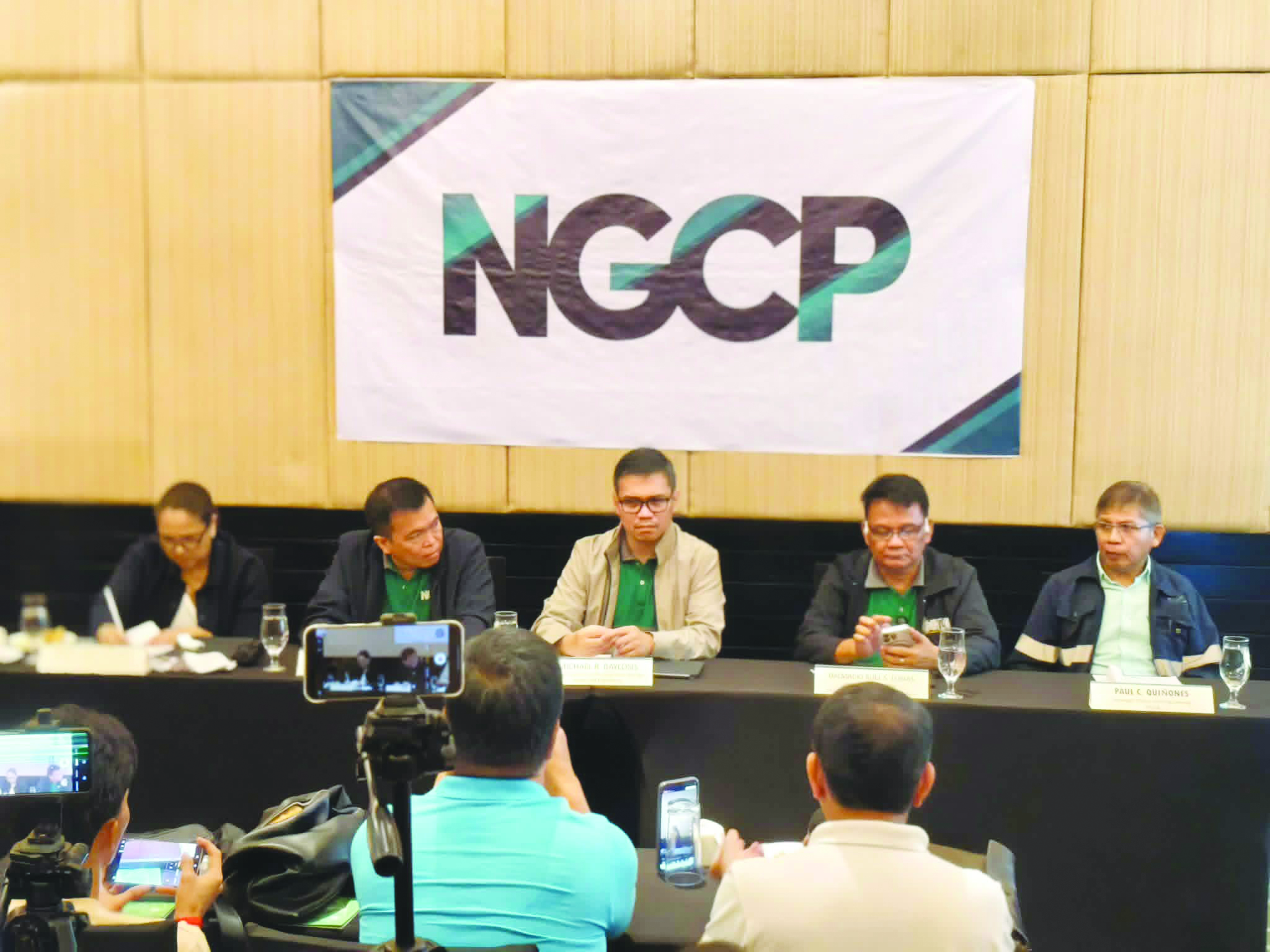
GRID UPDATE. NGCP spokesperson Atty. Cynthia Perez Alabanza explains that the corporation does not set electricity rates during the Power 101 forum in Tacloban City on July 16, while company officials also presented major transmission projects aimed at strengthening the Leyte and Eastern Visayas power grid.
As it unveils Leyte grid expansion projects
GRID UPDATE. NGCP spokesperson Atty. Cynthia Perez Alabanza explains that the corporation does not set electricity rates during the Power 101 forum in Tacloban City on July 16, while company officials also presented major transmission projects aimed at strengthening the Leyte and Eastern Visayas power grid.
TACLOBAN CITY – The National Grid Corporation of the Philippines (NGCP) on Thursday, July 16, distanced itself from the looming increase in electricity rates in Eastern Visayas, saying it does not set power prices or profit from higher electricity bills, even as it unveiled a series of transmission projects aimed at strengthening the Leyte power grid.
The clarification came following an earlier announcement by the Federation of Rural Electric Cooperatives in Region 8(FRECOR-8) that consumers in Eastern Visayas could expect higher electricity rates due to several factors, including increases in transmission and ancillary service charges, generation costs, and other pass-through expenses.
Speaking during the Power 101 forum in Tacloban City, NGCP spokesperson Atty. Cynthia Perez Alabanza said the corporation has been wrongly blamed whenever electricity rates rise, stressing that NGCP merely transmits electricity from power plants to distribution utilities.
“We do not determine electricity rates and we do not benefit from increases in consumers’ power bills,” Alabanza said.
She explained that while transmission charges appear as one component of monthly electricity bills, NGCP’s transmission wheeling rates are regulated by the Energy Regulatory Commission (ERC) and are separate from ancillary service charges, which fluctuate depending on the operation of the power grid.
According to Alabanza, most adjustments in electricity bills are driven by changes in generation charges and ancillary service costs, both of which are pass-through charges collected by distribution utilities.
Her statement came after FRECOR-8 advised its member-consumer-owners of an expected increase in electricity rates, citing higher generation costs, transmission charges, and ancillary service fees that are beyond the control of electric cooperatives.
Amid the clarification, NGCP also presented ongoing and future transmission projects intended to improve the reliability and capacity of the power grid serving Leyte and the rest of Eastern Visayas.
Michael Baylosis, planning manager of NGCP’s Transmission Planning Division under its Project and Engineering Department, said the company is currently constructing the 230-kilovolt (kV) Babatngon-Palo Transmission Line Project, one of its major investments in Leyte.
The project is designed to reinforce power transmission to Tacloban City and neighboring areas, where electricity demand continues to rise.
It also includes the construction of a new 69-kV substation in Palo and the installation of a capacitor bank at the SEPALCO Solar Power Plant in Barangay Castilla, Palo, to improve voltage stability and system reliability.
NGCP is likewise installing additional transformers along the Tabango-Isabel and Maasin transmission corridors to strengthen the security and reliability of electricity transmission across Leyte.
Among its upcoming projects are the Tabango-Biliran 69-kV Transmission Line, the Maasin-Malinao 230-kV Transmission Line, the Sumangga 138-kV Substation and Transmission Project in Ormoc City, and the upgrading of existing substations and transmission facilities.
The company also plans to strengthen the Visayas grid by installing two additional submarine cables linking Cebu and Leyte, expanding the existing two-cable interconnection.
It will also extend the 230-kV transmission line from Ormoc to Babatngon and upgrade the Luzon-Visayas High-Voltage Direct Current (HVDC) system from monopole to bipole operation, effectively doubling its transmission capacity.
Baylosis said NGCP is also pursuing the development of a 230-kV transmission loop connecting Leyte, Bohol, and Cebu to provide alternative power routes during typhoons and other natural disasters, improving the resilience of the Visayas power grid.
The company also reported the completion of several transmission projects, including the Babatngon-Abucay 69-kV Transmission Line in 2025, the Ormoc-Lemon 69-kV Transmission Line in April 2026, and the Ormoc-Sumangga 69-kV Transmission Line in June this year.
The updates were presented during the Power 101 forum, which brought together journalists and local government information officers from across Eastern Visayas to improve public understanding of the country’s transmission system and clarify the respective roles of power generators, transmission operators, and distribution utilities in determining electricity costs.
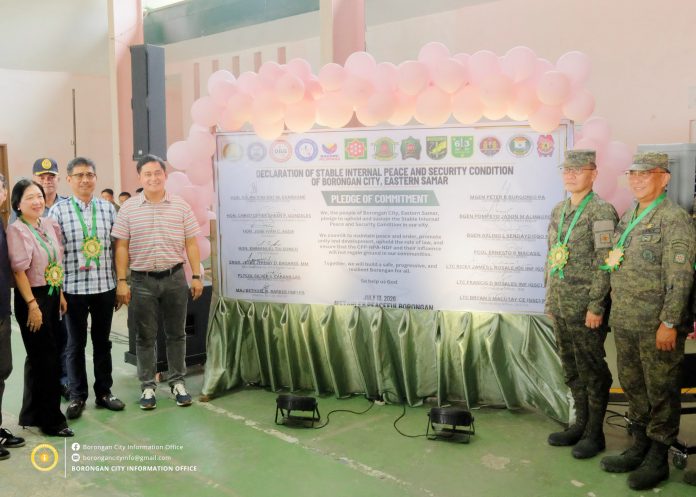
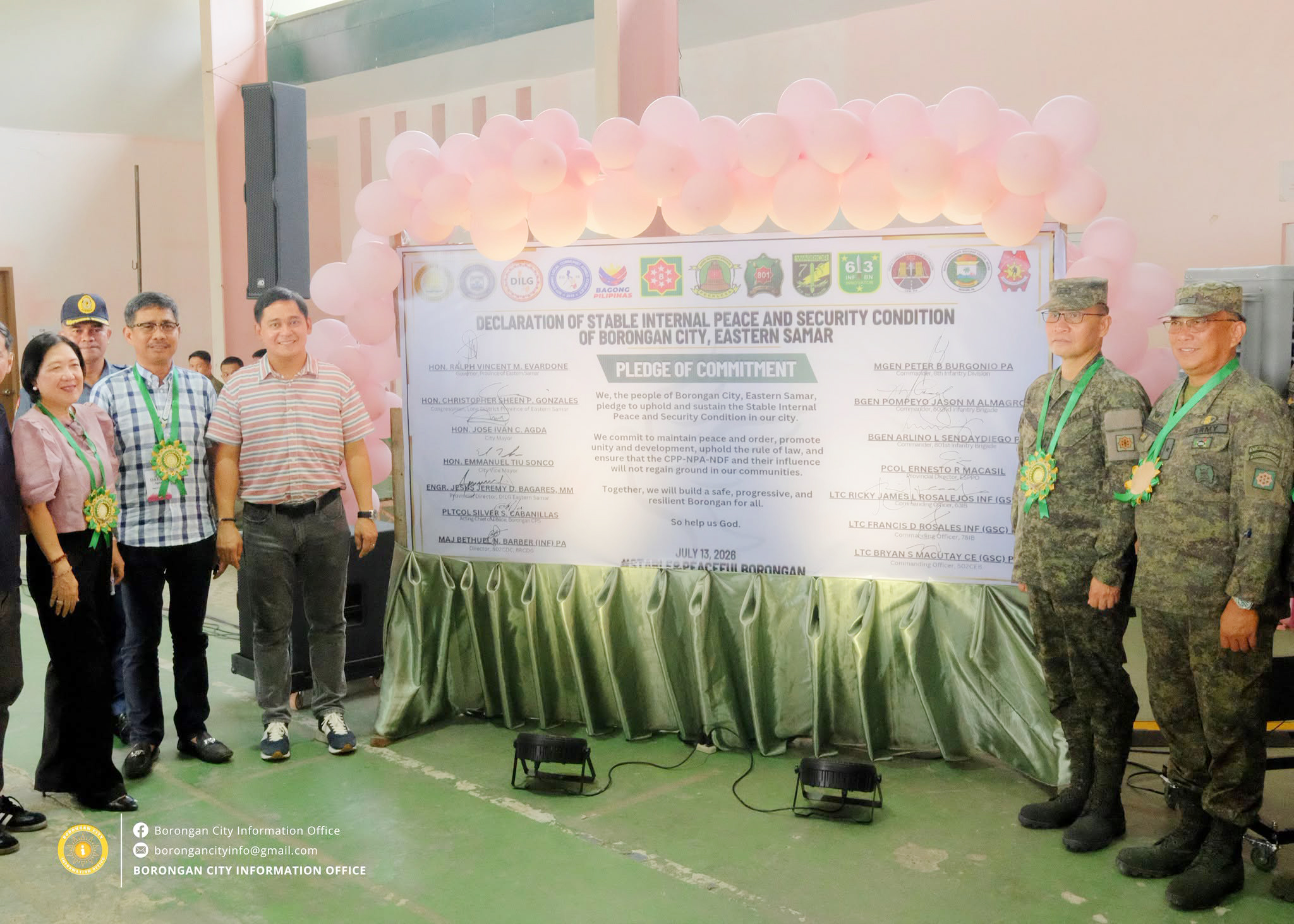
NPA-FREE. Major Gen. Peter Burgonio, commander of the Philippine Army’s 8th Infantry Division, joins Eastern Samar Representative Christopher Sheen Gonzales, Borongan City Mayor Jose Ivan Dayan Agda, Vice Governor Maricar Sison-Goteesan, and other officials during the declaration placing Borongan City under a Stable Internal Peace and Security Condition (SIPSC), recognizing the city’s significant gains in ending insurgency and sustaining peace and development.
(BORONGAN CITY INFORMATION OFFICE)
NPA-FREE. Major Gen. Peter Burgonio, commander of the Philippine Army’s 8th Infantry Division, joins Eastern Samar Representative Christopher Sheen Gonzales, Borongan City Mayor Jose Ivan Dayan Agda, Vice Governor Maricar Sison-Goteesan, and other officials during the declaration placing Borongan City under a Stable Internal Peace and Security Condition (SIPSC), recognizing the city’s significant gains in ending insurgency and sustaining peace and development. (BORONGAN CITY INFORMATION OFFICE)
BORONGAN CITY – This city has been officially declared under a Stable Internal Peace and Security Condition (SIPSC), marking what government and military officials described as a major milestone in Eastern Samar’s decades-long campaign against communist insurgency.
The declaration was led on Monday, July 13, by Major Gen. Peter Burgonio, commander of the Philippine Army’s 8th Infantry Division, together with Eastern Samar Representative Christopher Sheen Gonzales, Borongan City Mayor Jose Ivan Dayan Agda, and Vice Governor Maricar Sison-Goteesan, who represented Governor Ralph Vincent Evardone.
Also attending the ceremony were Brig. Gen. Pompeyo Jayson Almagro, commander of the 802nd Infantry Brigade; Brig. Gen. Arlino Sendaydiego, commander of the 801st Infantry Brigade; members of the city council, barangay officials, and other local stakeholders.
Agda said the declaration should serve not as the culmination of the city’s peace campaign but as a challenge to sustain the gains achieved through years of cooperation among the military, police, local government units, and communities.
“Let us work together even with this declaration that we are already free from these peace challenges. This should not stop us in our resolve to fight for good governance, accountability, and our malasakit sa kapwa,” Agda said.
The mayor recalled that when he assumed office in 2019, Borongan was still grappling with insurgency-related violence.
He cited two bombing incidents that year—one in the remote village of Pinanag-an that killed several soldiers and another along the national highway in Barangay Libuton that left police personnel dead and several civilians injured.
Since then, the city government has intensified its peace and development programs by encouraging communist rebels to surrender and return to mainstream society through the government’s Enhanced Comprehensive Local Integration Program (E-CLIP), which provides financial assistance, livelihood opportunities, and employment support to former rebels.
The city has also invested in road infrastructure to improve access to its interior villages. Of Borongan’s 61 barangays, only Baras and Pinanag-an remain accessible exclusively by motorboat.
Despite the declaration, Burgonio assured residents that military forces would continue maintaining a strong presence in Borongan, particularly in hinterland communities, to preserve the peace gains and prevent the resurgence of insurgency.
“Ako na po ang magsasabi na hindi kami aalis ng Borongan City, bagkus kami po ay magpapanatili ng mas malaking presensya,” Burgonio said.
He also called on barangay officials to continue strengthening the delivery of government services and help safeguard the city’s peace through sustained cooperation with security forces.
Borongan is the 21st local government unit in Eastern Samar to be placed under SIPSC. Only the municipalities of Dolores and Jipapad have yet to receive the same declaration.
The SIPSC is jointly conferred by the Armed Forces of the Philippines and the Philippine National Police on local government units that have dismantled insurgent influence, recorded no violent encounters between government forces and communist rebels, cleared guerrilla operations, and established functional peace and order mechanisms.
The designation signifies that insurgency-related threats have been reduced to manageable levels, paving the way for sustained economic growth, increased investments, tourism, and development projects.
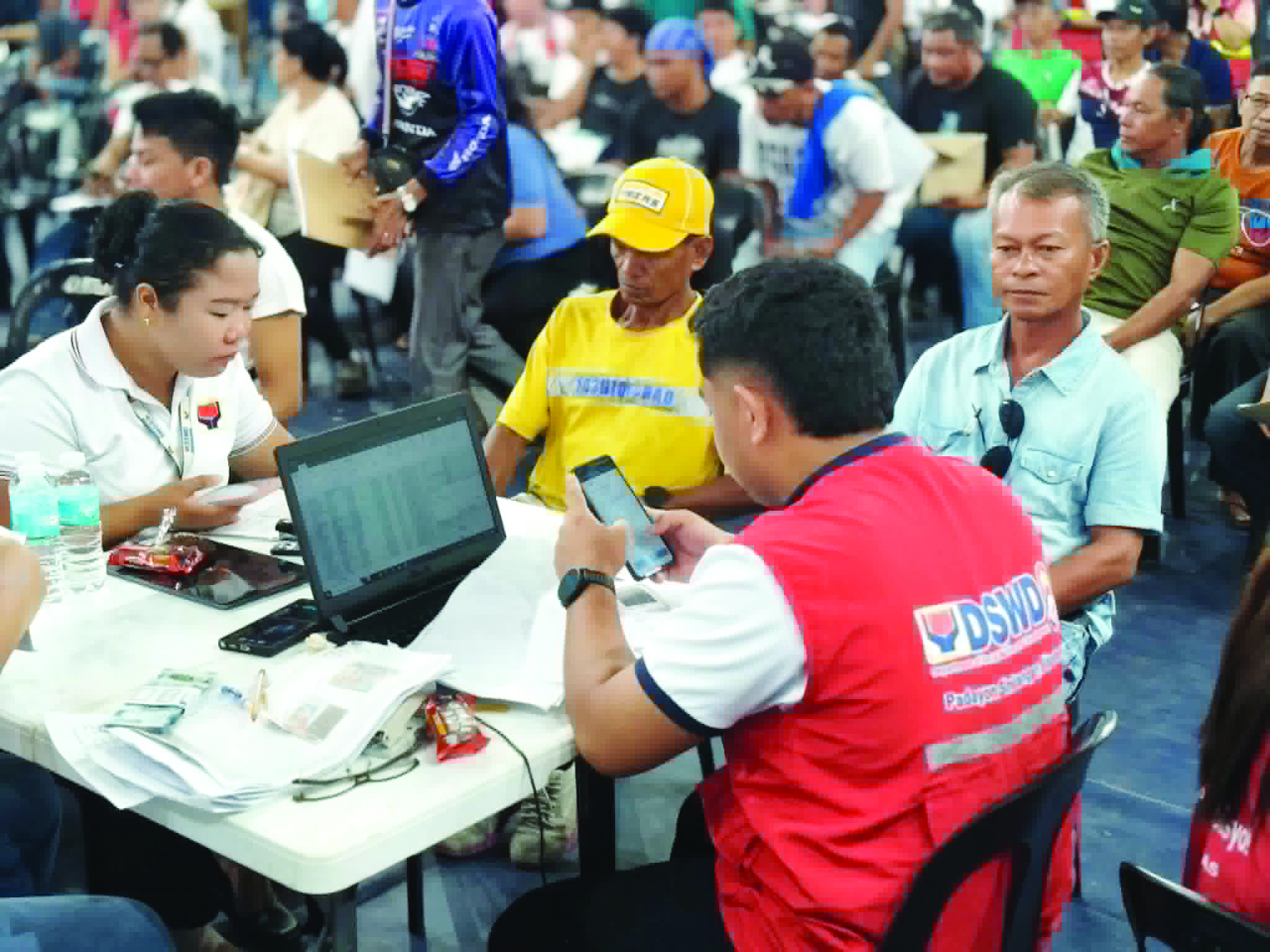
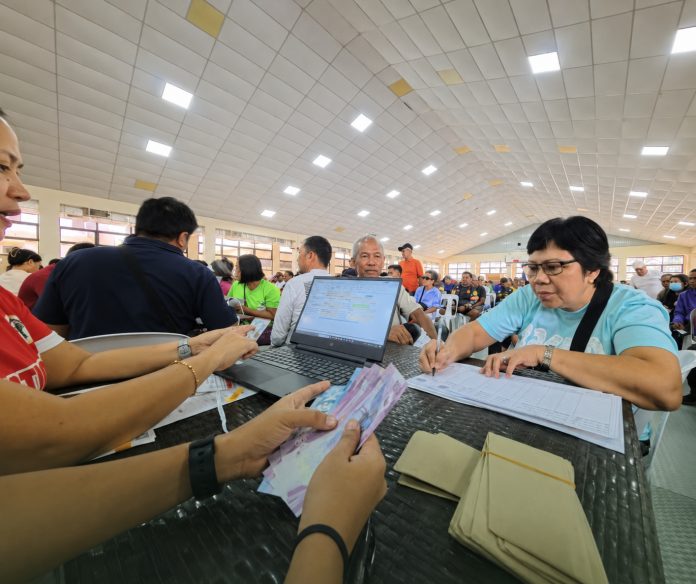
FINANCIAL ASSISTANCE. More than 50,000 farmers and fisherfolk from 35 local government units in Eastern Visayas receive ₱2,325 each in financial assistance under the Presidential Assistance to Farmers and Fisherfolk Program (PAFFP), with the Department of Agriculture releasing a total of ₱120 million during the month-long distribution from June 16 to July 14. (Photo courtesy of DA-8)
FINANCIAL ASSISTANCE. More than 50,000 farmers and fisherfolk from 35 local government units in Eastern Visayas receive ₱2,325 each in financial assistance under the Presidential Assistance to Farmers and Fisherfolk Program (PAFFP), with the Department of Agriculture releasing a total of ₱120 million during the month-long distribution from June 16 to July 14. (Photo courtesy of DA-8)
TACLOBAN CITY – More than 50,000 farmers and fisherfolk across Eastern Visayas have received a total of P120 million in financial assistance from the Department of Agriculture (DA) under the Presidential Assistance to Farmers and Fisherfolk Program (PAFFP), as the government seeks to cushion the impact of rising fuel prices and increasing production costs.
The distribution, which ran from June 16 to July 14, covered beneficiaries in 35 local government units (LGUs) across the region. Each recipient received P2,325 in direct cash assistance, according to the DA regional office.
The financial aid is intended to help small-scale farmers and fisherfolk cope with higher operating expenses brought about by increasing fuel prices and the rising cost of agricultural and fishing inputs, which have affected food production and household incomes.
The PAFFP is a national government intervention launched to provide immediate financial assistance to farmers and fisherfolk adversely affected by surging fuel prices. Beneficiaries are identified through the Registry System for Basic Sectors in Agriculture (RSBSA) and other validated government databases.
DA- 8 said the assistance would help beneficiaries continue farming and fishing activities while easing the burden of meeting their families’ daily needs.
Among those who received the assistance was fisherman Leonardo Mendiola, who said the cash aid came at a time when his family’s income was barely enough to cover basic expenses.
“This program of President Ferdinand Marcos Jr. has greatly helped fisherfolk throughout the country, especially with the rising prices of fuel and other basic commodities. We truly need assistance from the government during these difficult times. This support is a tremendous help to my family because my income from fishing and other sidelines is only enough to provide for our daily meals,” Mendiola said as quoted by DA.
Another beneficiary, Rogelio Padilla, said the assistance would be used primarily to buy fuel needed for his livelihood, while the remaining amount would go toward purchasing rice and helping finance his children’s education.
“I am grateful to the Department of Agriculture. This assistance is a great help in purchasing fuel for our livelihood. Whatever remains will be used to buy rice and support the education of our children,” Padilla said.
The DA said the cash assistance program forms part of the government’s efforts to ensure that farmers and fisherfolk continue producing food despite mounting economic pressures.
Eastern Visayas is among the country’s major producers of rice, coconut, fisheries, and other agricultural commodities. However, farmers and fisherfolk in the region have been grappling with rising fuel prices, higher fertilizer costs, and expensive fishing and farming inputs, reducing their already modest earnings.
The agency said it will continue implementing programs aimed at improving the productivity and income of farmers and fisherfolk while strengthening the country’s food security.