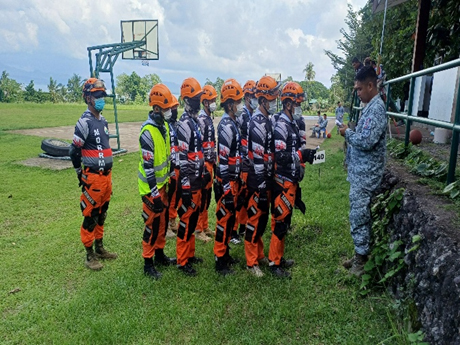
The Tactical Operations Group 8 (TOG 8), Tactical Operations Wing Central, Philippine Air Force, actively participated in the Regional Rescue Jamboree (RRJ) 2026 held on 12–17 July 2026 in Ormoc City, Leyte. Organized by the Office of Civil Defense (OCD) Region VIII, the annual capability building activity aims to enhance the knowledge, skills, and interoperability of disaster responders from local government units, uniformed services, and partner agencies through lectures, practical exercises, and rescue competitions, thereby strengthening disaster preparedness and emergency response capabilities in Eastern Visayas.
As one of the key training disciplines, TOG 8 conducted the Air-to-Ground Operations Support (AGOS) training from 13–15 July 2026, led by 1LT ROBERTO R REFUERZO JR. PAF and the Group’s Subject Matter Experts. The training covered Basic Meteorology, Combat Utility Helicopter (CUH) Capabilities and Employment, Landing Zone Preparation, Aircraft Vectoring, Aircraft Marshalling, and Safety Considerations in Air-to-Ground Operations.
Participants also underwent practical exercises and the AGOS obstacle course, where they applied the knowledge and skills gained through realistic scenarios using drone-assisted aircraft simulations. The activity enhanced participants’ proficiency in supporting air operations during disaster response and humanitarian assistance missions while promoting teamwork, coordination, and operational readiness.
Through its active participation in RRJ 2026, TOG 8 reaffirmed the Philippine Air Force’s commitment to strengthening disaster risk reduction and management initiatives, fostering inter-agency collaboration, and building resilient communities in support of national development. (PR)
The public is invited to watch the livestream beginning at 6:00 p.m. through the
official Outstanding Eastern Visayans Awards (OEVA) and Philippine Information Agency (PIA) Facebook pages.
The public is invited to watch the livestream beginning at 6:00 p.m. through the official Outstanding Eastern Visayans Awards (OEVA) and Philippine Information Agency (PIA) Facebook pages.
Tacloban City— Eastern Visayas is known for its scenic destinations and rich cultural traditions. Beyond these, the region is home to individuals whose leadership, service, and achievements have helped shape its communities and define its identity.
Recognizing that these stories deserve to be celebrated, the Department of Tourism (DOT) Region VIII, in partnership with Tingog Party-list, is set to honor the inaugural recipients of the Outstanding Eastern Visayans Awards (OEVA) on July 31.
“We are excited to honor this year’s awardees and celebrate the remarkable stories that have helped shape the region. Their journeys reflect the dedication, excellence, and commitment that continue to move our region forward, and we look forward to sharing these inspiring stories with the public,” said Ma. Catherina Apostol, Officer-in-Charge, Regional Director of DOT Region VIII.
First launched in April through a region-wide call for nominations, OEVA reflects DOT Region VIII’s broader vision of tourism as a platform for celebrating the people who drive sustainable and inclusive progress across Eastern Visayas.
OEVA will recognize exemplary individuals across 10 sectors: arts, culture and tourism; public service and governance; business, innovation, science and technology; education and research; environmental protection; health; youth leadership; media and communication; faith; and philanthropy.
“The awardees come from diverse sectors and backgrounds, but their stories reflect the many ways individuals can make a meaningful difference. We hope these stories encourage more Eastern Visayans to pursue excellence in their own fields, serve their communities, and contribute to the continued progress of our region,” Apostol said.
The recipients of this year’s OEVA were selected through a rigorous, merit-based evaluation process involving independent validation, interviews, and deliberation by the Board of Judges. The process was overseen by PricewaterhouseCoopers (PwC) Philippines as the official tabulator, with a Board of Judges composed of respected leaders from various sectors, including prominent local figure Henry Gosyco of the Philippine Chamber of Commerce and Industry Tacloban-Leyte.
The awardees will be formally honored on July 31, and the public is invited to watch the livestream beginning at 6:00 p.m. through the official Outstanding Eastern Visayans Awards (OEVA) and Philippine Information Agency (PIA) Facebook pages to celebrate this year’s honorees and hear the inspiring stories behind their contributions. (PR)
NO TO MINING. The three Catholic bishops of Samar Island—Bishop Crispin Varquez of the Diocese of Borongan, Bishop Isabelo Abarquez of the Diocese of Calbayog and Bishop Nolly Buco of the Diocese of Catarman—sign the endorsement of a pastoral position statement opposing mining activities in Giporlos and Balangiga, Eastern Samar. The endorsement was made during a gathering at Ibabao Hall of the Northern Samar Provincial Capitol in Catarman on July 23, 2026. (PHOTO COURTESY, CBCP)
Could result in environmental degradation
NO TO MINING. The three Catholic bishops of Samar Island—Bishop Crispin Varquez of the Diocese of Borongan, Bishop Isabelo Abarquez of the Diocese of Calbayog and Bishop Nolly Buco of the Diocese of Catarman—sign the endorsement of a pastoral position statement opposing mining activities in Giporlos and Balangiga, Eastern Samar. The endorsement was made during a gathering at Ibabao Hall of the Northern Samar Provincial Capitol in Catarman on July 23, 2026. (PHOTO COURTESY, CBCP)
TACLOBAN CITY — The three bishops of Samar Island have thrown their support behind a call for local governments in Giporlos and Balangiga, Eastern Samar, to oppose mining activities amid concerns that a recently approved mineral exploration permit could eventually pave the way for large-scale mineral extraction.
The call was contained in a pastoral position statement issued by the Diocese of Borongan and formally endorsed by the Samar Island Partnership for Peace and Development (SIPPAD), a regional peace and development network.
In the statement dated July 23, 2026, the Diocese of Borongan, through its Diocesan Commission on Social Action–Justice and Peace (DCSA-JP), urged the Sangguniang Bayan of Giporlos and Balangiga, as well as their respective barangay councils, to pass resolutions opposing mining activities within their jurisdictions.
The appeal followed the approval by the Mines and Geosciences Bureau (MGB) of Exploration Permit No. EP-2026-001-VIII, covering approximately 902.99 hectares in portions of the two municipalities.
The diocese acknowledged that the permit authorizes mineral exploration, not commercial mining or mineral extraction. However, it said exploration could mark the beginning of a process that may eventually lead to mining operations, making it necessary for local governments and communities to clearly express their position at the outset.
The issue has raised concern in the two municipalities. Giporlos Mayor Gilbert Go has clarified that there is currently no mining operation in his town and that the permit issued to the company covers exploration activities only. He also said any future application for actual mining would still have to comply with legal, environmental and consultation requirements.
The Diocese of Borongan said its position was shaped in part by the experiences of communities in Homonhon and Manicani islands, Bagacay and other areas of Samar Island where mining and mineral exploration have been the subject of long-standing environmental and social concerns.
Homonhon Island in Guiuan, Eastern Samar—historically known as the first Philippine landfall of Ferdinand Magellan in 1521—has existing mining operations and has remained part of the broader debate over the environmental and social impacts of extractive activities in the province.
The diocese warned that mining could result in the degradation of forests and watersheds, contamination of rivers and coastal waters, the loss of agricultural and fishing areas, increased risks of erosion, flooding and landslides, and social conflict among affected communities.
It also stressed that Eastern Samar, one of the country’s most typhoon-prone provinces, should give priority to protecting its natural ecosystems, which help shield communities from disasters and support the livelihoods of farmers and fisherfolk.
The pastoral statement called on local government officials, civil society organizations, faith communities, farmers, fisherfolk, Indigenous Peoples, youth groups and other stakeholders to work together in pursuing development that protects the environment, respects human dignity and promotes the common good.
Citing Pope Francis’ encyclical Laudato Si’, the diocese said authentic development should not be measured solely by economic growth but also by its impact on people, the environment and future generations.
SIPPAD formally endorsed the pastoral position statement during a gathering at Ibabao Hall of the Northern Samar Provincial Capitol in Catarman.
The endorsement was signed by the three Catholic bishops of Samar Island—Bishop Isabelo C. Abarquez of the Diocese of Calbayog, Bishop Crispin B. Varquez of the Diocese of Borongan, and Bishop Nolly Camingue Buco of the Diocese of Catarman.
SIPPAD said it supports the call for the municipal and barangay councils of Giporlos and Balangiga to adopt resolutions opposing mining activities, stressing that development should not come at the expense of ecological integrity, human dignity and community welfare.
The group also cited the experiences of Homonhon, Manicani and other communities affected by or facing proposed mining activities, saying these demonstrate the potential long-term environmental and social consequences of extractive industries.
SIPPAD urged local government units across Samar Island to adopt policies that protect the environment, preserve the island’s natural heritage and safeguard the welfare of present and future generations.
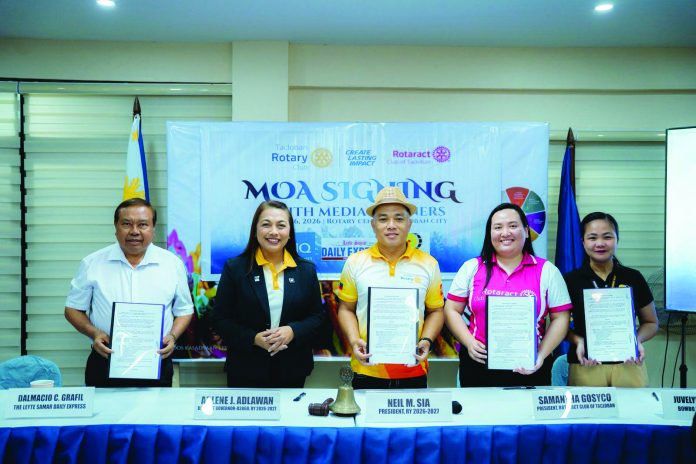
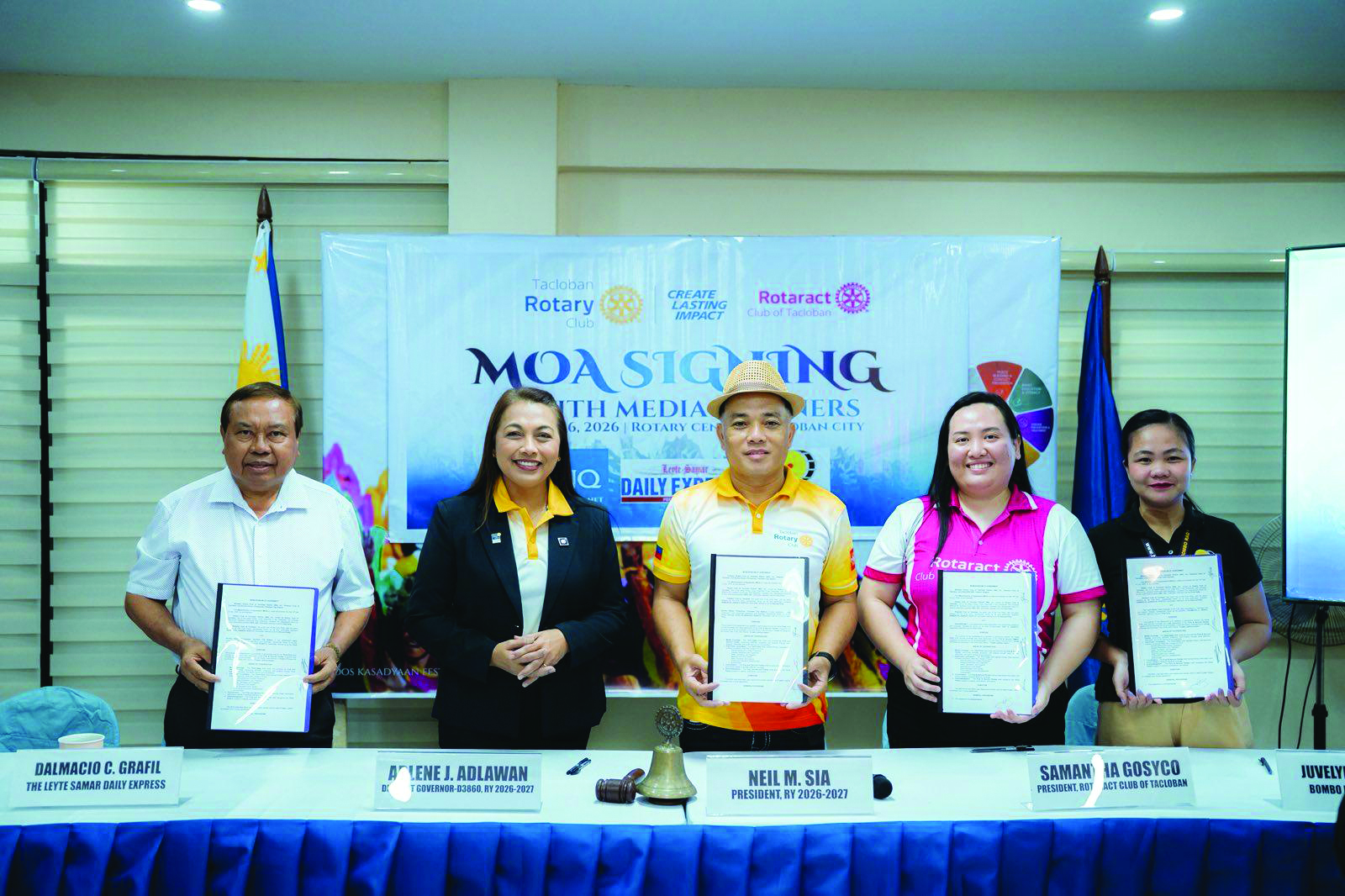
MEDIA PARTNER. Rotary Club of Tacloban president Atty. Neil Sia (center) signs a partnership agreement with media partners, including the Leyte Samar Daily Express represented by its publisher Dalmacio ‘Massey’ Grafil, on July 16, 2026, as part of the club’s efforts to raise public awareness of its community service projects and encourage greater participation in civic initiatives. (Photo Courtesy, Atty. Neil Sia)
MEDIA PARTNER. Rotary Club of Tacloban president Atty. Neil Sia (center) signs a partnership agreement with media partners, including the Leyte Samar Daily Express represented by its publisher Dalmacio ‘Massey’ Grafil, on July 16, 2026, as part of the club’s efforts to raise public awareness of its community service projects and encourage greater participation in civic initiatives. (Photo Courtesy, Atty. Neil Sia)
TACLOBAN CITY — The Rotary Club of Tacloban, the oldest Rotary club in Eastern Visayas, is strengthening its information campaign to raise public awareness of its community service programs and encourage greater participation in civic initiatives.
Rotary Club of Tacloban president Atty. Neil Sia said the club will launch in August a series of programs and projects to be implemented during his term, in line with Rotary International’s theme, “Create Lasting Impact.”
Sia said the club’s partnership with media organizations is aimed at ensuring that the public is better informed about its projects and the impact of its community service initiatives.
The partnership agreement, which included media partners such as the Leyte Samar Daily Express, was signed on July 16.
“The partnership aims to create a lasting impact by raising awareness of Rotary’s community service efforts, strengthening its public image, and inspiring greater participation in civic projects,” Sia said.
He said by working with trusted media outlets, the Rotary and Rotaract clubs in Tacloban are reaffirming their commitment to transparency, collaboration and service.
The partnership is also expected to help amplify the Rotary’s efforts to build stronger and more resilient communities through projects involving education, health and other areas of community development.
Sia cited the club’s 2024 deworming program as one of its major recent initiatives, benefiting more than 5,000 students from public schools.
The project was recognized by Rotary organizations covering about 900 clubs nationwide, he said.
The Rotary Club of Tacloban, established in 1979, is composed of members from various sectors of society, including business, academe and the professional community.
Sia said the club’s upcoming programs will be formally launched in August as part of its continuing efforts to serve communities in Tacloban and nearby areas.
Through its media partnership, the club hopes to provide the public with regular information about its projects, encourage volunteerism and strengthen community participation in programs designed to address local needs.
TACLOBAN CITY — Leyte is set to offer a new kind of travel experience that combines tourism with science, technology, and environmental education following the formal launch of a partnership to develop science-based tourism circuits in the province.
The Department of Tourism Regional Office VIII (DOT-8), Department of Science and Technology Regional Office VIII (DOST-8), Association of Leyte Tour Operators Inc. (ALTO), and Eastern Visayas Association of Tour Guides (EVATG) signed a memorandum of agreement (MOA) to establish the Science Tourism Initiative in Leyte.
The initiative’s pilot product, the “Leyte Science Trails: Energy, Resilience, and Innovation Experience,” will feature destinations and institutions that demonstrate the province’s contributions to renewable energy, disaster resilience, food innovation, environmental conservation, research, and technology.
The project seeks to move beyond conventional sightseeing by allowing visitors to learn about the science and technology behind various local industries, environmental initiatives, and community resilience efforts.
As part of the initial development of the tourism product, stakeholders identified two science tourism clusters after conducting site validation assessments.
The Ormoc-Baybay Cluster, themed “Powering Nature and Innovation,” will focus on renewable energy and technological advancements.
The Tacloban-Palo Cluster, carrying the theme “Science of Resilience and Recovery,” will feature disaster preparedness, post-disaster recovery, and scientific innovations that help communities cope with hazards and rebuild after disasters.
The initiative is covered by a three-year agreement, with each partner organization assigned specific responsibilities in developing and promoting the science tourism circuits.
DOT-8 will lead tourism product development, provide technical assistance in planning, coordinate with local government units, and conduct capacity-building activities for tourism stakeholders.
DOST-8 will oversee the scientific and technological components of the tourism circuits, including the accuracy of scientific information and educational materials to be presented to visitors.
ALTO will develop, package, cost, and market the science tourism products and encourage local tour operators to include the new offerings in their tour packages.
The EVATG, meanwhile, will prepare interpretive guide scripts and deploy trained tour guides who will lead visitors through the science trails.
The project is supported by government funding, with DOST-8 allocating P175,000 through its Grant-in-Aid program for the initial site assessment and validation activities in the two tourism clusters.
DOT-8 has also committed P106,500 as counterpart funding for the next phase of the initiative, which will include a Science Tourism Product Development Workshop, production of promotional and interpretive materials, official launch activities, and pilot dry runs.
The partner agencies said the Leyte initiative could serve as a model for developing similar science tourism products in other destinations across Eastern Visayas, allowing the region to showcase not only its natural and cultural attractions but also its scientific and technological innovations.
PHILHEALTH BENEFITS. Former Eastern Samar governor and congressman Ben Evardone supports calls to expand benefits for PhilHealth’s more than 37 million paying members and increase reimbursements for local government-run hospitals, saying the measures are provided for under the Universal Health Care Law and would help strengthen public healthcare services. Photo shows the former governor with Pres. Marcos.
(Ben Evardone Facebook)
PHILHEALTH BENEFITS. Former Eastern Samar governor and congressman Ben Evardone supports calls to expand benefits for PhilHealth’s more than 37 million paying members and increase reimbursements for local government-run hospitals, saying the measures are provided for under the Universal Health Care Law and would help strengthen public healthcare services. Photo shows the former governor with Pres. Marcos. (Ben Evardone Facebook)
TACLOBAN CITY — Former Eastern Samar governor and congressman Ben Evardone has urged the Philippine Health Insurance Corp. (PhilHealth) to expand benefits for its paying members and increase reimbursements to local government-run hospitals, saying both measures are necessary to strengthen the country’s public healthcare system.
Evardone said the expansion of benefits for PhilHealth’s direct contributors is not merely a policy proposal but an obligation already provided under the Universal Health Care (UHC) Law.
In a statement, Evardone expressed support for Executive Secretary Ralph Recto’s proposal to grant additional benefits to PhilHealth’s more than 37 million paying members.
He also backed Recto’s separate proposal to expand PhilHealth coverage for services provided by hospitals operated by local government units (LGUs), saying higher reimbursements would help ease the growing financial burden on local governments.
Evardone urged PhilHealth and the Department of Health (DOH) to act immediately on both proposals, particularly the provision on additional benefits for direct contributors under Republic Act No. 11223, or the Universal Health Care Act.
Section 9 of the law states that PhilHealth “shall provide additional program benefits for direct contributors, where applicable.”
The UHC Law took effect in February 2019. However, Evardone said the provision on additional benefits for direct contributors has yet to be fully implemented.
“PhilHealth should now obey the law and do justice to its millions of paying members and their dependents,” Evardone said.
Direct contributors include government workers, private sector employees, self-paying members, and overseas Filipino workers. They account for more than 37 million, or about 63.4 percent, of PhilHealth’s 58.7 million members as of 2025.
Evardone also supported Recto’s call for increased PhilHealth reimbursements to LGU-operated hospitals.
He said local governments are struggling to meet the rising cost of providing healthcare services while also financing infrastructure, education, social welfare, and other essential programs.
“Hospital services are draining so much funds of LGUs. They need as much help as they can get from PhilHealth for the healthcare of their constituents,” he said.
Recto earlier called for expanded benefits for PhilHealth’s paying members and stronger financial support for LGU hospitals as part of efforts to improve public healthcare services and maximize the use of the state insurer’s available funds.