30.4 C
Tacloban City
September 28, 2026 - Monday | 12:10 PM
Home Blog Page 776

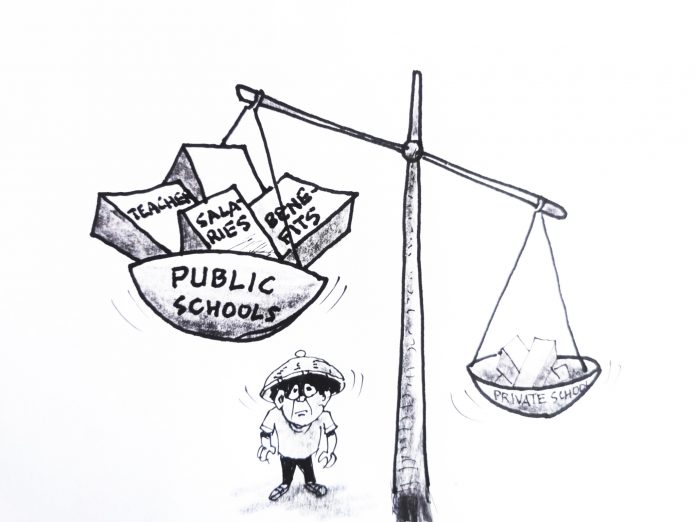
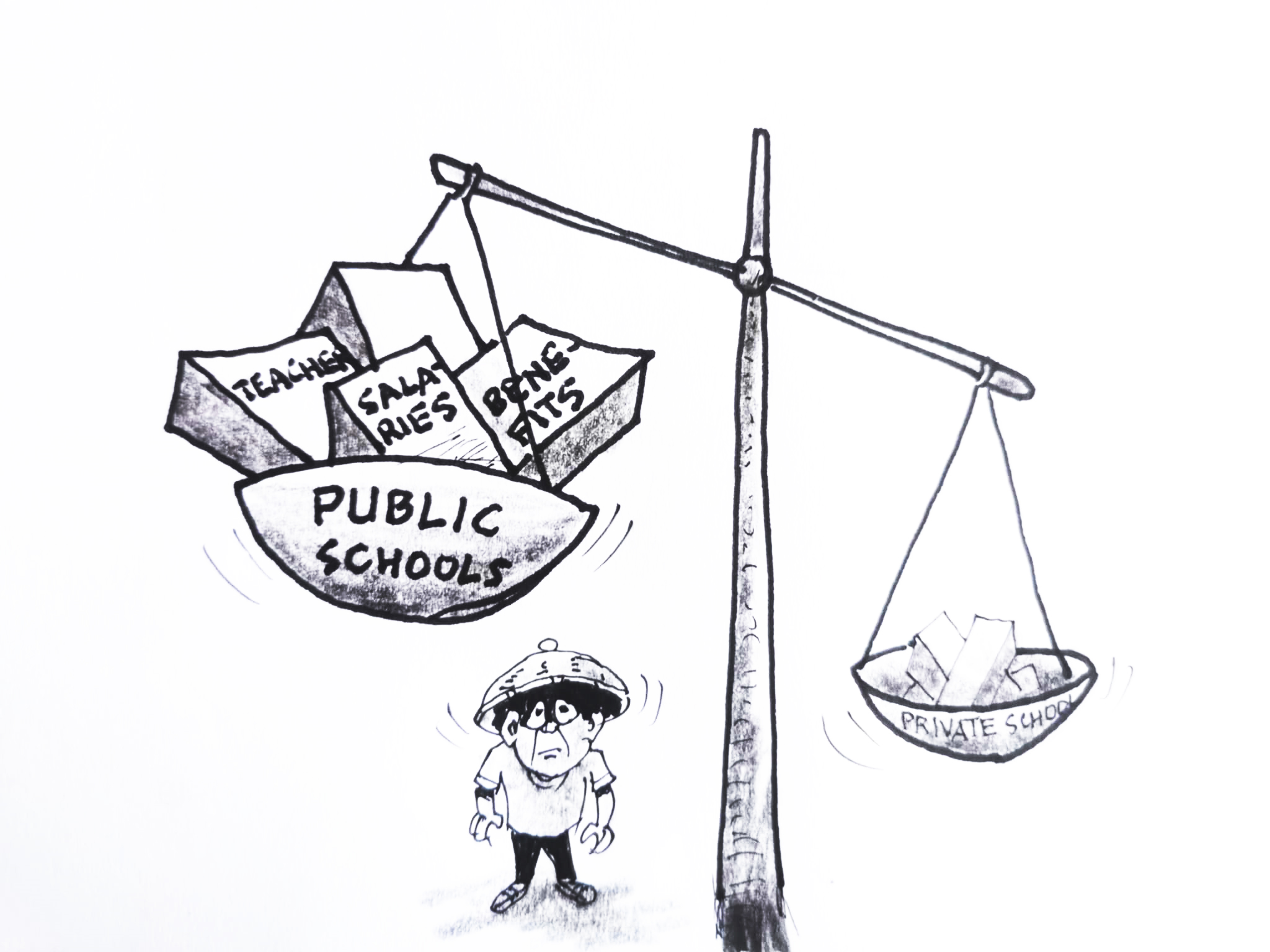
Addressing the imbalance

0

As we celebrate Teachers’ Day in both private and government institutions, there is an underlying issue that often goes unaddressed: the disparity in how teachers are treated, appreciated, and supported in these sectors. While government teachers enjoy national recognition, job security, and standardized benefits, many private school teachers struggle with job precarity, lower salaries, and less visibility. The imbalance needs to be confronted for fairness and the future of education in the country.

Government teachers are undeniably the backbone of our public education system. They benefit from state-sponsored recognition, salary adjustments, and additional perks like tenure. Public institutions usually host grand celebrations during Teachers’ Day, with government officials lauding their dedication. This system of support allows them to continue serving despite the challenges of overcrowded classrooms, limited resources, and bureaucratic red tape. However, the robust backing they receive highlights the gap between their experience and that of private school teachers.

Private school teachers, on the other hand, often face more challenges with less support. While they also dedicate themselves to the education of our youth, many do so under more financially constrained conditions, with lower wages and less job security. Teachers’ Day is celebrated in these institutions, but the recognition often remains limited within the school itself. The sacrifices of these educators, who are crucial to the success of the private sector, deserve more visibility and acknowledgment on a national scale.

The issue at hand is not just about celebrating Teachers’ Day but about the systemic inequalities that exist between the two sectors. We must ask ourselves: how can we, as a society, claim to value education when the teachers in one sector are left behind? This disparity is not just an issue of pay but one of respect and validation. We need to elevate private school teachers to the same level of acknowledgment as their counterparts in government institutions.

Moving forward, the government and the public must work toward bridging this gap. Teachers’ Day should not only be about festivities; it should be a time to reflect on what more can be done for all educators. The government, through policies and recognition programs, must ensure that private school teachers receive similar benefits and protections. We need to create a more equitable environment where all teachers, regardless of where they work, are equally celebrated and supported in their noble profession.


Authenticity over spectacle

0
DOMS PAGLIAWAN
DOMS PAGLIAWAN

Local choreographers find this trend bothersome that local festivals are being choreographed by hired professionals from other regions, who bring in steps, props, and influences that don’t belong to our culture. This practice strips the festivals of their original essence, turning what should be authentic expressions of our heritage into performances with a foreign flavor. While some may argue that these changes enhance the spectacle, I believe they dilute the true cultural significance of these events.

When one attends a local festival, one expects to experience something deeply rooted in one’s traditions. The colors, dances, and rituals should reflect the history and stories of one’s ancestors. But with the increasing influence of choreographers from outside the community, we see more and more elements that feel alien to our own heritage. These choreographers may be talented, but they often introduce modern, flashy routines and props that feel disconnected from the festival’s original meaning. It’s disheartening to watch a festival that used to celebrate our roots morph into something that feels more like a generic, commercial production.

I understand that festivals evolve. But there’s a fine line between evolution and erosion. When choreographers bring in elements that are foreign to our culture, they risk erasing the very traditions the festivals are meant to preserve. We’ve seen this happen in our own locality, where once-familiar dances now include steps that are completely foreign to us. The result is a festival that looks impressive but feels hollow as if the soul of the event has been lost in favor of entertainment value.

One of the issues, I think, is that some local officials or organizers feel pressured to make the festivals more visually exciting to attract larger audiences, especially tourists. They believe that hiring professional choreographers will help achieve that. While we appreciate the effort to put our local events on the map, I feel like we’re losing sight of what matters: staying true to our culture. Festivals are not just performances; they are a celebration of our identity, and when we compromise that for spectacle, we lose something far more valuable.

We also wonder if the younger generation, growing up with these “new and improved” festivals, will even know what the original traditions looked like. When we were younger, we remember watching the elders lead the dances and rituals, and there was something sacred about it. Now, with these choreographed performances, we fear that future generations will have no memory of the authentic steps, songs, and traditions that were passed down through centuries.

Of course, I’m not saying we shouldn’t evolve or make our festivals appealing to a wider audience. But there has to be a balance. We can incorporate modern elements without losing the core of what makes the festival ours. The solution lies in involving local cultural experts or elders in the planning process. They can work with choreographers to ensure that the integrity of the festival is maintained, even as we look for ways to keep the event fresh and engaging.

We also need to educate ourselves and others about the importance of cultural preservation. It’s not enough to celebrate these festivals once a year; we need to understand the stories behind them and pass that knowledge down to the next generation. If we allow outsiders to define what our festivals should look like, we risk losing a crucial part of our identity.

While hiring outside choreographers may add flair to local festivals, we mustn’t lose sight of their original purpose. Our festivals are more than just entertainment—they are living expressions of our heritage. We should involve more local experts, prioritize authenticity over spectacle, and educate future generations about the importance of preserving our traditions. We need to ensure that our festivals remain true to their roots while still being relevant to today’s world.

Marriage is not our creation

0
FR. ROY CIMAGALA
FR. ROY CIMAGALA

“WHAT therefore God has joined together, let not man put asunder.” (Mk 10,9)
That, in a nutshell, is how God created and designed marriage for us. It’s a lifelong, unbreakable commitment that is founded on God’s love and on our faith in him. Marriage is never just our own invention that would depend on how things go nor on the terms we set for it. Marriage should be entered into according to God’s designs for it, according to his terms, and not ours.

Thus, in the wedding ceremony, the man and the woman, armed by God’s grace, promise each other that they will stick together “for better, for worse, for richer, for poorer, in sickness and in health, until death do us part.”

As designed by God, marriage is for a man and a woman who in their God-based love for each other make themselves one flesh. Being a God-based love, it has to go beyond the human level of love. It has to be a love that is supernatural as shown to us and shared with us by Christ.

This God-based love will definitely be quite a tall order for us, since we are expected to go beyond our human and natural powers and resources. But as long as our faith in God is deep and strong, we can hack it, because more than us it is God himself who will enable us to love as God loves as shown to us by Christ. This God-based love can handle anything in our life.

Given the confusion and errors now besetting this issue on marriage, we need to reiterate that marriage is meant only for a man and a woman. There’s no such thing as same-sex marriage. Why? Because marriage is meant primarily for procreation of children.
And it has be exclusive—that is, between one man and one woman. It cannot be polygamous. Why? Because marriage is based on a love that involves the use of the body.

Since in love, everything is supposed to be given to the beloved by the lover, once that body is given to the beloved, it cannot anymore be shared with another partner. Unlike in a love that is spiritual, the more people we love, the better.

But more important to realize about marriage is that it is actually a path to holiness. It is not just a purely human and temporal affair. It has great potentials for the parties involved to pursue the common goal of ours to attain holiness, our identification with God through Christ, since we are all God’s image and likeness.

That is why everything has to be done to make marriage achieve its fullest dignity. And that means that we have to purify and elevate the love that is the very germ of marriage to the supernatural order as it should be.

That love has to develop from simply being natural and body-emotion-world reliant to being more and more spiritual and supernatural, driven by grace rather than by mere natural forces.

With the sacrament of marriage, the love between husband and wife is already guaranteed to have all the graces needed to make that marriage reach its fullness. What is needed is the faithful and generous correspondence of the parties concerned to those graces.

The parties involved should realize that their love for each other should reflect and channel the very love Christ has for the Church. Yes, the union of husband and wife should be like that of Christ toward the Church. (cfr. Eph 5,22-33)

Teachers as originators of Public Good

0
CLEMELLE L. MONTALLANA,DM, CESE ASSOCIATE PROFESSOR III
CLEMELLE L. MONTALLANA,DM, CESE
ASSOCIATE PROFESSOR III

Teachers as originators of Public Good must be celebrated and be given its rightful respect , it gives justice to their efforts and breath admiration to their vocation.

Public Good is a term in Economics that mean individuals can benefit from the goods without directly paying for it. Technically, its Non-Excludable (No one can be excluded from using the good. For example, once a public park is created, anyone can use it without being prevented from doing so.) and Non-Rivalrous (One person’s use of the good does not reduce its availability to others. For instance, one person enjoying the benefits of clean air does not diminish the amount of clean air available for others.) .

Teachers themselves are not public goods in the strict economic sense, but the services they provide—education—can be considered a public good.

In the UNESCO official website there lies a Working Paper that revisits Education as Public Good, The 17th Working Paper on the challenges facing education has been published. This latest paper re-examines the principle of education as a public good in the current context in which education is being increasingly privatized and commodified.

Education has been considered a human right and a public good in global public policy at least since 1945. This conceptualization has been produced and advanced by international organizations ever since, particularly by UN agencies and, among these, UNESCO. However, the educational landscape has changed considerably since then and it is now characterized by an increasing involvement of non-state actors, including for-profit organizations.

Education as a public good is essential for several reasons:

1. Equal Opportunity: Public education ensures that all individuals, regardless of their socio-economic background, have access to learning opportunities. This helps level the playing field and allows everyone to reach their potential.

2. Economic Growth: An educated population is crucial for economic development. Education equips individuals with the skills and knowledge needed to participate effectively in the workforce, driving innovation and productivity.

3. Social Mobility: Education provides a pathway for individuals to improve their socio-economic status. It opens doors to better job opportunities and higher incomes, helping to reduce poverty and inequality.

These are just to name a few, By ensuring that education is accessible to all, societies can build a more equitable, prosperous, and stable future.

Teachers as originators of Public Good must be celebrated and be given its rightful respect, it gives justice to their efforts and breath admiration to their vocation.

“Innovative Business Models: Redefining Industries and Creating Competitive Advantage”

0
MARIA JENILEEN CORDERO-ALANO

We live in a world of constant change. No matter how much we hold on to the things that we are used to, we all need to grow and embrace these changes that will make our lives easier. Technology evolves at breakneck speed, consumer preferences shift like sand dunes in the wind, and the old rules of business are constantly being rewritten. In this dynamic landscape, one thing remains clear: companies that want to thrive need to be innovative. And that innovation doesn’t just stop at products or services. It starts with the very foundation of how they operate – their business model.

I’ve always been fascinated by the power of business models. It’s not just about selling a product, it’s about creating a system, a network, a way of doing things that resonates with the market. Think about it: Uber didn’t invent the taxi, Airbnb didn’t invent hotels, and Spotify didn’t invent music. But they redefined how we access and consume these services, creating entirely new industries in the process. Forty years back, we have not imagined that we can all have what we want in a snap!

These innovative business models are not just about disrupting existing markets, they’re about creating new ones. They’re about finding ways to deliver value to customers in a way that’s more efficient, more convenient, or simply more appealing than the old ways. The systems that we may have been accustomed to were effective when they were created year ago. However, technology now allows us to do things more efficiently, thus saving time, allowing us to get so many things done is a day. This may seem tedious, but when you look at how much more we can do in a day, embracing an improved system can significantly improve how a business operates.

Take the subscription model, for example. It’s been around for decades, but it’s experiencing a resurgence in popularity across industries. From streaming services like Netflix, iFlix, and Viu to meal kit companies like Blue Apron in the United States, subscription models offer customers convenience, affordability, and a sense of predictability. For businesses, they provide a steady stream of revenue and valuable customer data.

But innovation isn’t just about adopting new models. It’s also about adapting existing ones to meet the changing needs of the market. Think about how Amazon has evolved from an online bookstore to a global e-commerce giant, offering everything from groceries to cloud computing services. They’ve constantly adapted their business model to stay ahead of the curve and capitalize on new opportunities.

The beauty of innovative business models is that they can create a competitive advantage that’s difficult for rivals to replicate. It’s not just about having a great product or service, it’s about having a system that’s uniquely positioned to deliver value to customers in a way that no one else can.

So, what does this mean for you, the aspiring entrepreneur or the seasoned business leader? It means being constantly curious, always looking for new ways to solve problems, and being willing to challenge the status quo. It means embracing the power of technology to create new possibilities and finding ways to connect with customers in a meaningful way.
In a world where change is the only constant, innovative business models are not just a competitive advantage, they’re a necessity for survival. It’s time to embrace the power of reinvention and create the future of business, one innovative model at a time.

SIDE NOTE: Your entrepreneurial journey has a powerful story to tell. Sharing it could inspire and motivate others to pursue their dreams. Would you be willing to share it with us for a future article?
————–
If you have any questions or would like to share your thoughts on the column, feel free to send an email to jca.bblueprint@gmail.com. Looking forward to connecting with you!

Evasiveness

0
AL ELLEMA
AL ELLEMA

More than being secretive about her escape away from the jurisdiction of all government authorities, fugitive Alice Guo had been in full circles in nooks that law enforcement authorities could hardly find. The simple issues regarding her true identity led to many more issues that unmasked the entry into the country of foreigners, mostly Chinese people, some of whom were reportedly with criminal records.

It took so much time and resources for the senate investigating committees to conduct hearings with the aim of finding the truth. In all the hearings conducted, the dismissed mayor was too evasive answering questions. She had a retinue of lawyers providing counsel on how to answer the questions raised by the investigating committee.

Meanwhile, all concerted efforts by law enforcement authorities took too long to find the fugitive Alice Guo. Its slow development in tracking the whereabouts of the fugitive Alice Guo became another concern. Even the public that were following the investigation were getting dismayed over the slow action of the law enforcement authorities.

By all indications, the fugitive Alice Guo had good links and connections with government officials who appear too cooperative with her moves. It was not surprising to all observers that the raids being conducted by law enforcement authorities are steps to late than the evasive moves. Reports of the fugitive Alice Guo moving from one lair to another had embarrassed the authorities as they have ample funds to conduct surveillance operations.
The temerity of the fugitive Alice Guo to be forgetful on basic information about her life in the purported farm and the story about her parents and siblings were insulting the intelligence of the people who were keenly following her incredible story. The confusing tales are tough to believe and concerned people started providing information to belie her story about her life in the farm. Indeed, she was a classmate to many in a private school and her story about being under a tutor was a lie.

Surprisingly, her lying before the senate investigating committee was met with kindness as she was only threatened with contempt. She got off the proverbial hook for lying under oath, as she was cited for contempt albeit too latte, and eventually jailed for her dastardly acts. She was unlike other resource persons who easily get cited for contempt and held under detention.

With all the kindness and accommodation extended on the fugitive Alice Guo, she surreptitiously packed her things with the help of all her supporters both with her private as well as with her government connections. Finally, she slipped from all government authorities simply with her evasiveness.
comments to alellema@yahoo.com

Recent Posts

DALMACIO C. GRAFIL
PUBLISHER

ALMA GRAFIL
EDITOR-IN-CHIEF

ROMEO CEBREROS
OFFICE IN-CHARGE

OFFICE
BRGY. SONGCO, BORONGAN CITY

CONTACT NUMBERS
(055) 261 – 3319 | 0955 251 1533 | 0917 771 0320 | 0915 897 7439 | 0921 511 0010

DALMACIO C. GRAFIL
PUBLISHER

RICKY J. BAUTISTA
EDITOR

ALMA GRAFIL
BUS. MANAGER

OFFICE
RIZAL AVENUE, CATBALOGAN
(INFRONT OF FIRE DEPARTMENT, NEAR CITY HALL)

CONTACT NUMBERS
0917 771 0320 | 0915 897 7439 | 0921 511 0010

EMAIL
lsdaily2@yahoo.com

WEBSITE
www.issuu.com/samarweeklyexpress