

28.4 C
Tacloban City
November 15, 2026 - Sunday | 10:27 AM
Home Blog Page 183

Calbayog, Lope de Vega forge pact to boost disaster response along key Samar Road

0
AGREEMENT. Officials from Calbayog City and Lope de Vega sign a memorandum of agreement to strengthen joint disaster response and emergency coordination along the Calbayog–Catarman Road during a ceremony at the Lope de Vega municipal hall.(RAYMUND ‘MONMON’UY FACEBOOK)

TACLOBAN CITY — In a move to improve emergency response and disaster preparedness along a critical inter-provincial route, the city government of Calbayog City and the municipality of Lope de Vega, Northern Samar have signed a memorandum of agreement (MOA) formalizing closer cooperation in disaster risk reduction and management.

The agreement was sealed during a ceremony held on April 20 at the Sangguniang Bayan Session Hall in Lope de Vega, led by Calbayog City Mayor Raymund Uy and Lope de Vega Mayor Bobby Sulidario.

At the core of the partnership is the joint management of emergencies along the Calbayog–Catarman Road, a vital transport corridor linking Samar and Northern Samar that has been prone to vehicular accidents and other emergencies.

Under the MOA, the two local government units (LGUs) agreed to establish coordinated mechanisms for rapid response, including cross-border deployment of rescue and medical teams. The agreement also covers joint trainings and simulation exercises, as well as the sharing of facilities, communication systems, and technical expertise.

Both LGUs committed to maintaining open and synchronized communication lines during emergencies to ensure faster coordination and response.

Funding for the initiative will be sourced from each LGU’s disaster risk reduction and management funds, with cost-sharing arrangements in place for large-scale incidents.

Mayor Uy emphasized that the agreement reflects the need for collaboration in addressing risks that affect neighboring communities. He added that the partnership could later expand to include cooperation in livelihood development and agricultural trade.

Local officials said the pact is expected to significantly improve response time, strengthen coordination, and enhance overall disaster preparedness in both Samar and Northern Samar—areas frequently exposed to natural hazards and road-related incidents.

(ROEL T. AMAZONA)
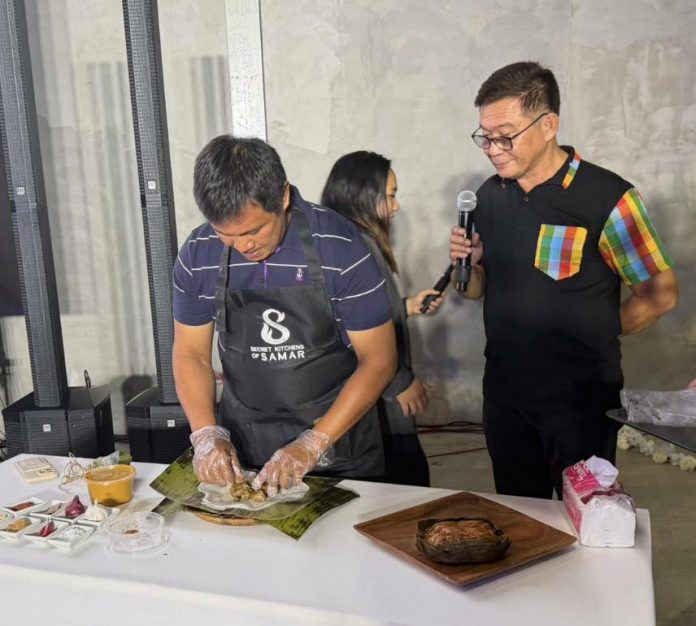
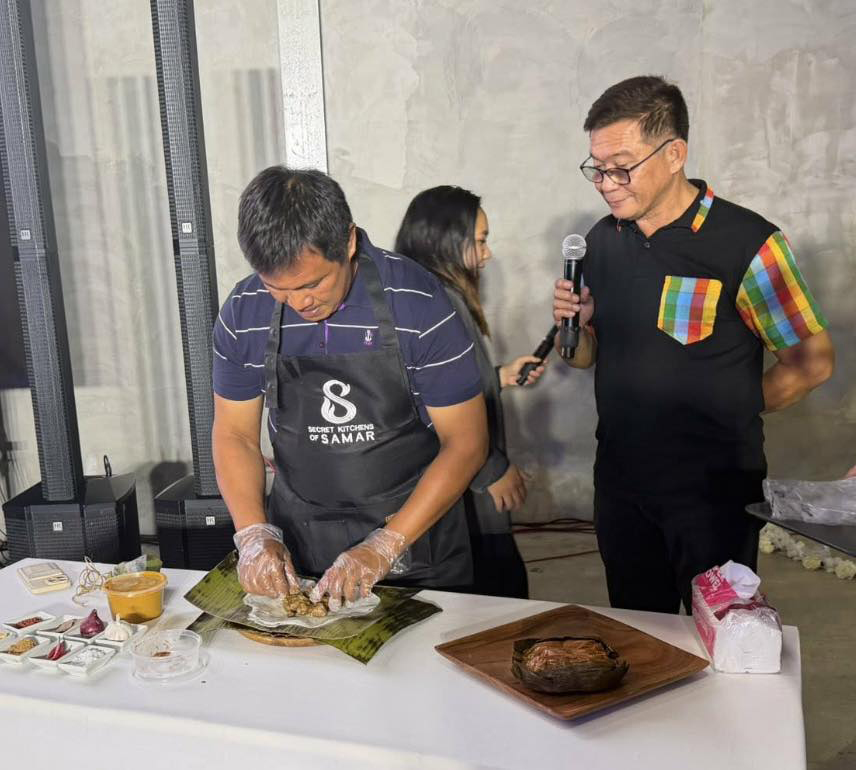
Samar showcases culinary heritage at NCCA ‘Food Wednesdates’

0
Provincial officials and cultural advocates from Samar showcase local delicacies such as tamalos and bola catalana during the “Food Wednesdates” event of the National Commission for Culture and the Arts at Likhaang Filipino, highlighting the province’s culinary heritage and cultural identity. (MARVIN PICZON FACEBOOK)
Provincial officials and cultural advocates from Samar showcase local delicacies such as tamalos and bola catalana during the “Food Wednesdates” event of the National Commission for Culture and the Arts at Likhaang Filipino, highlighting the province’s culinary heritage and cultural identity.
(MARVIN PICZON FACEBOOK)

TACLOBAN CITY — The provincial government of Samar took center stage in promoting its rich food traditions and cultural identity during the “Food Wednesdates” series of the National Commission for Culture and the Arts (NCCA).

Held at the Likhaang Filipino, the event featured Samar’s cultural heritage through performances inspired by the Manaragat Festival, highlighting the province’s deep connection to the sea.

A key highlight was a live cooking demonstration of local delicacies tamalos and bola catalana, showcasing traditional preparation methods and efforts to preserve indigenous culinary practices.

Provincial Tourism Officer Marvin Piczon also presented the Samar brand, emphasizing culture-driven development through storytelling and local products, while cultural advocate Clang Garcia shared insights on “Secret Kitchens of Samar,” a globally recognized culinary book series documenting the province’s diverse food traditions.

NCCA Chair Eric Zerrudo commended Samar for translating cultural mapping into programs that support heritage conservation and development.

The Center for International Trade Expositions and Missions (CITEM) likewise expressed support in promoting Samar’s culinary products to wider markets.

The initiative is part of ongoing efforts to position Samar as a hub for cultural and culinary tourism while preserving its traditional heritage.

ROEL T. AMAZONA

Eastern Visayas food fest to rotate to Samar next year after Tacloban run

0
DOT Regional Director Karina Rosa Tiopes
DOT Regional
Director Karina Rosa Tiopes

TACLOBAN CITY — The Eastern Visayas Food Fest will move to a new host province next year after two consecutive years of staging in Tacloban City, the Department of Tourism (DOT) announced.

DOT Regional Director Karina Rosa Tiopes said the 2026 edition of the festival will be hosted by the provincial government of Samar and the city government of Catbalogan City, giving more communities across the region the chance to experience and showcase their local cuisine.

Tiopes made the announcement during the successful street food festival held along Magsaysay Boulevard in Tacloban, noting that the rotation aims to promote wider appreciation of Eastern Visayas’ diverse culinary offerings.

She said bringing the event to Samar will allow residents to experience street foods from different provinces while also introducing regional delicacies to new audiences beyond Tacloban.

“All over the region we have different street food and to introduce them to Eastern Visayas is something that we wanted to do,” Tiopes said.

The festival features ready-to-eat dishes and snacks from across the region, including baduyang pasayan and ube of Catbalogan City; puto bugas, bibingka, and kutsinta of Calbayog; piyaya and milky donut of Tacloban; tuba-based ice cream from Palo; moron and empanada from Leyte; and various local products from Northern Samar towns.

Farm products such as vegetables, poultry, and rice were also showcased by farmers’ groups from Tacloban and Palo with support from the Department of Agriculture.

The Eastern Visayas Food Fest is part of the Filipino Food Month celebration under Proclamation No. 469, led by the DOT, the National Commission for Culture and the Arts, and the Department of Agriculture, aimed at promoting and preserving Filipino culinary heritage.

Tiopes also floated the possibility of organizing localized versions of the festival in the future, encouraging private stakeholders to sustain similar food tourism events in the region.

(ROEL T. AMAZONA)

Taking sides

0

The clash between the Armed Forces of the Philippines (AFP) and the New People’s Army (NPA) in Toboso, which left 19 alleged rebels dead, has triggered calls within the government to investigate and possibly penalize the military. Such a posture is misguided and dangerously weakens the very institution tasked with defending the state.

The AFP exists precisely to confront armed groups that seek to overthrow the government through violence. The NPA is not a civic organization or a dissenting political party; it is an armed insurgent force engaged in a decades-long rebellion against the Republic. When soldiers encounter such a group in the field, engagement is not optional—it is their duty. To treat the outcome of such encounters as inherently suspicious or illegitimate is to deny the reality of armed conflict and the responsibilities assigned to the military.

Calls for investigation are not, by themselves, improper. Any operation that results in multiple deaths must be subject to scrutiny to ensure compliance with the rules of engagement and the laws of armed conflict. However, the tone and timing of these demands matter. When high-ranking officials publicly cast doubt on the legitimacy of a military success without evidence of wrongdoing, they send a message that soldiers may be punished for doing their job. This creates hesitation in the field, where clarity and decisiveness are essential, and it emboldens insurgents who thrive on signs of political division.

The silence of the country’s leadership, including the President of the Philippines, further complicates the situation. Military operations, especially those that neutralize armed threats, require not only legal backing but also moral support from civilian authority. When such support is absent—or worse, replaced with threats of sanctions—the chain of confidence between the state and its defenders begins to fracture. A military that feels abandoned by its own government cannot operate with full effectiveness.

The proper course is clear. Investigate the incident with fairness and discipline, but refrain from prejudging the outcome or undermining the institution involved. Government officials must choose whether they stand with the rule of law or with those who seek to dismantle it by force. If the AFP is to continue fulfilling its mandate, it must be supported, not second-guessed at every turn. Anything less invites disorder and signals weakness to those already committed to destabilizing the nation.

Of cars and fuel

0

The day another fuel price hike was announced this April, I noticed something telling: more “FOR SALE” signs on car windows than usual, even in my own neighborhood. That sight says it plainly—this is not just about oil prices, and it is not as simple as people giving up on cars. Something deeper is shifting in how we think about ownership, cost, and convenience.

Oil price hikes are the loudest culprit, of course. In the Philippines, weekly fuel adjustments have become a kind of national ritual—gas stations changing numbers like restless clocks. Every increase quietly rewrites a household budget. A full tank that once felt routine now feels like a small financial decision, almost a debate with oneself at the pump. But blaming fuel alone misses the bigger picture. The cost of owning a car has been creeping up on all sides—maintenance, insurance, parking fees, and even traffic itself, which wastes fuel and time with equal cruelty.

I have come to see that traffic, more than fuel, is the silent persuader. In cities like Cebu, where the roads seem permanently under siege by congestion, a car can feel less like freedom and more like a beautifully engineered cage. You spend for it, you maintain it, you fuel it—only to sit still, inching forward with a patience you never agreed to develop. At some point, people start asking a blunt question: Why am I paying so much to go nowhere slowly?

Then there is the rise of alternatives, which people once dismissed but now quietly embrace. Ride-hailing services, motorcycles, carpooling, and even the occasional return to public transport have become practical choices. They are not perfect—far from it—but they shift the burden. Instead of carrying the full weight of ownership, people now pay only when they need to move. It is a subtle but powerful change in mindset: from owning mobility to accessing it.

So, is it wise to buy a car now? Only if you are very sure why you need one. Not want—need. A car still makes sense for families, for those with unpredictable schedules, or for people living far from reliable transport routes. But buying one today without a clear purpose feels like signing up for a long-term expense in a time when flexibility is becoming more valuable than possession. The romance of owning a car fades quickly when confronted with receipts.

Regarding those selling their vehicles, I don’t view it as a surrender. In many cases, it is a rational decision—a quiet recalibration of priorities. Letting go of a car can mean freeing up cash, reducing monthly stress, and choosing a lifestyle that fits current realities. There is no shame in that. If anything, it shows a kind of clarity that many people resist until it is too late.

For prospective buyers, the question should not be “Can I afford this now?” but “Will this still make sense a year from now?” That difference matters. Fuel prices may rise again. Traffic will not magically disappear. Urban living will likely grow more complex, not less. A wise buyer today thinks beyond the showroom and imagines the daily grind that comes after—the parking hunts, the repair bills, the slow crawl of rush hour.

The best option is not a single answer but a careful balance. For some, it may still be owning a modest, fuel-efficient car. For others, it could mean relying on a mix of transport options and letting go of ownership altogether. What matters is honesty—about one’s needs, one’s habits, and one’s tolerance for cost and inconvenience. The road ahead is not just paved with asphalt anymore; it is paved with choices, and not all of them require a car.

The mark of divine filiation

0

WE have to be more familiar with this Christian doctrine about our divine filiation. Simply said it means that through God’s grace which he gives us, we become adopted children of his, sharers of his life and nature, without erasing the distinction between God who is our Father, the Model and the Keeper of such identity for us, and who is the creature.

We also have to realize that this divine filiation is actually meant for all of us. It is not reserved only to a few people or to some special kind of men and women.

To enable us to receive this grace and to become adopted children of his, God created us with a spiritual nature, endowed with intelligence and will that would enable us to know and love him. The ideal condition for us is to always have an intimate and constant relation with God.

This ideal condition was once expressed graphically when Christ described the relationship between a shepherd and his sheep. “My sheep hear my voice, I know them, and they follow me,” he said. (Jn 10,27) In other words, for us to live out an authentic spirit of divine filiation, there should be some kind of synchronization between God’s will and our will.

We would always follow God’s will, regarding such disposition as the perfection of our freedom. To be sure, to attain such setting, we would need a certain discipline that would involve practices like prayer, recourse to the sacraments, deep knowledge of the doctrines of our faith. There is also need for continuing ascetical struggle and conversion, and the ability to discern the things of God amid our varying earthly conditions.

In short, we can truly say that we have a healthy spirit of divine filiation when we can honestly, accurately and with conviction say that we are doing nothing other than the will of God. Somehow, we can echo the words of St. Paul when he said: “It is no longer I who live, but Christ who lives in me.” (Gal 2,20)

This may sound like something impossible to achieve, but with a strong faith lived consistently in our life, that impossibility can become not only possible, but also real. We should just train ourselves to feel at home with this incredible truth of our faith.
In this regard, we should try our best to go beyond our natural self without abandoning it, to enter into our supernatural self which God is offering us. For this, we have to live the Life in the Spirit.

That is to say, our life should be animated first of all by the Holy Spirit, the spirit of God that makes us children of his in Christ, making us “alter Christus” (another Christ), since Christ is the pattern of our humanity. It should not be a life animated simply by natural elements and principles.

Somehow, we can say that we are living the life in the Spirit when we can see in ourselves the fruits of the Holy Spirit as mentioned by St. Paul. They are “love, joy, peace, patience, kindness, goodness, faithfulness, gentleness, and self-control.” (Gal 5,22-23)

Yes, in spite of the varying conditions of our earthly life, in spite of the many challenges and trials that we are going to encounter here, we can manage to enjoy these fruits. That’s when we can say that we are doing things in synch with God’s will and ways. That’s when we can say that we are truly living as children of God, that we have the mark of divine filiation!

Recent Posts

DALMACIO C. GRAFIL
PUBLISHER

ALMA GRAFIL
EDITOR-IN-CHIEF

ROMEO CEBREROS
OFFICE IN-CHARGE

OFFICE
BRGY. SONGCO, BORONGAN CITY

CONTACT NUMBERS
(055) 261 – 3319 | 0955 251 1533 | 0917 771 0320 | 0915 897 7439 | 0921 511 0010

DALMACIO C. GRAFIL
PUBLISHER

RICKY J. BAUTISTA
EDITOR

ALMA GRAFIL
BUS. MANAGER

OFFICE
RIZAL AVENUE, CATBALOGAN
(INFRONT OF FIRE DEPARTMENT, NEAR CITY HALL)

CONTACT NUMBERS
0917 771 0320 | 0915 897 7439 | 0921 511 0010

EMAIL
lsdaily2@yahoo.com

WEBSITE
www.issuu.com/samarweeklyexpress