TACLOBAN CITY – It was an early Christmas treat for 30 Grade 1 pupils of Judge Antonio Montillo Sr. Elementary School when they were selected by Robinsons North Tacloban to be their guests at the official switch-on of their giant Christmas tree on Sunday(Oct.9).
The pupils received school supplies and toys from Robinsons and their tenants as part of the giant activity held at the shopping mall’s activity area.
Mayor Alfred Romualdez joined Robinsons regional operations manager Jennifer Puno, area marketing manager Ian Virrey, leasing manager Joanna Pauline Modesto, and city tourism officer Malou Tabao in the switching of the giant Christmas tree.
The Palo Ambassadors Orchestra Kusog Performing Arts and the Group San Isidro Dove Choir of Blessed Sacrament provided the entertainment during the more than an hour event.
As Filipinos start to prepare for the Christmas season, Puno said that they wanted their costumers to feel its atmosphere while they shop and dine at the Robinsons shopping mall.
Robinsons North also has lined up events throughout the Christmas season.
Mayor Romualdez, in his message, said that getting back to normal from the pandemic was made possible by the cooperation of all and following protocols set by the government to prevent further spread of the virus.
He also thank Robinsons for staying and helping the city government in facing the challenges brought on by the pandemic that affected the city’s economy.
Authorities described referendum as successful and orderly
YES WINS. As expected, the ‘yes’ votes easily win during the plebiscite held on Oct.8, calling for the merging of 28 barangays into three districts and the renaming of another village. The electoral process was described by the Comelec as peaceful and successful. (ORMOC CITY GOVERNMENT)
ORMOC CITY-As projected, the ‘yes’ votes for the merging of several barangays and the renaming of a barangay won during a plebiscite conducted here in the city on Saturday (Oct.8).
The Commission on Elections (Comelec) said that the voters’ turnout for the plebiscite was about 53%.
Of the 5,315 voters who cast their votes during the plebiscite, 4,767 of them favored the merging while the remaining 538 chose to vote no.
There were 10,029 registered voters of the 29 barangays that were involved in the plebiscite.
The plebiscite involved the merging of 28 barangays into three ‘super barangays’ or districts.
Barangay 1, 2, 3, 4, 5, 6, 7, 8, 12, 13, 15, 17, 23 and 27 will now be known as Barangay South while Barangays 9, 10, 11, 16, 18, 25 and 28 will now be refer as Barangay East.
Meantime, Barangays 14, 19, 20, 21, 22, 24 and 26 shall now be known collectively as the Barangay West.
Also, Barangay 29 will be known as Barangay North.
With the merging, the city’s 110 barangays will now be reduced to 85.
Lawyer John Rex Laudiangco, the spokesperson of the Comelec, said that the result will have an immediate effect with the Department of Interior and Local Government(DILG) to be notified on the changes with the final results or votes canvassed during the conduct of the plebiscite as an attached document.
Current officials of the affected barangays will serve their terms until a new election for the barangays and Sangguniang Kabataan(SK) will be conducted.
Top officials of the Comelec, headed by its chairman, George Erwin Garcia, monitored the conduct of the plebiscite declaring it successful and generally peaceful.
A representative of Namfrel (National Citizens Movement for Free Elections), Angel Averia, noted that there were instances that some polling precincts were crowded, there were designated areas for senior citizens and persons with disabilities and there was no proclamation of a non-working day which could contribute why many of the 10,029 voters of the affected villages failed to cast their votes.
The city government of Ormoc decided to collapse these 28 barangays into just three districts on ground for easy management on top of the fact that many of these villages either have few residents which result for them not to have needed personnel like watchmen or lack of areas for them to build facilities like day care or health center and barangay hall.
Mayor Lucy Torres Gomez expressed her gratitude for supporting their move.
“I like to thank everyone who worked to make the merging happen and the barangays who selflessly supported the merging. Time will tell that this is a very good move and will redound for better services to the barangays,” she said.
The move was started back in 2020 during the incumbency of now Leyte Rep. Richard Gomez.
For this political exercise, the city government has allocated P8 million.
Meantime, it was learned from Comelec Chairman Garcia that the Ormoc plebiscite is one of the 20 similar activity that the poll body will be supervising in other parts of the country.
Earlier, the Comelec conducted plebiscites in Alabel, Saranggani province for the creation of a new barangay held last August 20; the conversion of the town of Calaca, Batangas into a city last Sept.3; and the division of Maguindanao province into Maguindanao del Norte and Maguindano del Sur held last Sept.17.
CHRISTMAS ON THE AIR. Tacloban City Alfred Romualdez lead in the switching on a giant Christmas tree at the Robinsons North on Sunday(Oct.9) wherein he announced during an interview on the plan of the city government to buy and rehabilitate the Leyte Park Resort and Hotel, a facility built by her aunt, former first lady Imelda Marcos. (ROBINSONS NORTH)
Using a Land Bank loan
TACLOBAN CITY– The city government here has sought a P1 billion loan from the Land Bank of the Philippines, a sizeable amount of which will be used to buy and rehabilitate a hotel built by former first lady Imelda Marcos.
This was confirmed by City Mayor Alfred Romualdez, nephew of the former first lady, who said that the move to manage the Leyte Park Resort and Hotel is to ‘save’ it from total decay.
“It’s not a question of venturing (into hotel business) but all I want is to save it and make use of it. It’s for the Taclobanons,”Romualdez said.
The city mayor said that eventually, the facility will be offered to a private company that has the capacity and knowledge in running a hotel business.
He also said that the reopening of the hotel will not only provide at least 2,000 jobs but add to the hotel rooms needed by the city as it expects an influx of tourists and even investors with the reopening of the economy affected by the pandemic for almost three years now.
He added that they will hire a private company that will help the city government redesign the hotel as he disclosed that they intend to have a convention center inside the 6.1-hectare property to accommodate thousands of visitors during a meeting or convention.
The city mayor further said that the operation of the Leyte Park Resort and Hotel will complement with the operation of an improved Daniel Z. Romualdez Airport.
According to Romualdez, needed papers are now being prepared regarding the possible takeover of the hotel by the city government using the P1 billion planned loan of the city government from the Land Bank which gave a P1.7 billion credit line to the local government.
The city mayor, however, clarified that not all of the P1 billion planned loan will be spent for the purchase and rehabilitation of the said hotel.
While Romualdez did not say the amount to be spent for this purpose, there were information that the city government will be spending P500 million for this endeavor.
The city mayor said that the hotel is now in a state of decay reason a ‘huge amount’ of money will be needed to make it useful again.
The hotel ceased to operate in 2021 after its private operator, whose been leasing the facility since 1994, did not renew its contract as it chose to build his own hotel, also in the city.
The Leyte Park Resort and Hotel is being managed by the Privatization Management Office (PMO), the Leyte provincial government, and the Tourism Infrastructure and Enterprise Zone Authority (TIEZA), an attached agency of the Department of Tourism.
PMO serves as the national government’s marketing arm concerning transferred assets, government corporations and other properties assigned to it by the Privatization Council for disposition.
On the other hand, TIEZA is responsible for implementing policies and programs of the DOT related to the development, promotion, and supervision of tourism projects” in the country.
The Leyte provincial government owns the lot where the hotel is built.
The hotel, located along Magsaysay Boulevard here, was built in 1979 by the Marcos widow and was considered Eastern Visayas’ main hotel during its heyday.
However, it was seized in favor of the national government in 1987 claiming its part of the so-called ill-gotten wealth of the Marcoses.
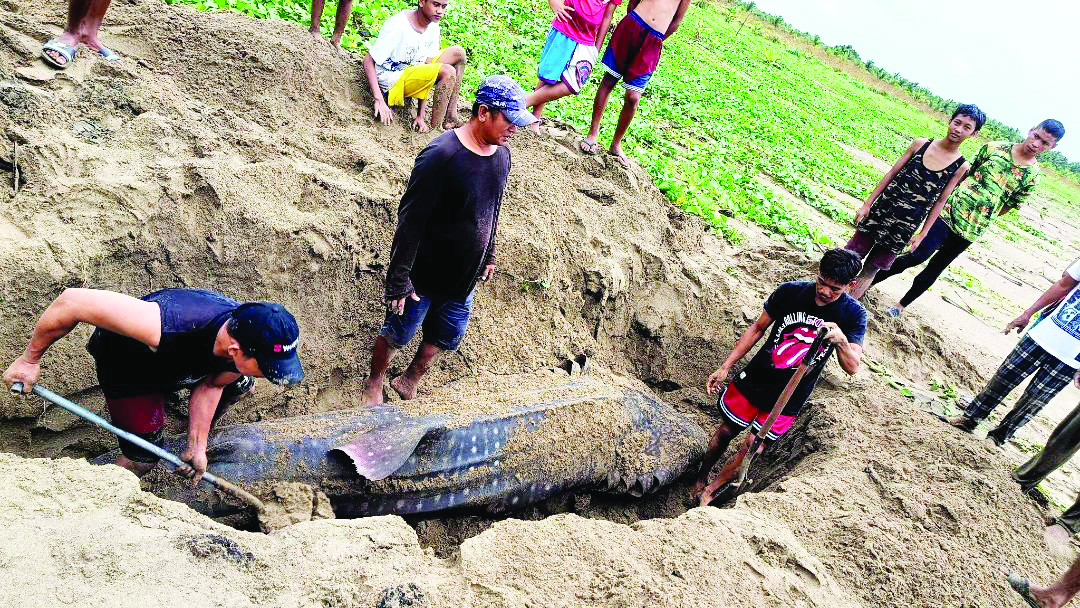
Residents of Barangay Bagasbas, Mondragon in Northern Samar buried a whale shark that was found adrift in their shore last Monday (Oct. 3).
ORMOC CITY- Residents of a coastal barangay in Mondragon, Northern Samar were stunned to find a weakling whale shark that later died on Monday (Oct.3).
Wilson Tenebroso, who works at the municipal government, in an interview said that their office received information that shark was found adrift along the shore in Barangay Bagasbas at about 9 am.
Tenebroso said that when they arrived in the village, the shark was already dead.
He added that based on the accounts of the residents, the animal, locally known as ‘butanding,’ was seen eating planktons and shrimp which are abundant in the area.
However, the locals told him that the whale shark seems to be disoriented on how to get out of the area.
He explained the seawater of the shore of Bagaspas is shaped like a basin and most often a disoriented fish could never come out from the area.
Tenebroso also said that based on the report of the provincial office of the Bureau of Fisheries and Aquatic Resources, the whale shark measured 14 feet and weighed 1,000 kilograms.
And quoting the BFAR report, the big fish had red markings under its mouth going to the anal fin.
The fisheries officials theorized that the whale shark got this while trying to come out of the shore and since it was still juvenile, it got disoriented that resulted for the shark to be trapped.
Moreover, the fishery officials said that the continued slamming of the fish as it ran aground from a shallow portion of the seawater could have caused the red markings that later made the fish weak. The red markings must have hurt the whale shark so much that caused the giant fish to get weakened until it succumbed, the BFAR officers told Tenebroso.
The BFAR officers also opened the stomach of the whale shark to find if it ate something that could cause its death. But so far only small shrimps and plankton were found inside the stomach and no foreign matter was found.
The whale shark was buried at a 6-foot graveyard on the shore of the barangay.
Upon burying the LGU and BFAR officials poured gasoline inside the belly and the whole body of the whale shark for the community not to dig or consume it. (ROBERT DEJON)
We all have our handicaps. Mine is unique. I have a very poor memory for names—people’s names, that is; especially those that have just been introduced to me.
It’s for this reason that I find it futile sometimes that new acquaintances get introduced to me. I can hear the names, of course, but right after that, I forget them. To my embarrassment at times. Because once there is a need for me to call them by their names right there, I can’t do it.
It’s not that I can’t remember people’s names—I can! It’s just that I take the time to do so. It takes me days, weeks, or months before I can memorize their names as matched with their faces. From the first meeting to that extent, I grope in the dark as to what I should call them in case they happen to be my new colleagues. It’s two-fold, I have difficulty memorizing names, and matching them with their owners.
How I envy those people with a computer-like memory for names. I know of some. I came across a teacher who had memorized his students’ names, including their nicknames. Every time they met elsewhere on the campus, he would call them by their names. Another one I know is a college president who could memorize even the names of their foreign students, with the latter’s hard-to-pronounce names.
It really takes time for me to internalize names matched with the faces. But this could be expedited, especially if these new acquaintances make some initiatives and finally make it to my attention, and eventually to my memory. If one makes it to my heart, that would be better. Make no mistake, though, I mean no malice here. This could mean that, perhaps, one lent me money in a time of need.
Make no mistake, further, because, at the introduction stage, I get to know a person right away, through some other way. I may not be good at noting names, at memorizing them, but as a visual person, I can figure out a person at once: that he is my student, that he is a colleague, that he is a superior, etc. Just don’t ask me what the name is. How funny! But it’s not amusing at all. I don’t like it either.
But you know what, the moment one’s name matched with the face sinks into my memory, it’s good as lasting. It will become part of my memory bank. I don’t easily forget. Slow to memorize, but slow to forget as well. I guess this is better than quick to recognize but is also quick to forget. What do you think?
Seriously, you can blame it on my being a visual person that I am like this. This makes me a bit confused. Music to me is auditory, not visual. You show me notes, but I can’t read them. But let me hear a musical sound and I can appraise it. When it comes to getting to know people, though, I am visual, not auditory. Forgive this handicap. Please bear with me.
Two legislators, Reps Eric Go Yap (Benguet) and Paolo Z Duterte (Davao City), alarmed by the smuggling of agri-fishery goods estimated at P667.5 million in 2019-2022, have co-authored House Bill 168 urging the Lower House committee on agriculture and food to conduct an investigation.
Accordingly, only P10 million worth of the smuggled items were apprehended. Added to this was another P1.99 billion worth of agricultural products in 542 raids conducted in 2019!
Yap and Duterte were quoted saying that “smuggling of agricultural products has been causing price distortion in the produce of Filipino farmers and defeats the efforts to increase farm production.
Smuggling activities have been active despite the creation of a Task Force to investigate the sudden proliferation of smuggled vegetables in the local market like carrots, ginger, onions and poultry products. The TF is composed of representatives from the Bureau Customs (BOC), Department of Trade and Industry (DTI) and the Bureau of Internal Revenue (BIR).
MY COMMENT:
Smuggling, likened to an incurable disease, has been in the country since time immemorial. While we do not profess being the only smugglers paradise, we abhor such reference! Unless eradicated fast enough (like corruption), attempts to inject fresh blood to the battered economy, is forecast to remain a dream.
ooo000ooo NEXT TOPIC : “Secretary Balicasan supports Sugar importation only IF?” SHARE S & T THOUGHTS through E-mail: drpacjr@yahoo.com.