TACLOBAN CITY– Police arrested a man and seized two handguns and 38 rounds of ammunition during a search operation in Barangay Tubig-Guinoo, Kawayan, Biliran on Sept. 21, authorities said.
The Kawayan Municipal Police Station (MPS), led by Maj. Ian Salvador Po, officer-in-charge, implemented the search with support from other police units as part of the Simultaneous Anti-Criminality Law Enforcement Operation (SACLEO).
Police seized from the target of the operation a .38-caliber revolver with a defaced serial number, a .45-caliber pistol, four live rounds for a .38-caliber revolver, 33 live rounds for a .45-caliber pistol, one .45-caliber magazine, a sling bag, and one shotgun round.
The seized items were marked and inventoried in the presence of the arrested individual, witnesses and family members, police said.
The suspect and the confiscated firearms and ammunition were brought to the Kawayan MPS for documentation and processing.
Police said the suspect is being processed for a possible violation of Republic Act No. 10591, or the Comprehensive Firearms and Ammunition Regulation Act.
The filing of charges remains subject to evaluation by the proper authorities.
Po said the Kawayan MPS would continue to conduct lawful operations against illegal firearms and ammunition as part of efforts to maintain peace and public safety in the municipality.
Police also urged residents to report information about the illegal possession or use of firearms and other unlawful activities to the nearest police station.
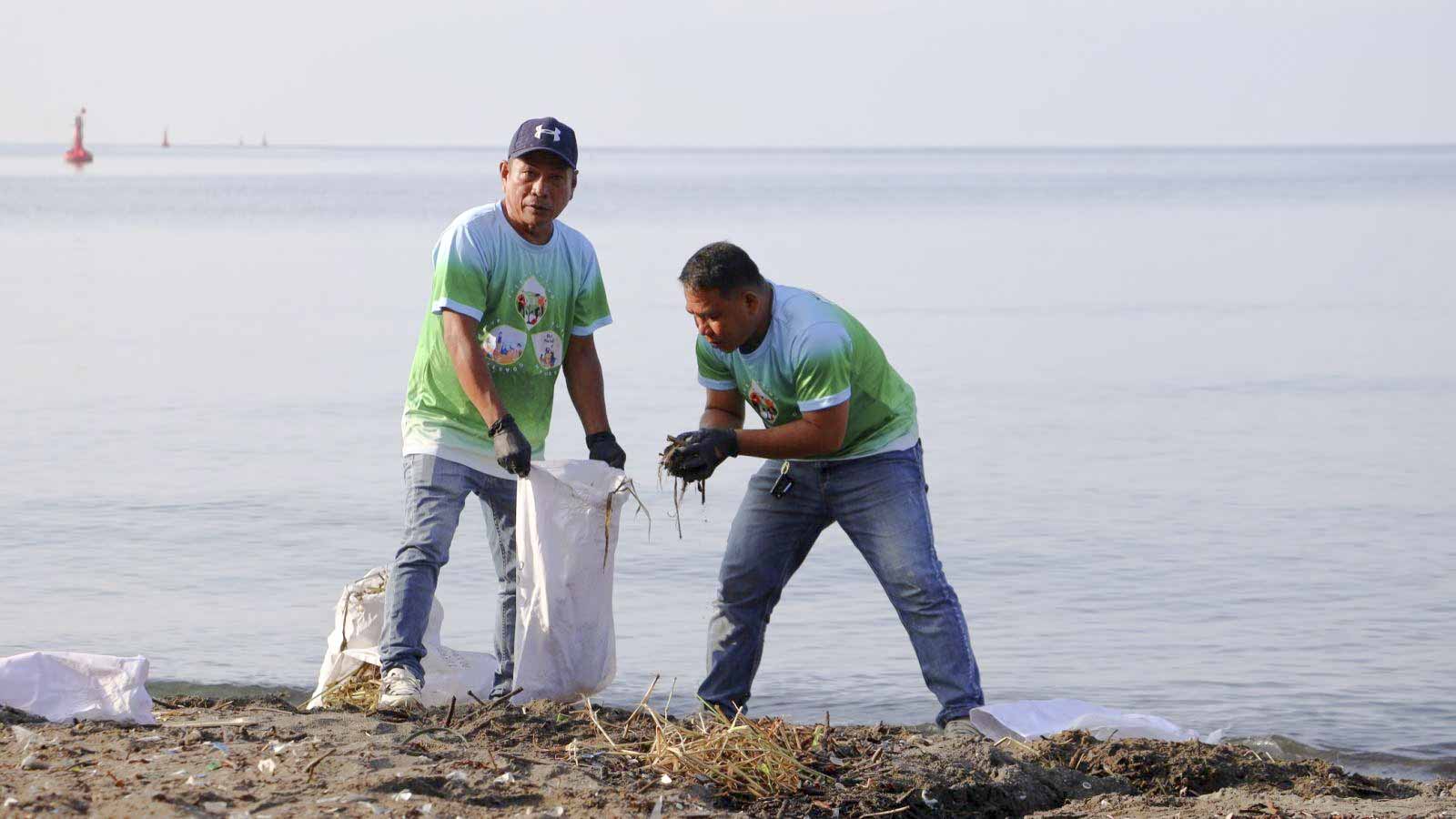
ORMOC CITY– Employees of the Department of Public Works and Highways (DPWH) Leyte 4th District Engineering Office (DEO) took part in this year’s International Coastal Cleanup (ICC) Day, gathering along the shores of Ormoc Bay to clear the area of waste.
Through their collective effort, the volunteers collected a total of 58 sacks of garbage, ranging from plastic bottles and caps, food wrappers, straws and other forms of debris.
OIC-District Engineer Peter Scheler V. Soco stated that maintaining a clean environment requires the participation of everyone. “As a government office, we have a responsibility to do our part in keeping our surroundings clean,” he said. “This activity may seem simple, but collecting 58 sacks of garbage shows how much waste can accumulate in our coastal areas.”
ICC Day is a global initiative started by the Ocean Conservancy in 1986, now observed annually by millions of volunteers across over 100 countries to remove trash from beaches and waterways and raise awareness on marine pollution. In the Philippines, it is institutionalized under Presidential Proclamation No. 470, series of 2003. (PR)
Through its active support to the Municipality of Laoang, the Department of Public Works and Highways Northern Samar Second District Engineering Office (DPWH-NSSDEO) enthusiastically joined the 258th Laoang Founding Anniversary Parade on Saturday, September 19, 2026.
The parade commenced at 6:00 in the morning at the Immaculada Concepcion Plaza of Laoang and proceeded through the major streets of Laoang Poblacion. Leading the parade were Laoang Riders, followed by the Anniversary Tarpaulin, Flag Pannel composed of PNP Flag Bearers, the Philippine National Police, the Municipality of Laoang Flag, and the UEP Laoang Drum and Lyre Corps.
Vibrant marching bands, national and local government agencies, schools, and various organizations filled the streets with color, history, energy, and music showcasing the genuine Laoanganon spirit, marking the 258 years of history and rich culture.
The participation of DPWH NSSDEO in this significant celebration reflects its unwavering commitment not only to delivering quality infrastructure but also to fostering strong relationship and partnership with the communities and local government units. Through active engagement in activities that celebrate local heritage, DPWH-NSSDEO continues to support community growth and development, not only for the Municipality of Laoang, but also for the people of Laoang.
NEW LIVELIHOOD. Members of the Daram Association of Fish and Squid Processors and the Barangay Ubo Dried Fish Vendors Association in Daram, Samar demonstrate solar salt production using equipment provided through the Bureau of Fisheries and Aquatic Resources’ Development of the Salt Industry Project. The initiative aims to provide fisherfolk with an additional source of income while supporting the production of locally made salt.
(BFAR-Eastern Visayas)
NEW LIVELIHOOD. Members of the Daram Association of Fish and Squid Processors and the Barangay Ubo Dried Fish Vendors Association in Daram, Samar demonstrate solar salt production using equipment provided through the Bureau of Fisheries and Aquatic Resources’ Development of the Salt Industry Project. The initiative aims to provide fisherfolk with an additional source of income while supporting the production of locally made salt. (BFAR-Eastern Visayas)
TACLOBAN CITY – Fisherfolk in Daram, Samar are turning to solar-powered salt production as an additional source of income, with government assistance providing equipment and training to help them develop the new livelihood activity.
The Daram Association of Fish and Squid Processors and the Barangay Ubo Dried Fish Vendors Association received equipment, materials and production inputs through the Development of the Salt Industry Project (DSIP) of the Bureau of Fisheries and Aquatic Resources (BFAR).
Gilda Dosal Añez, president of the Daram Association of Fish and Squid Processors, said salt production has good potential as a livelihood because it requires relatively little capital and can be managed by women.
“The potential of salt production as a livelihood is high because it does not require a large capital investment and can be easily managed, particularly by women,” Añez said.
The Daram association, composed of 16 fisherfolk members, and the Barangay Ubo association, with 25 members, each received a solar salt production module using a low linear density polyethylene (LLDPE) liner and frame worth P100,000.
The groups also received a generator, submersible pump and high-density polyethylene drums, as well as capability-building activities to help them operate and manage the technology.
Their initial production yielded 180 kilograms of salt, which the associations used for their fish-drying activities.
The initial output showed how salt production could complement their existing livelihood activities while reducing their need to purchase salt for fish processing.
The associations plan to increase production by adding more liner setups and eventually shifting to mass production. They also intend to produce iodized, food-grade salt and explore other value-adding opportunities for their products.
They also plan to replicate the technology in other barangays interested in adopting the solar salt production system.
BFAR-8, through the DSIP, is set to provide additional P300,000 worth of collapsible salt production setups to associations in Daram to further increase their production capacity and the availability of locally produced salt.
The intervention is expected to provide fisherfolk with an additional livelihood and income source while contributing to the development of the local salt industry.
In Eastern Visayas, the DSIP has identified 230 individuals from 13 associations and one cooperative to receive various salt production interventions.
The program covers Daram Island in Samar; San Roque in Northern Samar; Maasin and Hinunangan in Southern Leyte; Baybay City in Leyte; Guiuan and Arteche in Eastern Samar; and Naval and Maripipi in Biliran.
Pamana Project. A P100-million bridge project funded under the 2024 Payapa at Masaganang Pamayanan (Pamana) program is being constructed in Barangay Maduroto, Matuguinao, Samar. The project is expected to improve connectivity between the town center and outlying communities and eventually provide a direct link toward Las Navas, Northern Samar. (Contributed Photo)
Pamana Project. A P100-million bridge project funded under the 2024 Payapa at Masaganang Pamayanan (Pamana) program is being constructed in Barangay Maduroto, Matuguinao, Samar. The project is expected to improve connectivity between the town center and outlying communities and eventually provide a direct link toward Las Navas, Northern Samar. (Contributed Photo)
TACLOBAN CITY— A P100-million bridge project in Barangay Maduroto, Matuguinao, Samar is expected to improve access to remote communities and eventually provide a direct road link between the town and Las Navas, Northern Samar.
Funded under the 2024 Payapa at Masaganang Pamayanan (Pamana) program, the project is intended to address transportation difficulties in geographically isolated communities and improve the movement of residents, agricultural products and other goods.
The bridge will connect the Matuguinao poblacion with outlying barangays, with the planned road network eventually extending toward Las Navas in Northern Samar.
Once completed, the project is expected to provide residents with a safer and more efficient route to the town center and other areas, reducing travel difficulties faced by communities with limited access to transportation infrastructure.
Improved connectivity is also expected to support local economic activities by making it easier for farmers and other producers to bring their products to markets.
The project could likewise improve access to government services, schools, health facilities and other essential services for residents in remote barangays.
The Pamana program supports conflict-affected and conflict-vulnerable communities through socioeconomic development and infrastructure projects. It seeks to address development gaps while complementing government peacebuilding efforts.
The Matuguinao bridge is part of efforts to use infrastructure development to improve connectivity and create opportunities for communities facing geographic and development challenges.
The planned connection to Las Navas could also strengthen economic and social interaction between communities in Samar and Northern Samar, particularly those with shared livelihood and geographic links.
Local officials said improved road access could help create conditions for greater economic activity and more efficient delivery of public services once the project is completed.
The bridge project highlights the role of infrastructure in improving access and supporting long-term development in remote communities in Eastern Visayas.
Senator Francis “Chiz” Escudero is pushing for the rapid, nationwide rollout of the government’s maritime digital passenger manifest system after the Philippine Coast Guard (PCG) raised the possibility that the ill-fated MV June Aster may have been carrying more passengers than its official manifest recorded.
According to Escudero, the recent sea tragedy in Coron, Palawan once again exposes critical gaps in maritime safety protocols, underscoring the urgent need to real-time passenger data during emergencies. While the Maritime Industry Authority (MARINA) has already mandated the use of digital passenger manifests to curb overloading and strengthen sea safety, Escudero observed that implementation across regional ports remains inconsistent.
“What happened to MV June Aster shows why we must accelerate and expand the rollout,” he said. Last March, MARINA tapped Iloilo and Guimaras as pilot areas where it implemented tap‑and‑go cards that automatically generate manifests and QR‑based registration via a mobile app developed by the Department of Information and Communications Technology.
These technologies provide port authorities and the PCG with accurate, real‑time data before any vessel leaves the pier, significantly strengthening emergency response capabilities. The veteran legislator pointed out that several ASEAN neighbors have already adopted stricter digital manifest protocols, and the Philippines must “catch up” to prevent tragedies from being compounded by information gaps.
Among its regional neighbors, Escudero noted that Singapore and Malaysia require electronic submission of manifests before sailing, Indonesia uses QR‑based boarding systems, and Japan and South Korea mandate real‑time electronic manifests for all commercial passenger vessels.
He said the Philippines must adopt similar standards to ensure maritime safety keeps pace with regional best practices. “Kung ang aviation ay may mahigpit na real‑time digital passenger manifest, dapat ganito rin ang pamantayan sa ating maritime sector. Sa panahon ng digital systems at real‑time reporting, hindi dapat nagkakaroon ng ganitong kalaking puwang sa impormasyon,” he said, adding that millions of Filipinos rely on inter‑island travel and deserve the same level of protection.
The senator likewise extended his condolences to the families of the victims and urged government agencies and the ship’s owners to provide full assistance to relatives arriving in Palawan.
He likewise called for support for survivors currently being treated in hospitals. According to the latest PCG report, there were 132 people on board the MV June Aster as per the manifest.
Of these, 76 have been confirmed dead, 43 survivors have been accounted for, and 13 remain missing. Two passengers listed in the manifest did not board. The PCG urged relatives of those still missing to coordinate with the local government of Coron and the Coast Guard to help authorities establish the actual number of unaccounted passengers and crew.
Escudero said the tragedy should lead to a comprehensive review of the country’s maritime safety system, including fire suppression standards under the Philippine Ship Safety Rules and Regulations (PSSRR, 2021); crew training and certification under the Standards of Training; Certification and Watchkeeping (STCW, 1978, as adopted in RA 10635); vessel age limits under the Domestic Shipping Development Act (RA 9295); and regulatory oversight by the Philippine Coast Guard Law (RA 9993).
“It has been almost five days since the incident, and the investigation must be expedited. As we grieve, we must also act. Hindi na dapat maulit ang ganitong trahedya na puwede namang maiwasan. Tiyakin natin ang ligtas na biyahe para sa bawat pasaherong tumatawid sa ating mga karagatan,” he said. (PR)