CATARMAN,Northern Samar– The Department of Public Works and Highways Northern Samar 1st District Engineering Office recently turned over the newly completed 2-storey Rural Health Unit Facility to the Local Government of Catarman Northern Samar on December 13, 2022.
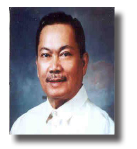
District Engineer Mario D. Villena turned-over the facility to Municipal Health Officer Dra. Myrna C. Trongcoso. The ceremonial turn-over was also attended by the Municipal Administrator Renato Esidera, Municipal Engineer Carlito Danque, Municipal Planning and Development Coordinator (MPDC) Engr. Norman Camposano and Municipal Health Office personnel.
DE Villena disclosed that P14.8 million was earmarked by Department of Health (DOH) for the construction of the said health facility.
“The construction of this facility is part of DPWH commitment to build necessary infrastructure to improve the precision of health care services in Catarman,” said District Engineer Mario D. Villena.
The Rural Health Unit building with a total area of 460.17 square meter includes provisions of 24-hour birthing facility and a function hall sufficiently ventilated for patient consultation and other basic health services.
MHO Trongcoso expressed her excitement that they can now occupy to a bigger and sturdier building.
This newly built facility will augment efficient and upgraded health services in the municipality with 55 barangays catering more than 100,000 population. (ANALIZA A. PABIA /PR)
CLEMELLE L. MONTALLANA,DM, CESE ASSOCIATE PROFESSOR III
“This is a story of our changing planet, and what we can do to help it thrive…” -Sir Richard Attenborough
As the year ends and another year slowly comes, it would be wise not to look for what Santa brought to us. It would be wise to look into what the future offers. Amidst the opening of the economy and the ebbing down of Pandemic realities, it is imperative that we look into that often overlooked pandemic of sorts, plastic pollution.
Marian Bigum, Circular Economy Specialist at Asian Development Bank wrote “Plastics are a key global material and an important part of the global economy. However, plastics present considerable challenges, including high waste generation, low recycling rates, and climate gas emissions from production and waste disposal.
Greenhouse gas emissions from plastics are rising not only because of increased consumption but also because plastic waste is incinerated, releasing the embedded carbon to the atmosphere in the process. The Center for International Environmental Law found that given the present trajectory, plastic alone could consume 10%–13% of the 2˚C scenario global carbon budget in 2050. The Global Plastics Outlook: Economic Drivers, Environmental Impacts and Policy Options (Organisation for Economic Cooperation and Development, 2022) estimates around 460 million tonnes of plastic waste were generated in 2019, corresponding to 1,800 million tonnes of CO2-equivalent.
The United Nations Environment Programme said it more straightforwardly “While plastic has many valuable uses, we have become addicted to single-use plastic products — with severe environmental, social, economic, and health consequences.
Around the world, one million plastic bottles are purchased every minute, while up to five trillion plastic bags are used worldwide every year. In total, half of all plastic produced is designed for single-use purposes – used just once and then thrown away.
Plastics including microplastics are now ubiquitous in our natural environment. They are becoming part of the Earth’s fossil record and a marker of the Anthropocene, our current geological era. They have even given their name to a new marine microbial habitat called the “plastisphere”.
The worrying effect would be this, in the long run, the world will choke, and natural flow and water circulation will be hampered, and the same could create problems for Earth’s Homeostatic and systemic well-being. In layman’s terms, the Earth’s arteries and veins are clogged by the arteries and plastics are the cholesterol that hampers systemic functioning. Given the nearly indestructible state that they are, the fight is arduous as it is nearly impossible to win.
As the new year comes, let us all be reminded that every time we wantonly throw plastics in single use or other forms we are contributing to the demise of the planet. Yes, it would not come soon but our children and the next generation of Earthlings would curse our generation of plastic addicts.
Let this be our crucial reminder, the Earth is choking in plastics . We can cover our nose for a minute or two and we shall know how bad it is!
THAT’S right! If we are truly and consistently Christian, fear would have no place in our heart other than that wonderful gift of the Holy Spirit himself that is the fear of the Lord, which is a healthy kind of fear. The fear of the Lord is the fear of offending God that would lead anyone to prefer to die for Christ rather than to sin.
We are reminded of this truth of our faith in that moving story of the first disciple to be martyred, St. Stephen, whose feast is celebrated the day after Christmas. He was martyred purely out of envy—some men could not stand the wisdom and the spirit with which he spoke in their debates. (cfr. Acts 6, 8-10.54-59)
With Christ, we really would have no reason to fear, nor to wallow in worries, anxieties and sadness. Christ himself has reassured us in this regard: “In the world you will have tribulation. But take heart; I have overcome the world.” (Jn 16,33) Let’s also remember that these unfortunate states are fertile ground for the enemies of our soul, especially the devil, to take advantage of us.
About the only reason to fear, worry and be sad is when we lose our faith, when we lose touch with God. We have to pray and pray so that our doubts and fears would not undermine our faith.
What also helps is to develop a sporting attitude in life, because, to be realistic about it, we will always have frustrations, disappointments, mistakes, failures, sins and defeats in our life. But we just have to learn how to move on, just like a good sportsman.
We should always be cheerful in life, and strive to show it even externally with smiles and happy, warm and encouraging dispositions. Even in our grief and mourning, we should manage to learn how to be serene, knowing that suffering and death have already been redeemed by Christ and are now endowed with redemptive power.
Let’s not waste time and energy by falling into the grips of fears, worries and sadness. When we notice that we are having some languid moments, it can be a sign that our faith is not working, and that we are succumbing to the laws of the flesh and the world, if not, to the tricks of the devil.
Especially in our dark and difficult moments, which these days are not anymore uncommon, when we feel so miserable that we can think that we have been deserted by God, we need to react immediately and reassure ourselves strongly that God never fails us.
It might be a good idea to rally the power of our faith that tells us that God takes care of everything. There is really nothing to worry even if we are made to suffer, since that suffering, if united to that of Christ, becomes something purifying and redemptive not only to oneself but also to everybody else.
It might be a good idea to come up with the different arguments of our faith to buoy up our drooping spirit that is weighed down by our many challenges in this life. God is a God of mercy and compassion. He will take up all our suffering more than us bearing them ourselves alone.
We really have no reason to fear. If ever it comes as a spontaneous reaction to some situations, it should not be allowed to stay with us for long.
Basic energy in the form of renewable energy project has been conceived by the Alternergy Holdings Corp. in collaboration of listed Basic Energy Corp. has started assessment energy from wind power.
It was learned from the Alternergy chief technical director that the corporation has recently installed an 80-meter tall meteorological mast in Alabat, Quezon province intended”. . .to measure the wind resource in the area. The mast “will validate the strength and capacity of the wind resource over the next two years. ”The Alabat meteorological mast “has more than seven meters per second average wind speed, similar to the wind resource in Rizal province where the corporation has a 54-megawatt (MW) Pililla wind farm is located.”
“Aternergy aims to develop up to 1,370 MW of additional wind, off-shore wind, solar, and run-f-river hydro projects in the next five years”, per its Chairman.
On the part of Basic Energy, “. . . in a stock exchange filing, said wholly owned subsidiary Mabini Energy Corp. has officially commenced the wind resource assessment campaign after successfully installing and testing the meteorological mast facility at Mabini, Batangas for its potential 50-MW Mabini wind energy project.” Furthermore, it was learned that “a favorable one-year period would lead to the micro sitting process to determine the wind turbine locations, as well as its design. ”Also, Basic Energy management has allotted P6.35 million to explore areas for wind power development, and to deliver energy to the grid by 2027.”
MY COMMENTS:
May I suggest to both Alternergy and Basic Energy corporations to explore areas further south in the Visayas particularly Eastern Samar’s Guiuan coastal town.
ooo000ooo NEXT TOPIC : “Local Salt Industry revival pushed” SHARE S & T THOUGHTS through E-mail: drpacjr@yahoo.com.
I honestly lost my temper on the 25th day of December, a Christmas day. It’s not that I have high-blooded or high sugar. Something had just provoked me. It’s quite inappropriate, but my accumulated anger had caused me to rather flare up against somebody, or against a system or practice.
You see, for many years now, our subdivision has been neglected, I would say, by the garbage collectors. Garbage trucks used to come to collect our trash, with a fixed schedule every week; but that was several years ago. This time, drivers of said trucks no longer regularly enter our subdivision for the purpose. It’s very rare, and very inconsistent, too. Now you see them, now you don’t.
They have assorted reasons to cite when confronted: the road leading to our place is badly damaged; the road is very narrow for their big truck; they can’t pass through because some cars are parked at the sides; the residents are not usually ready with their garbage bags, etc. While some of these reasons may be true, they also prove to be just alibis.
Occasionally, they do come. But they do not consistently do it. They just stop at a certain point near the subdivision entrance and do not go inside the subdivision proper. So many homeowners do not know if they are around or not. In the past years, garbage trucks would come as scheduled, and once inside, they announced their presence by sending some of their men to the streets inside, shouting out to residents that they were collecting the garbage.
The present collectors do not do it, reasoning out that it’s the homeowners’ job to watch out and wait for their coming, as though waiting for them is the only job of residents. It seems as if they are happier if some obstacles block their way so that they would not have to come. They are just after justifying reasons that could explain their failure to come.
Fed up by this attitude, some homeowners have just hired a man who could collect the garbage using his old tricycle. Each household pays him a certain amount every month. This we did since the official garbage collectors from the city are not doing their job as they should. Too bad, but every year-end or new year, the city residents in subdivisions are obliged to pay for garbage collection in the city hall. We are paying for it, yet we are not able to avail of their services. We then have to pay doubly—to the city garbage collection services, and to the guy who collects our garbage for real.
Last December 25, the garbage truck came to our subdivision and parked somewhere. Then members of their group went from house to house trying to collect the residents’ garbage with loud announcements. But besides the garbage, they were also collecting money from the residents as their “pamasko”. When one of them came to our house, I lost my temper.
“So you just come when it’s time for you to collect “pamasko”, but through the rest of the year, you do not show up!” I half-shouted angrily.
Well, I was just acting from instinct. I guess you would feel the same anger if you were in my shoes. It just heated up and accumulated through these past years.
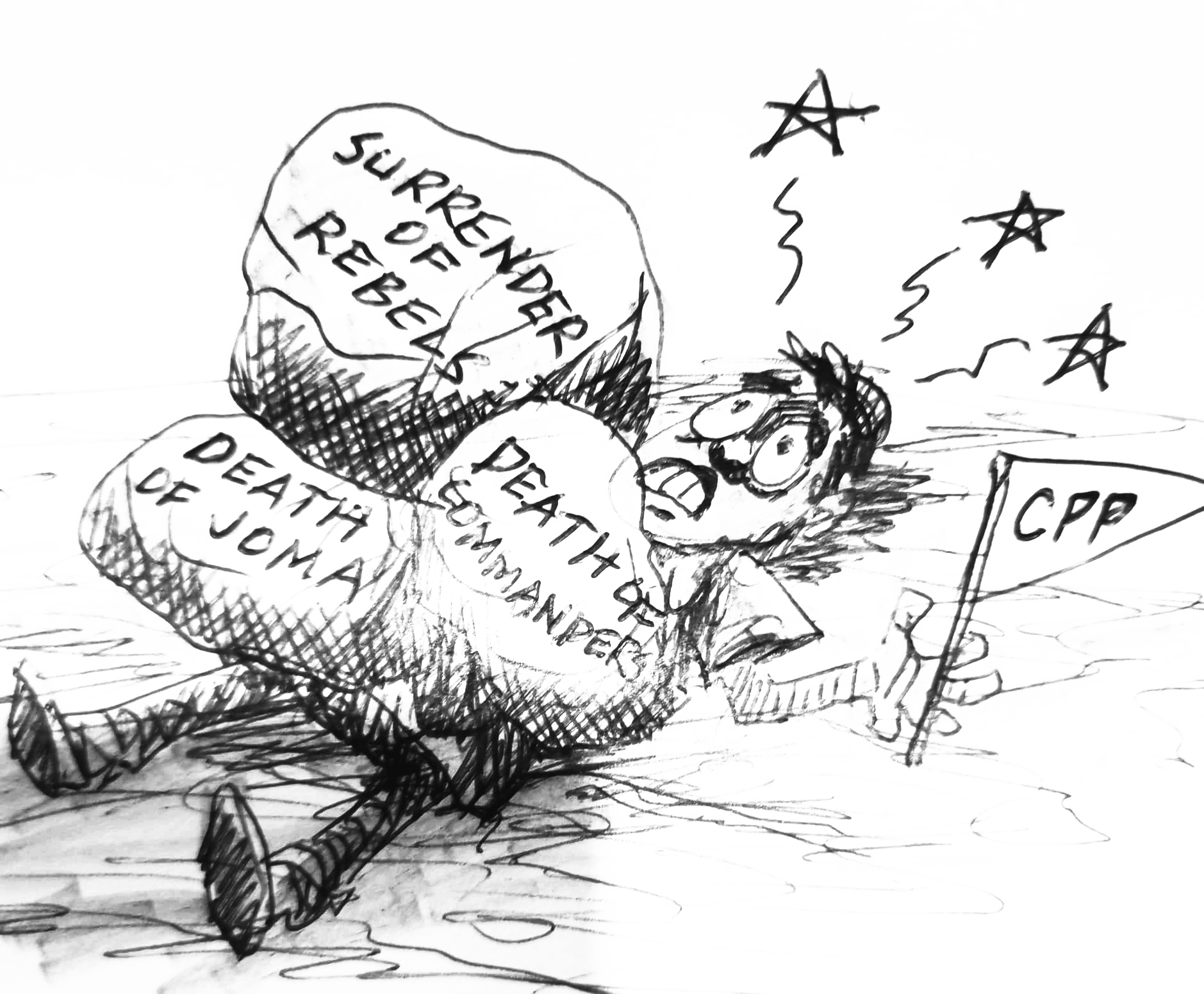
As of this writing, on the 26th of December, the Communist Party of the Philippines (CPP) and its front and allied organizations were supposed to celebrate its founding anniversary. This year, however, it’s going to be a lot different than their past anniversaries which they celebrated with fiery festivities.
Tree things could make the difference: first, numerous communist rebels throughout the country have already surrendered to the folds of the law; second, many of their key leaders have been apprehended and killed in combat; third, their founder-leader Jose Maria Sison has just died, leaving their organization without a smooth leadership transition.
Surely, these are great blows to their overall network. And although their old leader will soon be replaced, the other two blows are not easy to recover from. They would have to strengthen their recruitment and propaganda activities to bring back to their fold those mass supporters and leaders who have already abandoned their units. As to their commanders who have been killed in combat, there is no way they can recover their lives.
A fourth blow could still be added, which is the deployment to Samar island of some 400 combat-trained soldiers tasked to annihilate the remaining fronts, which are said to be the biggest number of remaining communist rebels in the country. Once these soldiers, fresh from a rigid training from Australia, are fielded to the mountains, they would face some elite troops.
Given all these, how can the CPP-NPA-NDF and their front/allied organizations celebrate their anniversary with a big bang? Instead of a jubilant anniversary, they might as well mourn over these things since, from the looks of it, these developments are rather demoralizing. The fact that they have been waging war for more than fifty years without winning it is the most demoralizing of all. It’s time to give peace a chance by ending this longest insurgency in history.