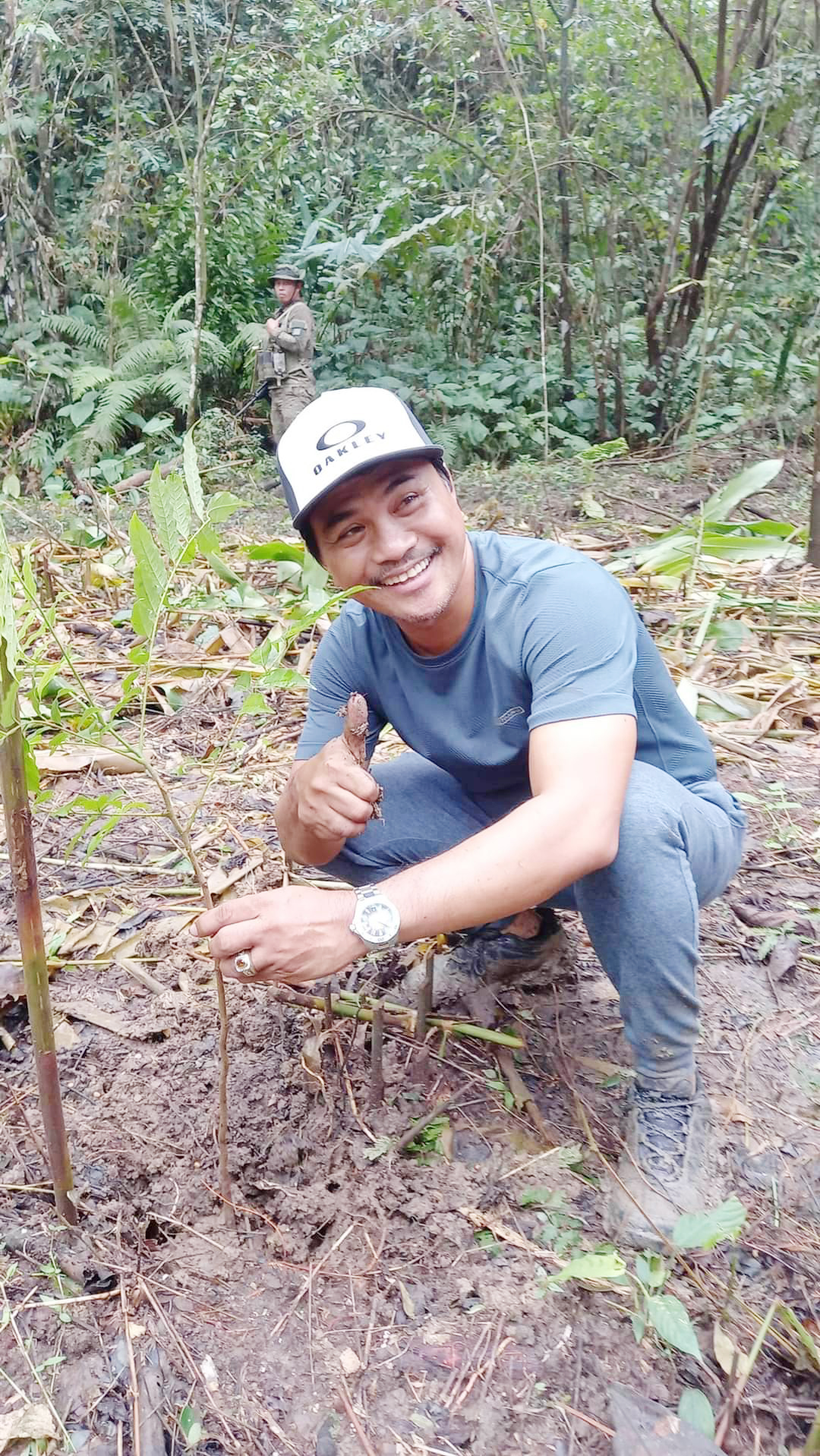
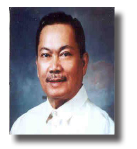
TACLOBAN CITY – A total of 5,100 tree seedlings were planted in various locations in Matag-ob town, Leyte, coinciding with the birthday celebration of its mayor, Bernandino Tacoy, last Saturday (Jan. 14).
Matag-ob Mayor Bernardito Tacoy
Tacoy personally planted 51 seedlings symbolizing his birthday.
The tree planting was held in watershed areas in the villages of San Vicente, Bulak, and Masaba II.
The tree planting was participated by personnel from the local government unit, barangay officials, academe, people’s organizations, and private groups like the AKHRO fraternity. (ROEL T. AMAZONA)
TACLOBAN CITY– A suspected member of the New People’s Army (NPA) from Negros Oriental and his companion were nabbed for alleged possession of firearms and explosives in Baybay City on January 8, 2023.
The suspects were identified as alias Sander, 20, and a resident of Pamplona, Negros Oriental; and a 22-year-old male from Zamboanga City.
Authorities chanced upon the two suspects, who were both carrying backpacks and other personal belongings while heading towards the mountainous area of Barangay Hilapnitan, Baybay City.
In the information released by Police Regional Office 8, the police operatives were in the area to conduct validation monitoring and information gathering on the alleged unidentified and suspicious personalities roaming around in the villages of Bunga, Caridad, and Hilapnitan.
Police confiscated from the suspects one unit of caliber .45 with two magazines loaded with eight pieces of ammunition, two suspected explosives, and two other pellet guns.
The inventory was conducted in the area with the presence of the officials of Hilapnitan, police said in the report.
During the investigation, police discovered that alias Sander is an alleged member of Lenovo Platoon in Negros Oriental.
Meanwhile, the second suspect’s identity was still subject to further verification.
The operating units include intelligence operatives of Baybay City Police Station, Leyte Police Provincial Office-Provincial Intelligence Unit, First Leyte Provincial Mobile Force Company, and Leyte Provincial EOD-K9 (Leyte-Pecu). (RONALD O. REYES)
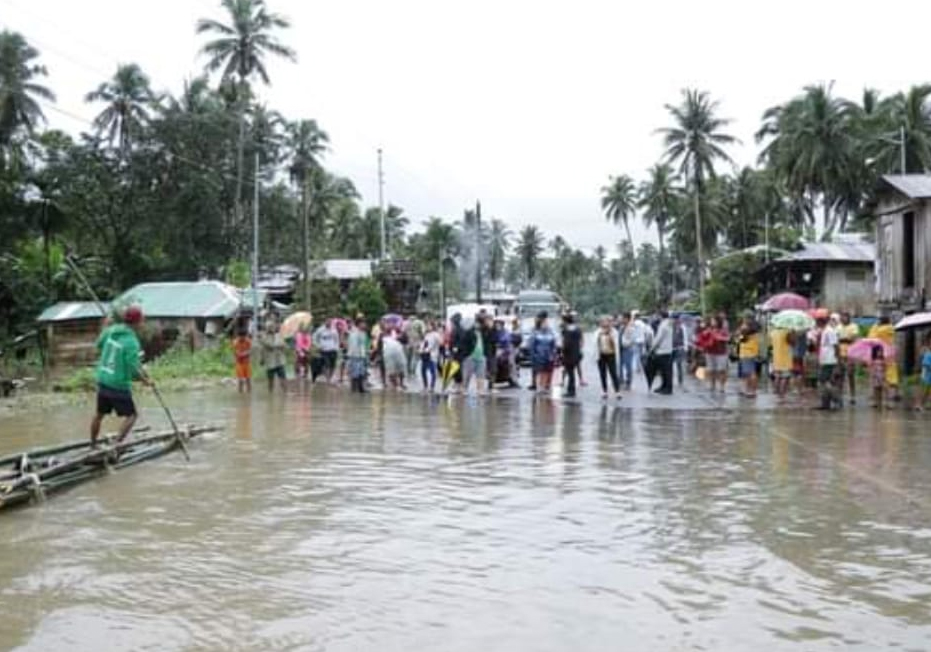
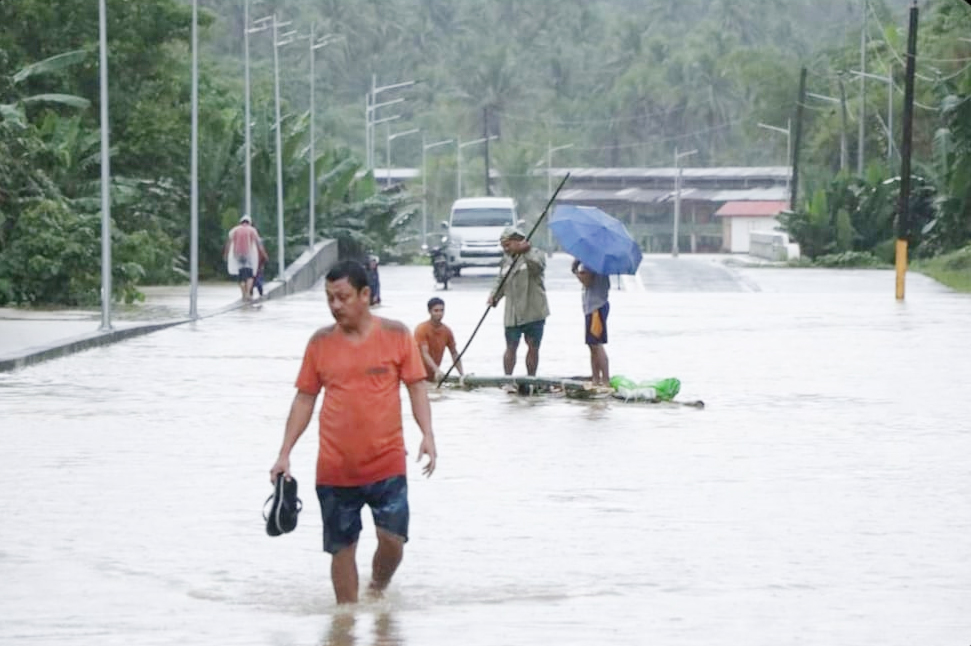
With widespread destructions due to the incessant rains spawned by a low pressure area, several areas affected by the calamity were placed under a state of calamity like the entire province of Eastern Samar and Calbayog City. Photo shows flooding in Tinambacan District in the said Samar city. (CALBAYOG MAYOR’S OFFICE)
TACLOBAN CITY– The province of Eastern Samar was placed under a state of calamity on Thursday (Jan.13) due to the destructions it suffered due to the flooding and landslide incidents spawned by a low pressure area and the shear line.
The declaration was based on the recommendation of its provincial disaster risk reduction management council through a resolution and approved by Governor Ben Evardone.
With the declaration, the provincial government could make use of its quick response fund to provide assistance to the affected families and repair of damage infrastructures, it said.
The city government of Calbayog also declared a state of calamity on Friday claiming it sustained severe damages to its crops in the amount of P7.18 million and displacing 9,317 families due to flooding.
Based on the resolution, the inclement weather which Eastern Samar has been experiencing since December 24 of last year, has resulted to the destruction of various public roads and bridges across the province in the amount of P18 million while its agriculture sector, notably palay, sustained damage with an equivalent cost of P208.70 million.
The resolution also said that the incessant rains caused by the LPA and shear line also resulted in the deaths of three people and six others still missing.
The casualties were from the city of Borongan, two and one from San Julian town.
Meantime, the missing persons were from Dolores (3); Sulat (2); and one from Quinapondan.
Two persons, who were earlier declared as missing, one each from the towns of Quinapondan and Giporlos were rescued in Surigao and Southern Leyte, respectively.
Gov. Evardone has earlier called for assistance for the flood victims.
The Diocese of Borongan has also appealed to the public to provide help to those who were affected by the natural calamity.
“Some towns in Eastern Samar are affected by extreme flooding due to heavy rainfall. The families from the affected areas are in need of lifesaving supplies such as food packs, drinking water, and hygiene kits. Its time to help,” it said.
Out of its 22 municipalities, 18 were affected by the nonstop rain including its provincial capital of Borongan City. (JOEY A. GABIETA/ROEL T. AMAZONA)
WHAT is Pharisaical legalism? At bottom, it’s the understanding of law that is based only on our human ways, ignoring the ultimate basis of law who is God as revealed fully in Christ. As such, it tends to be rigid, to be quick to judge and to claim it has the last word in any issue or question.
We are reminded of this danger in that episode where Christ was confronted by some Pharisees because his disciples were picking heads of grain while passing through a field on a sabbath. (cfr. Mk 2,23-28) Christ had to correct them about how the sabbath law should be taken.
We certainly should always be guided by laws. We should just see to it that our human laws are properly based and oriented. And given our limitations, not to mention our errors and sins, our human laws should also give due allowance for this unavoidable fact of life.
Truth is our laws should reflect the law and order as designed by God the Creator for the whole world and for man, specifically. They should respect and in fact reinforce what God has given as the law of nature and the moral law that governs our human acts.
But, alas, we wonder whether these things about natural law and moral law are given due consideration these days. What we can notice is a steady drift toward what is called as legal positivism.
Legal positivism is when our legal and juridical systems are simply based on perceptual experiences and people’s consensus while systematically shutting out any input from faith and divine revelation that tells us that God is in fact the very foundation, inspiration and perfection of our human laws.
In other words, without any reference to God’s law, our human law cannot help but be out on a limb. For all the brilliance, wisdom and success a Godless human law can have and accomplish, it can only go so far. It cannot go the distance required by our human dignity. Sooner or later, it will fail and fall into forms of injustice, many of them so subtle that injustice can be committed under cover of our human law.
A clear example of this latter case is the law on abortion. It is a lot worse than the so-called extrajudicial killing. Abortion is clear murder of the most defenceless members of our human society—the infant while inside the mother’s womb.
Of course, rationalizations can come aplenty. It’s not yet a baby, they say. It’s just a bundle of tissues. It does not have life on its own. But no one can contest the fact that that so-called clump of tissues has the DNA of the parents, and that it cannot but be a living baby if it is allowed to develop to its full course and no problems and complications come along the way.
The Bible has many passages that the unborn is already a child, a person, chosen by God, etc. The Book of Jeremiah, for example, says: “Before I formed you in the womb I knew you, and before you were born I consecrated you. I have appointed you a prophet to the nations.” (1,5)
And to be more blunt about it, precisely Christ before he was born was already the Son of God who became man to redeem us! Could Mary and Joseph have thought of aborting the unborn Christ because they thought he was just a bunch of tissues while still in the womb?
CLEMELLE L. MONTALLANA,DM, CESE ASSOCIATE PROFESSOR III
Sunday morning on the 15th of January was a day like no other.
The people are upbeat to the chances of the Miss Philippines competing in the Miss Universe happening at New Orleans.
Celeste Cortesi, a Filipina -Italian Model was trending in the internet.
Experts, predicted her reign from the favorability of analytics.
From Darna – inspired national custume and a vibrant, full of life smile to the sure gait and poise.
As the pageant progressed snd the installments announcement if which she never made the cut, the mood prevailing in this hemisphere , proved to be humid ,hot and angry.
Ms Philippines was a big , big persona here and her inability to get to the round of 16 was anticipate.
Twitter Trends # Celeste but her numbers were down and thus, not part of the last country.
Last country to barge into the 16.
We were sad and you can hear the anguish cries of the neighborhood homes watching the pageant.
Faced with that reality, we switch off the gadgets and soldier on with life, sans the glorious Ms Universe title, we learn to expect.
But there are Morals and take aways.
We were witness to the adjustments employed by the qualifiers.
India and USA were family oriented and creating community involved lives.
The fashion designer in the would be Ms Universe, Miss USA should a community based tailoring and fashion scene.
The Social Workers were abundant in the Top 16 with 3 contestants.
The pageant had shown that socially relevant back story and committed self-less candidates are sure winners.
In the end, I saw the best trait of Ms Universe Pageants its not just about beauty, its about Purpose.
And that must be the REBOUND that I was looking for, from the vanity and the glam, we saw the Social Relevance of this Pageant Frenzy.
I will watch it again next year and may the best lady win, not just the most beautiful, but the most relevant beauty wins.
A rosier report from the Philippine Statistics Authority (PSA) projected the higher palay production for the 3rd Quarter of 2022. Accordingly, the production of unhusked rice (palay), grew by 2.2 percent, not taking into account the destruction by Super typhoon Karding’s impact since its landfall on September 25th that castigated Luzon’s 6 agricultural regions. Worst hit was Central Luzon where the country’s rice granary Nueva Ecija is located.
The PSA data showed that palay production in July to September based on standing crop as of August 1 pointed the increase to 3.83 million metric tons, a bit higher than the 3.75 million MT in the same period in 2021.
Harvest from rice field area is forecast to increase by 1.7percent from 912,660 hectares to 928,200 hectares, and yield on per hectare up by 0.5 percent from 4.11 MT to 4.13 MT.
However, the harvested area based on standing crop, decreased by 2.3 percent to 790,470 hectares from 809,270 hectares, but yield per hectare increased by 6 percent from 2.83 MT to 3 MT. Also, the “PSA reported that about 276,516 hectares or 41.6 percent of the updated standing crop had been harvested. And, that 21`3,760 hectares, or 27 percent of the 790,470 hectares of the planting intentions have been realized. The production stood at 658,480 MT.”
MY COMMENT:
The PSA data on a 2.2 percent increase in unhusked rice or palay recorded in the 3rd quarter of the current, while a positive indicator to the PBBM’s aspiration to increase rice production, is still way below to what the country needs for its ballooning population. The Filipinos relatively high rice level consumption is driven by its belief that rice provides the needed energy to meet the demands of their daily work. ooo000ooo NEXT TOPIC : “Batangas LGU fights ASF assisted by DOST” SHARE S & T THOUGHTS through E-mail: drpacjr@yahoo.com.