The Meat Importers and Traders Association (MITA), has written President Ferdinand Romualdez M. Jr. (PFRMJr), through the Department of Agriculture (DA) undersecretary Domingo Panganiban, appealing for the president to issue an Executive Order (EO) “to further lower tariffs on pork imports for another five years to help address rising inflation and food security concerns.” Specifically, the EO requested will further reduce the import duty rate on pork at 5 percent in-quota and 15 percent out-quota for 5 years.
MITA was quoted saying “Since the conditions surrounding the issuance of EO 134 persist, we believe there is no need for DA to petition the Tariff Commission anew.” EO 134, signed by then President Duterte in May 2021, provided that in-quota pork imports or those under the minimum access volume (MAV), are slapped with a 10 percent tariff for 3 months and increased to 15 percent in the remaining months. This is lower than the original rate of 30 percent. The EO was issued amid spread of African swine fever (ASF) and the adverse effects in pork supply then.
Likewise, EO 171 was then signed last May 2021, which extended the 15 percent in-quota and 25 percent out-quota tariff rates for pork until Dec. 31 that year to bring down prices and stabilize the supply of pork in the country.
MY COMMENT:
I think that PBBM was being reasonable to have kept the headship of the DA given the multifarious problems inherited from the Duterte administration. The mandate of DA is crucial to the economy and lives of Filipinos which need 24/7 management. My 1 cent suggestion is to de-load the agency from functions that includes the aquatic resources management – create a Department of Fisheries.
ooo000ooo NEXT TOPIC : “ADB approves $3.8 Million to protect Phil. Coral Reefs” SHARE S & T THOUGHTS through E-mail: drpacjr@yahoo.com.
IN our liturgical celebrations, we can either be lavish or austere depending on the circumstances. What is important is what is in our heart—whether there is real love or not, whether there is a sincere effort to worship and please God or we are just making a show, whether we are making present the redemptive action of Christ or just playing games.
We are somehow reminded of this consideration in that gospel episode where Christ said that “there will not be left a stone upon another stone that will not be thrown down,” referring to the temple that was adorned with costly stones and votive offerings. (cfr. Lk 21,5-6)
Obviously, if our motives are sincere and our understanding about the liturgy is clear, we would really give the best that our capabilities can give. If we can give diamonds instead of just gold, then we would do it. We can never give enough to God. We can never be too extravagant in this regard.
But if all we can afford are just stones and pebbles picked up from the road, no problem. God looks at the heart more than the things we give him. And to God, there is no more precious thing than our heart if it is fully given to him. One good heart, faithful and full of love for God and others, is worth much more, infinitely more, than a world of precious gems.
What we have to avoid at all costs is hypocrisy in our liturgical celebrations. If we are really sincere in our liturgical celebrations, we will do and give our best. Even those little details of kneeling, genuflecting, singing and praying should be done in such a way that genuine piety can readily be seen. Such behavior not only would draw more graces from God but also would inspire others in their own piety.
I am happy to note that there is a marked improvement in the way our churches are built and furnished these days. The altars, the reredos, the ambos and the general interior decoration are being done in a splendid manner. The sacred vessels and vestments, the linens have, in general, improved in quality.
They somehow show the kind of faith and piety of the people in general, even if we also know that we still have a lot of economic difficulty around. They somehow show people’s knowledge of what truly matters in this life, what truly gives them eternal joy and not just a transient one. Their sense of beauty transcends the economic costs and all other sacrifices involved.
We just have to make sure that our liturgical celebrations are done with the proper dispositions. This is something that has to be studied and put into practice, since it is no joke to be involved in the liturgy properly either as a celebrant or a participant.
To be sure, the liturgy is not just some kind of dramatization. It is nothing less than the making present and effective of Christ’s sacrifice and his entire redemptive action. Both the celebrants and those who attend the celebrations should never miss this reality and should act accordingly. In the liturgy, everyone steps into the spiritual and supernatural world where Christ works out our redemption.
Again, this requires of us to have a deeply theological mind, where faith more than anything else rules all our human faculties.
I wrote this article in time when I was supposed to celebrate my birthday. So what do you think could its theme be? One of festive nature, right? Well, to some indeed, such a day is a time to enjoy—to “eat, drink, and be merry”, in celebration of another year that has been added to their lives.
For me, though, a birthday means so many things, depending on my stage of life. Basically, it has never been part of our family tradition to celebrate birthdays through some parties with invited guests, sumptuous foods, and lavish decorations. We were so poor to have such things. So in my younger years, a birthday was nothing but a day to remember. As a child, I would usually go to our house post and check if I had gotten taller based on my previous height markings.
In my teens, a birthday became a source of embarrassment, especially when it came during weekdays and some of my classmates would ask me to treat them to ice cream or the like that required me to shell out some amounts from my pocket that was oftentimes empty. I then tried to avoid such demanding friends every time my natal day came, even if it means skipping my classes in school.
When a meager and inconsistent income started to come my way, I then began to ‘celebrate’ my birthdays, but not the traditional way of again preparing a variety of foods and drinks with many invited guests. I would just do it with a close friend or two; we would eat somewhere, talking about topics of interest to us. Mine was just to mark my day with someone who could greet me in return. At least, someone became aware that it was my birthday.
To be quite honest, most of my birthdays in the past were never celebrated since it’s not really a big day for me. It’s just an ordinary day that I did not look forward to. In fact, there were times when I forgot a day was, after all, my birthday. Funny but other people were more aware than I was. I would just be surprised that somebody would greet me with a ‘happy birthday’.
But now that I’m getting older and nearing my senior years or old age, I am taking my birthdays more seriously. I am more grateful to God that a birthday comes my way, that I reach an advanced age, knowing that it’s only by his grace that I’m alive up to now. When I think of my younger years as a very sickly child, I could not help but wonder how I survived on many occasions without proper medication. There were times when I was bedridden, close to actually dying, but God spared my life in some miraculous ways, not because I am important—am just nothing and nobody—but because of his sovereign will.
This time, then, I look at my birthdays as an accumulation of God’s graces, provisions, and protection. It’s not a day to ignore, or set aside as unimportant. It is a solemn day to observe, contemplate, to thank God for. It means an added year to this life, a precious gift to reckon with, a token of God’s mercy. Hence it should be celebrated, not necessarily through lavish festivities, but through an open recognition of God’s faithfulness as the source and sustainer of life. A simple thanksgiving activity held with loved ones will do.
The massive demand nowadays for English teachers in non-English speaking countries who desire to learn the language results in the hiring of many Filipino English teachers to teach online. At first glance, this is to their advantage knowing that they get hired and thus earn an extra income. But if we will look at it closely, they are underpaid and are just exploited.
Leading among these countries is China, where the demand for English teachers is so great. Their schools actually prefer to hire native English speakers, for whom they pay much, in US dollars. But not contented seemingly, parents and students are still hiring private tutors to teach them the language. And for this, they prefer Filipino English teachers because aside from the latter’s good command of the language, they also make do with low salaries.
While the Chinese online schools have to pay 15 or more US dollars per hour to native English teachers, they spend 1 or 2 dollars per hour to Filipino teachers, who are compelled to accept the insulting salary for lack of job opportunities in the country. For sure, Chinese students are paying much to these online schools, but this does not translate to higher or least fair wages for Filipino teachers.
And so, as can be observed, these Chinese online schools that are catering to Chinese English learners have now mushroomed and multiplied, earning huge profits at the expense of poor Filipino teachers. Again, much as these teachers do not like the idea of being exploited, they have no choice but to work for these schools as such income is better than earning nothing at all or staying idle at home.
But in reality, such logic is unacceptable. Something is wrong in this system, and some culprits are at work and to blame. First, we condemn these online schools that are treating our teachers unfairly, and unjustly. Second, we blame our government for not doing anything about it when we know it could intervene, like regulating or accrediting these schools before they can hire our teachers for higher pay.
Globe Platinum, in collaboration with street artist Distort Monsters, has raised P450,000 for underprivileged breast cancer patients in a special charity art auction hosted by luxury cosmetics manufacturer Estée Lauder.
The brand participated in the inaugural version of The Pink Ball: Estée Lauder’s Charity Gala for the Breast Cancer Campaign’s 30th Anniversary, which gathered esteemed guests for a great cause.
The breast cancer campaign started in 1992 and has since evolved into a global movement dedicated to women’s health through life-saving research, education, and medical services.
One of the event’s highlights was “Monster in Pink,” a commissioned piece by renowned street artist Distort Monsters, an ambassador of Globe Platinum. “Monster in Pink” represents solidarity with all the brave individuals who have fought or continue to fight breast cancer.
Distort Monsters hopes that his work can give them the same solace they give him when coping with his own anxieties.
The special sculpture went from a starting bid of P60,000 to a winning bid of P450,000. The proceeds will be used to support the Philippine Foundation For Breast Care (Kasuso Inc.) in providing free mammograms to Filipino women in need.
“We are very thankful to Distort Monsters for the exceptional artwork. We are also grateful that Monster in Pink has rendered high value for art connoisseurs and allowed us to raise more funds for a good cause,” said Kaisie Del Carmen-San Pablo, Business Unit Head for Globe Platinum.
The charity ball raised a total of P9.8 million, surpassing its initial goal of P6 million. The amount will fund over 6,000 mammograms.
Globe Platinum’s participation in the Charity Gala is in line with Globe’s support for the Sustainable Development Goals, particularly SDG No. 3, which promotes good health and well-being for all.
More Distort Monsters art can be purchased by Globe Platinum customers by upgrading to the newest and latest innovation of the brand, the Platinum ONEPlan, which bundles together unlimited home fiber, mobile data, unlimited calls and texts, and VIP service. Customers can register via glbe.co/platminimonsterhead and be part of the raffle. (PR)
GUIUAN, Eastern Samar — Nine years after the deadly storm surge triggered by Super Typhoon ‘Yolanda’ (international name: Haiyan) flattened communities in Eastern Visayas, residents of a village in Guiuan town still feel anxious.
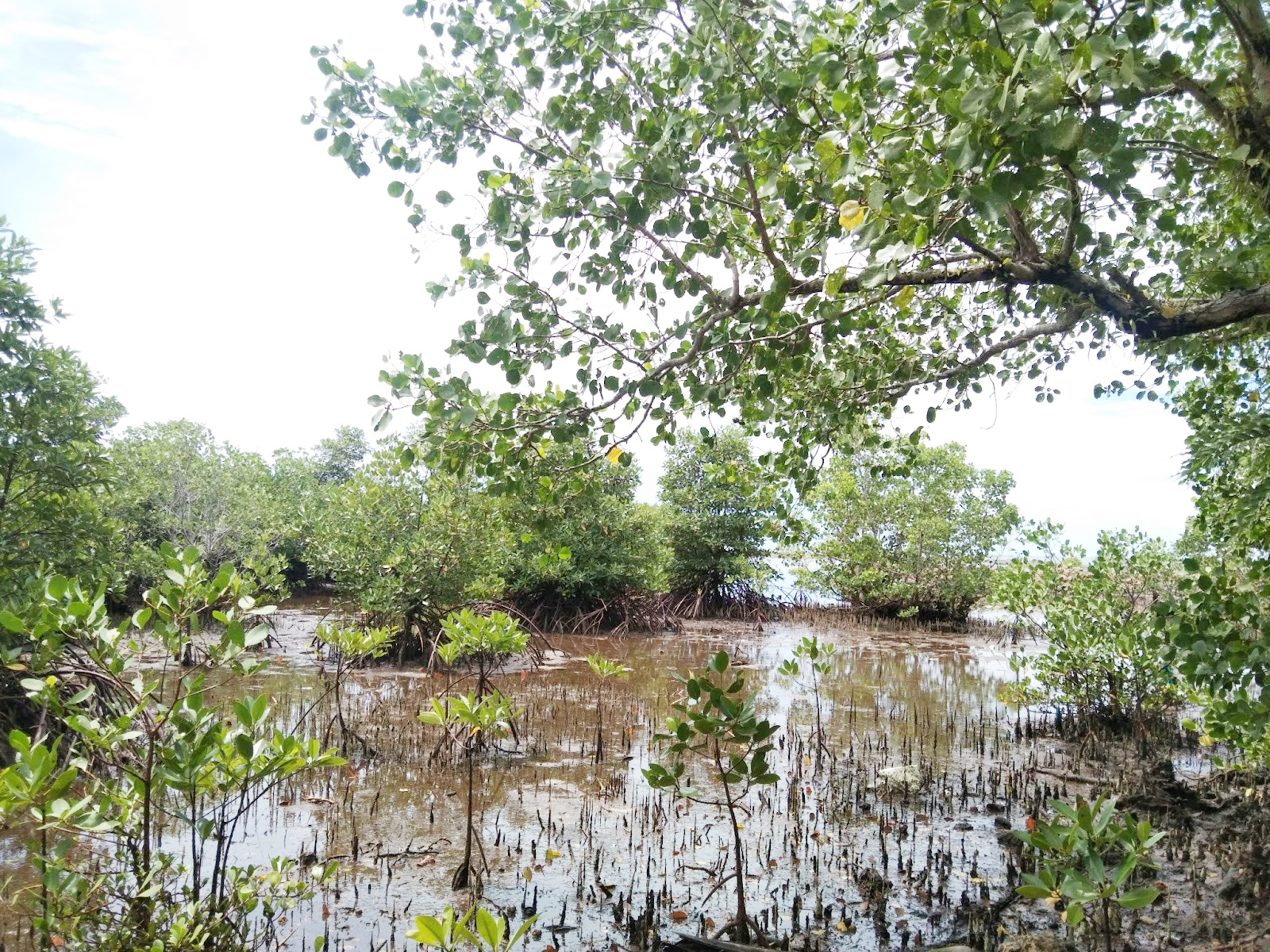
Mangrove trees in Barangay Bungtod, Guiuan in Eastern Samar. Photo by Aprille Ann Yodico
It is because the seawall in Barangay Bungtod that was destroyed by Yolanda in November 2013 remained far from fixed, exposing coastal communities to hazards.
“Yolanda’s winds were so strong and I could hear the waves crashing against the seawall since my house is just near the shore,” recalled Oscar Gaje, barangay captain of Bungtod.
Federico Paglinawan Jr., also a resident of Bungtod, said they saw more destruction when Typhoon Ursula (international name: Phanfone) struck Eastern Visayas in 2019 because the coastal defense remained damaged.
“Ursula brought us more water than wind so the houses near the shore were almost submerged,” he said.
In a bid to protect residents from waves and storms, coastal communities like Bungtod are engaging in mangrove restoration.
Successful restoration
Mangrove patches in Bungtod protected residents when Yolanda pummeled many parts of Visayas. Most of the mangroves near the shore, however, did not survive the onslaught. So community members have been planting and rehabilitating mangroves.
Mangroves in areas severely damaged by the super typhoon are now recovering. Gaje said that almost half of those living along the shore are growing seedlings, thanks to the different activities organized by the environment and natural resources office in Guiuan and non-governmental organizations such as SIKAT Inc.
“We help whenever there are activities conducted. It’s nice if we receive incentives after like the post-Yolanda cash for work, but without it we’ll still help because it’s for our community,” said Bernardino Tanqui-on, a father and resident of Bungtod.
Mangrove forests guard coastlines all over the world by minimizing losses of life and damage to properties. Mangrove forests cover roughly between 33 million and 49 million acres of the planet and are one of the world’s most productive ecosystems, the World Wildlife Fund said.
These coastal ecosystems prevent coastal erosion, improve water quality, and act as breeding ground of coastal species.
They also play a vital role in the climate fight. These trees can store carbon dioxide for hundreds— sometimes even thousands—of years, making them among the most carbon-rich habitats on Earth.
According to the Protected Area Management Office of the Guiuan Marine Resource Protected Landscape and Seascape, 104.39 hectares of recovered areas with planted seedlings have been mapped out as of 2020.
Mistakes in planting
On the other hand, residents of Barangay Sulangan, another barangay in Guiuan, are encountering problems with mangrove planting.
Angela Amos shared they had various mangrove planting activities post-Yolanda but the seedlings did not survive when planted close to the shore.
“Because they did not survive, we eventually stopped planting and just let them reproduce naturally,” Amos said.
Dr. Jurgenne Primavera, a marine scientist and mangrove expert, said the efforts were unsuccessful because “wrong species [are] planted in the wrong sites.”
“Planting at the seafront will not give us the mangrove area we need for environmental sustainability. For one, it has notoriously high mortality rates because the lower intertidal to subtidal location is not ecologically favorable,” Primavera explained.
Because of the lack of mangrove patches, the only source of protection of residents in the area is a seawall.
Barrier
Sulangan’s seawall stretches from the seafront area of the famous San Antonio De Padua Parish Church to the corner street of the households living close to the shoreline.
The residents are less anxious when cyclones are approaching Guiuan because of the seawall. However, it becomes a breeding ground for mosquitoes during rainy days due to trapped water and waste.
While seawalls lessen the damage of typhoons to homes and properties, residents of Sulangan still want their mangrove forests to thrive.
“Mangroves are home for fish and other sea creatures so we are still helping our community officials and our Bantay Dagat in protecting them,” Amos said, noting that residents monitor illegal activities and comply with policies such as the ban on mangrove cutting.
Residents of Baras, a neighboring barangay of Sulangan, do not conduct massive mangrove planting activities like Bungtod. But they disagree with the idea of building a seawall in their shoreline.
“It’s still up for discussion between the council and the residents. But yes, the fisherfolk already stated their dislike for seawall construction,” said Jim Abrajano, a barangay official.
Fishing is the main livelihood of Baras residents. Fishermen put their boats behind thick mangrove trees along their shoreline whenever there are typhoons in hopes that they will be protected by the mangroves’ roots and branches.
They expect the seawall will affect their lives and livelihood if it is constructed.
“We still have a lot of mangroves but I think a seawall ould also be a big help. However, if the majority of the people here won’t opt for it then that would also be okay with me. It’s their livelihood that’s on the line so it should not be taken lightly,” Remedios Gapate, a resident of Baras, said.
Coastal greenbelts better
Primavera, the chief mangrove scientific advisor of the Zoological Society of London and co-chair of the IUCN mangrove specialist group, said she is personally not for seawalls.
“What we need are coastal greenbelts,” she said.
“Guiuan specifically needs more beach forests because it has very steep shorelines, that’s why if the wrong species are planted they don’t survive,” Primavera added.
Primavera and Oceana Philippines earlier called for legislation that would create coastal greenbelt zones composed of mangroves and beach forest areas to protect coastal communities from the severe impacts of climate change.
In a report released this year, the Intergovernmental Panel on Climate Change said that while seawalls effectively reduce impacts to people and assets in the short-term, these defenses “can also result in lock-ins and increase exposure to climate risks in the long-term unless they are integrated into a long-term adaptive plan.
This story was supported by Climate Tracker Asia and Oxfam Pilipinas




MITA appeals for extension on importation of pork tariffs
The Meat Importers and Traders Association (MITA), has written President Ferdinand Romualdez M. Jr. (PFRMJr), through the Department of Agriculture (DA) undersecretary Domingo Panganiban, appealing for the president to issue an Executive Order (EO) “to further lower tariffs on pork imports for another five years to help address rising inflation and food security concerns.” Specifically, the EO requested will further reduce the import duty rate on pork at 5 percent in-quota and 15 percent out-quota for 5 years.
MITA was quoted saying “Since the conditions surrounding the issuance of EO 134 persist, we believe there is no need for DA to petition the Tariff Commission anew.” EO 134, signed by then President Duterte in May 2021, provided that in-quota pork imports or those under the minimum access volume (MAV), are slapped with a 10 percent tariff for 3 months and increased to 15 percent in the remaining months. This is lower than the original rate of 30 percent. The EO was issued amid spread of African swine fever (ASF) and the adverse effects in pork supply then.
Likewise, EO 171 was then signed last May 2021, which extended the 15 percent in-quota and 25 percent out-quota tariff rates for pork until Dec. 31 that year to bring down prices and stabilize the supply of pork in the country.
MY COMMENT:
I think that PBBM was being reasonable to have kept the headship of the DA given the multifarious problems inherited from the Duterte administration. The mandate of DA is crucial to the economy and lives of Filipinos which need 24/7 management. My 1 cent suggestion is to de-load the agency from functions that includes the aquatic resources management – create a Department of Fisheries.
ooo000ooo
NEXT TOPIC : “ADB approves $3.8 Million to protect Phil. Coral Reefs”
SHARE S & T THOUGHTS through E-mail: drpacjr@yahoo.com.