28.5 C
Tacloban City
December 31, 2025 - Wednesday | 2:46 PM
Home Blog Page 1166

In northern Salcedo, restoring mangroves is a community endeavor

0

SALCEDO, Eastern Samar — When Super Typhoon Yolanda (international name: Haiyan) wiped out much of the mangroves in Eastern Visayas, Oliver Layugan, a resident of Salcedo town, was filled with horror.
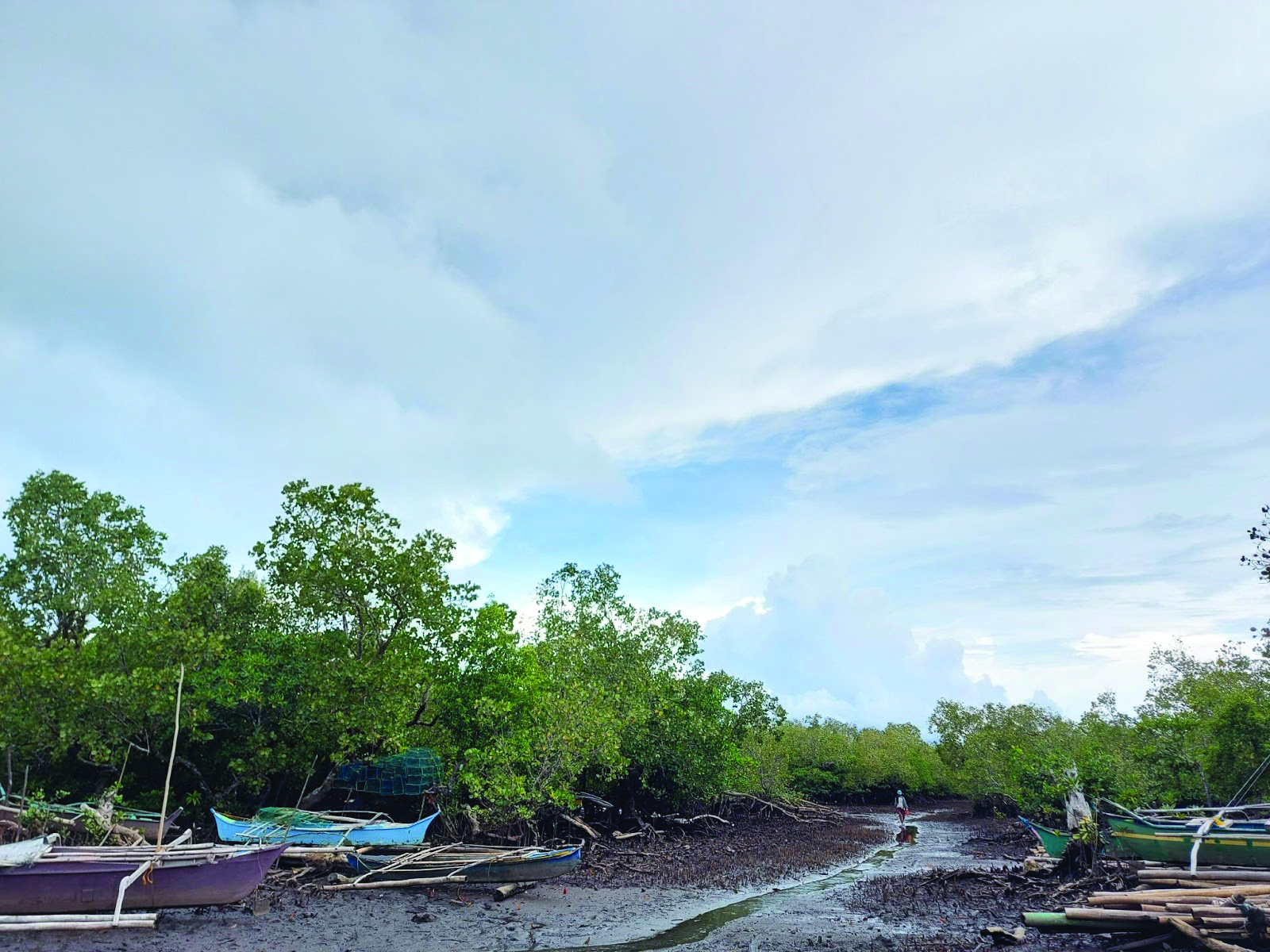
A wharf located in the middle of the mangrove protected zone in Barangay Caridad in Salcedo, Eastern Samar. Photo by Queene Tisha Dela Cruz)

“The [destruction of] mangroves after Yolanda was a lot bigger than I had expected… Huge mangroves were toppled down and drowned in mud,” Layugan said.

Some 5,163.06 hectares of mangrove forests were destroyed in the provinces of Leyte and Eastern Samar when Yolanda ravaged the central Philippines. According to the Global Mangrove Watch, 4,395.82 hectares of mangroves had recovered in the two provinces in 2020.

In the northern coast of Salcedo, mangroves have returned to their pre-Yolanda extent, save for some small patches, a study that calculated post-Yolanda mangrove damage and recovery using remote sensing found.

Over the years, the local government of Salcedo and private organizations have been working hand in hand to restore mangroves that protect coastal communities from storms and help in the fight against climate change.

Jessica Rojero, barangay captain of Caridad, said most of the mangroves in the village “are already recovered and in good condition.”

Community-based effort
In 2014, several organizations in Brgy. Caridad became beneficiaries of a program that aimed to restore mangrove areas and establish a nursery, which became a source of income for community members. Groups earn P10 for every mangrove seedling purchased from their nursery.

The barangay is also imposing fines and penalties to individuals who engage in the illegal cutting of mangroves in the protected zone.

“We are thankful that the community is participative and supportive in terms of these programs as well as for the active participation of the local organizations present in the barangay,” Rojero said.

Matarinao is also one of the barangays in northern Salcedo that reported good mangrove recovery. Residents there are active in reporting illegal activities, especially since mangroves are located in their backyards.

The Department of Environment and Natural Resources (DENR) introduced a family-based project where locals are paid annually by planting and nurturing 30,000 mangrove seedlings in the coastline.

Residents there applied the clustering method of planting, instead of the conventional straight line technique, claiming it has a higher success rate.

“A paradigm shift [is needed] as the government and most agencies define success at the start as present seedlings or hectares planted. Biological success should be defined at the end: What was the percent [of] survival? How many hectares have been created? And for that, we need monitoring,” said Dr. Jurgenne Primavera, a renowned mangrove expert in the country.

Locals said the rehabilitated mangrove areas in the northern coast of Salcedo do not only provide protection to communities but also sustain fisheries.

“Mangroves are important to us, especially those who live here in the coastline because it lessens the effects of the waves and the destruction to the community,” said Juny Natividad, a resident of Matarinao.

Lack of protection
On the other hand, large swathes of mangroves in the southern coast of Salcedo were still unable to recover nine years after the onslaught of Yolanda.

Allen Glen Gil, one of the authors of the study mapping mangrove damage and recovery in Eastern Visayas, explained that the largest damage was seen in the town’s southern portion because it was closer to where the super typhoon first made landfall.

Mangroves in the coastal barangay of Tagbacan are still recovering from the destruction caused by Yolanda, leaving residents concerned about the lack of coastal defenses.

According to the Municipal Environmental and Natural Resources Office (MENRO), parts of southern Salcedo’s coastal barangays have not yet recovered because of their geography. The frequent typhoons that hit the area also affect the growth of mangroves.

Restoration efforts usually fail when mangroves are planted in appropriate sites or when wrong species are planted. Rhizopora or bakhaw is commonly found in the area, even though it is not a good species for planting in some seafront or coastal areas.

“Why bakhaw? Because the propagules [are] quite big because if we plant avicennia marina and sonneratia alba you need a nursery. It is planted by convenience not by ecology,” Primavera said.

“Always remember the differences between the variety of mangroves and their locations. First, do not plant bakhaw on seagrass beds and mudflats. Plant pagatpat/piapi in the middle-upper intertidal and the LGU should monitor and report the percent of surviving mangroves rather than percent of target seedlings/area planted,” she stressed.

Tagbacan’s Sangguniang Kabataan Chairman Rexon Oguirra also said that illegal cutting of mangroves and the lack of community support also contribute to mangrove degradation in the area.

Wrong species
Barangay councils are still looking for ways to improve their mangrove rehabilitation programs and collaborate with other non-government organizations in implementing their future activities.

One of the major problems faced by the coastal folk is the lack of information dissemination on the proper ways of planting mangroves. The environment office of Salcedo said it trains residents to be knowledgeable on mangrove rehabilitation.

Primavera urged communities to try planting other species in areas where mangrove restoration endeavors have failed.

She added that the government should do an education campaign, implement a shift from paid labor to voluntary labor, and assist residents in securing forest management agreements and legal ownership of their mangrove areas in order for more people to appreciate mangroves and their ecosystem services better.

“I wish my people knew the reason why the air is so hot, why it is hard to catch fish in the nearby seas,” Layugan said.

“If the mangrove forest is fully restored, the extreme heat in the island can be lessened and we can be protected from the threat of typhoons,” he added.
This story was supported by Climate Tracker and Oxfam Pilipinas.

By: Queenee Tisha Dela Cruz and Dianuz Emstien J. Discar

400 cyclists bike their way to call for climate change mitigation

0

TACLOBAN CITY – About 400 cyclists joined on Sunday(Nov.6) the ‘Cycling for Climate Justice’ which calls local government units to provide bike lanes and more importantly help reduce carbon emission.

The cyclists, coming from this city and the nearby town of Palo, covered 31.5 kilometers that started at Balyu-an grounds, this city going to Palo town and back to Tacloban.

The route covered areas that were greatly devastated by the storm surge brought by Super Typhoon ‘Yolanda’, namely, the Anibong District in Tacloban where several ships were washed ashore that killed several residents, and the coastal community of Payapay in San Jose district, and to the coastal villages of Salvacion, Baras, and Candahug, all in Palo.

The cycling event was part of the activities that non-government organizations and local government units organized in relation to today’s 9th Yolanda commemoration.

Organizers of the event are calling for everyone to start being active in climate change mitigation efforts which the country had experienced in the wake of Yolanda’s onslaught.

They are also encouraging more people to try biking or cycling as alternative means of transportation to help lessen carbon emission and for local government units to provide equal rights to bikers in using roads.

They are also pushing for government agencies and LGUs to use bike in emergency response when motorbikes and vehicles are impossible to use.

The groups are also calling for rich countries to provide climate reparation to smaller countries that are now starting to experience the worst effect of climate change
The cycling event was organized by the OXFAM Philippines, Philippine Movement for Climate Justice, Firefly Brigade Inc., supported by the city government of Tacloban and the municipality of Palo. (ROEL T. AMAZONA)

Red Cross worker found dead in Catarman

0

ORMOC CITY– A Philippine Red Cross worker was found dead Sunday (Nov.6) in Barangay Galutan, Catarman, Northern Samar.

Police Lt. Col. Ma. Bella Rentuaya, regional information officer of the Philippine National Police, identified the victim as Jasper Marquez, 27, single, and resident of the village where his dead body was found in a grassy part of the village at about 7:30 am.

Rentuaya said that a report from the Catarman Police Station said that it was the village chairman, Elpidio Saliling, who reported the incident to the local police.

She added that based on the initial investigation conducted by responding police through an interview in the area with friends and relatives of the victim disclosed that Marquez was last seen about 1:30 early morning.

Rentuaya further said that a friend of the victim, Ernesto Pabia, disclosed that before the incident, he and the victim went on board on their respective motorcycle to Elyang Bar located at Bobon, also in Northern Samar to relax and have fun.

Pabia said that after consuming two bottles of beer they decided to go home and when they arrived at Catarman proper at about 1:30 am, the victim told him that he had to meet someone.

A thorough investigation is now being conducted by the local police to unmask those responsible on the gruesome murder of Marquez.
(ROBERT DEJON)

Unfortunate, unforgettable, yet unhealed

0
DR. CLEMELLE MONTALLANA

I simply cannot ignore the fact that as this coulmn see print, it will be the 9th year of that unforgettable calamity. Every pen pusher and pundit real and otherwise, would write and describe the said event. That era that similarly separated the Triassic to the Jurassic or the Normal Calamity to that of Yolanda.

Today i take cudgels and publish a real Story of a friend who happen to be a DOUBLE AMPUTEE, a person who had lost both feet due to a vehicular accident. His name is Rinbert Emmanuel Martinez , and this is a story of fortitude and hope;
Surviving Haiyan.

Day 1: As usual, Tatay and I woke up around 4am and had coffee. Heavy rain was already coming along with the strong winds. I woke up my wife and 2 children who were with us so we could pray the rosary together after we secured our windows and doors. But the ceiling was already leaking water that I told Tatay to go inside our room because it was the safest area in the house. Without turning his back he muttered: Don’t go inside the water is here already. I did not realize then that flood had came in as I was on my wheelchair.

I looked at our jalousie windows and saw the water level outside was already half of our house. Tatay didn’t seem to know what to do at this point and may have been shocked to see what was happening. So I took charge and asked Tatay to try opening the main sliding door, but it didn’t budge. I asked my 14 year old eldest son to quickly open the kitchen door so we could escape outside, it was also stuck. At that moment I was already thinking that this is it, we will all perish as the water level was now waist deep and I was already swimming leaving my wheelchair behind. The water was swirling around like the inside of a washing machine. As I looked and thought for ways to save all of us I looked up our ceiling and saw the manhole with its cover flown away. I pointed it to Tatay and told them to catch a table that was floating around and put a chair on it so we could escape through the ceiling.

I told my 8 year old daughter to go up first then my wife, my eldest son went up after his mother. Tatay didn’t want to go up as he was concerned knowing I won’t be able climb with them. I convinced him, that between us two he was more likely to survive and take care of my family after this. And besides, I told him, I can swim and I’ll just join them when the water reaches the ceiling.

And I did just that. We were up there from 7am up to 10am when the water subsided. I asked everybody to jumped down while the water was still waist level to cushion their impact. But when it was my turn to come down, I have to rappel down using the electric wire in the ceiling. Mud was knee-deep and everything inside our home were in shambles.

We didn’t know what to do, where to start cleaning and how. We were in danger of being cut from the debris inside as we didn’t have footwear, pun intended. We managed to open our main door but couldn’t get out since by now our surroundings were full of debris. So we just collected and salvaged food and drinkable water inside the house to help survive the uncertainty ahead. I managed to get out of home around noon time and saw for the first time the devastation brought by Haiyan.

I stayed outside for quite a while wondering if things really happened or was this just a dream, I even managed to slap myself to be sure that I was wide awake and sane enough to understand what just happened to us.

While outside I saw a lot of ‘zombies’ who didn’t know where to go, many were crying looking for loved ones some I know asked me if we all survived and I asked the same of them. Around 1pm I saw our mayor going down the debris coming from their residence near the airport, with him was his wife, their 2 daughters and a bodyguard with a canine tagging along.

I shouted to him and asked him how he was, he muttered tearily “Pareho pareho tayo”. As he went down the debris there was a military truck on stand by and he asked the soldiers if he can bring them to city hall, a soldier refused telling only that their orders was to proceed to the airport. The mayor told him, with all these debris no vehicle can go through to the airport. So the mayor and company continued walking in disbelief( I learned later that Roxas and Gazmin were just ahead in the highway island fronting Coca-Cola plant).

Sometime in the afternoon I saw in the distance my dear friends Ruel & Divina Latoja, in tattered clothes and mismatched footwear, coming out of San Jose district. They were with their children Aine & Dindin but minus the youngest baby Raphael. I learned that they lost their only boy as they cling for their lives to the only wall that was left standing in their home a mere 50 meters away from the seashore.

After a quick conversation the family moved along heading to the nearest relative to seek shelter and help. We decided to stay put for the day and spend another night at home because we didn’t know the condition of the rest of Tacloban City. Many neighbors shared our home, one of the few houses left standing in ground-zero, for the night and most of them were mothers nursing babies and little children.

Two beds in our room were dry as it probably floated during the flood, these became the sleeping beds for Tatay and my own family. Me, I stayed in the sala with the people who took shelter with us and slept on an old ‘baol’. Around midnight there was chaos outside and people were shouting: tsunami.
(to be continued next issue)

Toughness amid unavoidable scandals

0
FR. ROY CIMAGALA

YES, we have to be tough, with the toughness of charity, amid the unavoidable scandals in the world. Christ already warned us about this. “Things that cause sin will inevitably occur,” he said. (Lk 17,1) We should just be prepared for this condition in our life.

While those who cause scandals in others would be severely punished—”It would be better for him if a millstone were put around his neck and he be thrown into the sea than for him to cause one of these little ones to sin.” (Lk 17,2)—we should avoid reacting to these unavoidable scandals by falling into lack of charity.

If we have the charity that Christ commands us to live, we would know how to deal with these eventualities, willing to suffer and be patient while thinking of how we can help those who cause these scandals and those who are victimized by them.

As St. Paul said, true charity “does not rejoice over iniquity, but rejoices in truth. Charity suffers all, believes all, hopes all, endures all.” (1 Cor 13,7) It’s indeed a big challenge to live by that charity, but with God’s grace which we should always ask, we know that we can hack it.

What we should always do is to be most mindful of our words and deeds, because no matter how insignificant they may seem, we may already cause a scandal in others. And we also have to strengthen our defenses against scandals, so that instead of thinking badly, for example, of someone due to what we have seen or heard, we are ready to understand and help.

And scandal need not be in the sexual department only which is already a grave sin. It may only be a matter of gossip of any kind, as long as we cause another person to sin by thinking badly of someone or by leading him to have some critical thoughts, mental reservations, rash judgments, etc.

Of course, we have to distinguish between the temptation of scandal and the sin of scandal itself. Temptation is only temptation and is not yet a sin because we have not yet consented to it, though we may already be attracted to it. The sin of scandal is when we consent to the temptation and, worse, when we enjoy it and spread it around.

What we should always realize is we have a duty, as Christians, to always give good example to others. Not that we have to flaunt whatever good thing we have or do, doing some kind of virtue signalling, for Christ clearly said also that we should not show off our good deeds before men, to be seen by them, lest we lose our reward in heaven. (cfr. Mt 6,1)

We have to be aware that we always have to give good example to others for the sole purpose of leading others to God. It is to edify others, to encourage them to be holy and to pursue the path of sanctity in an abiding way.

This duty, therefore, should be carried out deliberately. It should somehow be planned and aimed at. It should not just be something incidental or something optional. Of course, this duty should not be done out of pride or vanity, but out of obedience to the will of God who wants to save all men. (cfr. 1 Tim 2,4)

ADB: Food Security Fund for Assistance to Phil.

0
DR. PACIENTE CORDERO

The Philippine food security program will get much-needed boost with the Asian Development Bank (ADB) seeking a slice from the $14-Billion fund being allocated to help address the food crisis in Asia and the Pacific in 2022 till 2025.

The ADB director-general expects to present to the multilateral development bank’s board funding support to the Philippines food security program under the Competitive Agriculture Reform program started 2 years ago by ADB. The Bank’s management was quoted saying “:it is building on the Rice Tarification Act looking at the agriculture productivity in different parts of the country as a measure of food security.”

The $14-Billion being lent by the ADB is to help address the worsening food crisis as well as strengthen the country’s adaptation and mitigating efforts to climate change as it impacts in Asia and the Pacific areas. The worst scenario being to see its population “going hungry and falling into deeper poverty.”

ADB president emphasized on “factors contributing to the worsening food security crisis include supply chain issues from the pandemic, and the Russian invasion of Ukraine that has pushed food prices to record highs.” The situation had some countries in Asia and the Pacific to rely on imports of staples and fertilizers.

MY COMMENT:
Strongly suggesting for the Philippine government to study the mechanics on how to avail of the $14-Billion food security fund from the ADB. As regular route of natural calamities like typhoons, the Philippines has better chance of its food security program being favored by the ADB Board for approval.
ooo000ooo
NEXT TOPIC : “MITA Appeals for Extension on Importation of Pork Tariffs”
SHARE S & T THOUGHS through E-mail: drpacjr@yahoo.com.

Recent Posts

DALMACIO C. GRAFIL
PUBLISHER

ALMA GRAFIL
EDITOR-IN-CHIEF

ROMEO CEBREROS
OFFICE IN-CHARGE

OFFICE
BRGY. SONGCO, BORONGAN CITY

CONTACT NUMBERS
(055) 261 – 3319 | 0955 251 1533 | 0917 771 0320 | 0915 897 7439 | 0921 511 0010

DALMACIO C. GRAFIL
PUBLISHER

RICKY J. BAUTISTA
EDITOR

ALMA GRAFIL
BUS. MANAGER

OFFICE
RIZAL AVENUE, CATBALOGAN
(INFRONT OF FIRE DEPARTMENT, NEAR CITY HALL)

CONTACT NUMBERS
0917 771 0320 | 0915 897 7439 | 0921 511 0010

EMAIL
lsdaily2@yahoo.com

WEBSITE
www.issuu.com/samarweeklyexpress