The Inflation Rate (IR) in Eastern Visayas eased to 4.0 percent in October 2023 from 4.9 percent in September 2023. This makes the region’s average IR from January to October 2023 at 4.5 percent.
The regional IR was lower than the 4.9 percent national IR in October 2023. In October 2022, the regional IR was higher at 7.4 percent.
The downtrend in the regional IR in October 2023 was primarily brought about by the faster negative inflation in the housing, water, electricity, gas, and other fuels commodity group at -5.5 percent during the month from -3.4 percent in September 2023.
The heavily weighted food and non-alcoholic beverages commodity group, which registered an IR of 8.5 percent in October 2023 from 9.3 percent IR in the previous month, also contributed to the downtrend.
In addition, decreased IRs were also recorded in the following commodity groups during the month: Transport, 0.5 percent from 1.4 percent;alcoholic beverages and tobacco, 8.1 percent from 8.5 percent;clothing and footwear, 1.1 percent from 1.3 percent; Restaurants and accommodation services, 5.0 percent from 5.1 percent; personal care, and miscellaneous goods and services, 3.6 percent from3.7 percent; and health, 2.8 percent from 2.9 percent
In contrast, the following commodity groups registered higher IRs during the month:
a. Furnishings, household equipment, and routine household maintenance, 5.7 percent from 5.5 percent; and b. Recreation, sport, and culture, 2.2 percent from 2.1 percent
Relative to their IRs in September 2023, all provinces recorded lower IRs in October 2023, except Eastern Samar, which registered higher IR.
Among the provinces, Eastern Samar still posted the highest IR at 7.5 percent in October 2023. Samar’s IR came next at 4.6 percent, followed by Leyte at 4.1 percent; and Northern Samar at 2.9 percent. The lowest IR was noted in Biliran and Southern Leyte both at 2.2 percent.
Meanwhile, IR for Tacloban City, the lone Highly Urbanized City (HUC) in the region, was recorded at 3.0 percent in October 2023, lower than its 3.5 percent IR last month (Figure 3 and Table 5).(PR)
TACLOBAN CITY – The tourism sector in Eastern Visayas which was greatly affected by Super Typhoon ‘Yolanda’ a decade ago is now slowly recovering, according to the region’s tourism department.
Karina Rosa Tiopes, regional director of the Department of Tourism (DOT), said that due to Yolanda, people became curious about Eastern Visayas and what destinations they could visit.
The super typhoon, she added, was also instrumental in knowing how resilient the region’s tourism industry was despite the massive destruction it caused to the tourism establishments and facilities.
Based on the record of the DOT-8, of the 101 tourist accommodation facilities in 2013 that were destroyed due to Yolanda, only 43 had opened after the devastation of the super typhoon to cater to the needs of people working in non-government organizations that came to the region to help in the recovery and rebuilding efforts.
But 10 years after Yolanda, from 101 tourist accommodations, the number surged to 693 accommodation facilities operating in towns and cities affected by the super typhoon.
The number of travel and tour operators also increased- from 36 in previous years, the region also now has 22 regional tour guides, and 104 community tour guides.
Despite the devastation of Yolanda in the last quarter of 2013, the region managed to attract a positive gain of visitors’ arrival in 2014 with 964,000 or 31.7 percent higher than their record in 2013.
The number of tourist arrivals continued to increase every year, according to the regional tourism chief.
From 1.73 million tourist arrivals in 2019, it went down to 313,930 arrivals in 2020 mainly due to the pandemic of coronavirus disease (COVID-19).
But the number increased in 2021 with tourist arrivals recorded at 1.07 million in 2022.
The DOT expects higher tourist arrivals this year.
Tiopes, however, said that there is still much to be done for the total recovery of the region’s tourism sector and surpass its gains, and meet the goal of making Eastern Visayas one of the top tourist destinations in the country.
“I’m not afraid to say that we are still weak in terms of marketing because marketing is not only a task of a certain tourism enterprise, it’s not only the task of DOT, it’s not only a task of the local government unit,” she said.
“We should have a concerted effort. We should have one brand that speaks about us and identifies us, makes us unique from other destinations and we have to communicate this properly to our target market,” Tiopes emphasizes.
She added that aside from marketing, local government units in the region must also learn how to focus their marketing strategy to capture their target audience or tourists.
Local government units must also develop their tourism master plans to guide them in their development directions. (ROEL T. AMAZONA)
TACLOBAN CITY– A leading humanitarian and development organization has urged local governments in the country “to shift from reactive spending to a proactive approach by utilizing local calamity funds, also known as the Local Disaster Risk Reduction and Management Funds (LDRRMF) effectively.”
“We cannot afford another Yolanda devastating people’s lives. We learned the hard way that the best way to reduce the impacts of a climate crisis is by preparing early for an imminent disaster,” Oxfam Pilipinas Executive Director Erika Geronimo said.
The group’s call came as the country commemorated the 10th year of Super Typhoon Yolanda (Haiyan), which affected more than 14 million people across 46 provinces on November 8, 2013.
Citing their new study entitled “Local Disaster Risk Reduction and Management Fund Utilization Patterns and Opportunities for Improvement,” it said that local government units (LGUs) “tend to spend their 30 percent quick response funds (QRF) in response to actual disasters but are less likely to spend a significant portion of the 70 percent disaster preparedness and mitigation fund.”
It will be better if local governments proactively utilize their 70 percent mitigation/preparedness funds that do not require a declaration of State of Calamity instead of merely expending their 30 percent QRF when disaster strikes, it said.
The report cited the annual audit reports of the Commission on Audit, which pointed out a chain of delays from plan submission to liquidation of funds, resulting in the annual accumulation of unspent funds.”
“It added that this bureaucratic inefficiency means that a substantial portion of funds that could have been spent on enhancing community disaster preparedness remains unspent, resulting in fewer investments to address the disproportional impacts of disasters on vulnerable groups,” the humanitarian group said in a statement.
Oxfam Pilipinas reminded LGUs that they “must listen to the voices of communities and co-create solutions to reduce risks and impacts of disasters before they even happen.”
“We should ensure that our humanitarian response helps communities prepare for the next disaster,” Geronimo said.
Meanwhile, the group encouraged local officials to also “prioritize the nuanced and differentiated needs of women, girls, persons with disabilities, indigenous people, the elderly, the youth, and people of diverse sexual orientations, gender identities, expressions, and characteristics (SOGIESC).”
“Their active participation in all stages of decision-making ensures that any humanitarian response is appropriate and builds more resilient communities,” it said.
“Inclusive and community-based disaster preparedness, along with anticipatory actions such as pre-disaster cash assistance, are effective strategies to reduce the devastating effects of the climate crisis,” added People’s Disaster Risk Reduction Network Executive Director Esteban Masagca.
Oxfam Pilipinas and its partners maintained that anticipatory action programs “have influenced government policies and actions to act preemptively when predetermined triggers are met.” (RONALD O. REYES)
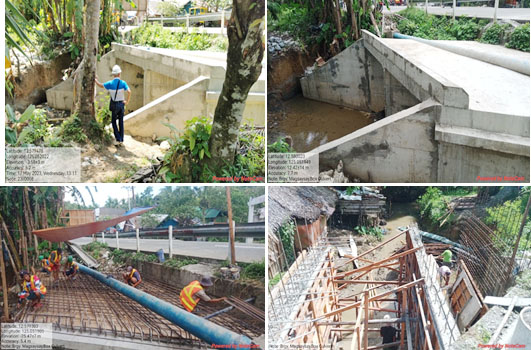
NSSDEO, Brgy. Burabud, Laoang, N. Samar– The Department of Public Works and Highways Northern Samar Second District Engineering Office (DPWH-NSSDEO), spearheaded by OIC-District Engineer Charlito S. Carlobos and OIC-Assistant District Engineer Arthur Eric L. Sabong, has completed the Construction/Upgrading/Rehabilitation of Drainage along Laoang-Calomotan Road, Northern Samar, which mitigates flooding and improve infrastructure resiliency.
The construction of drainage has a big impact to the travelling public, where the primary goal is to mitigate the risk of flooding during heavy rainfall and can enhance the resilience of infrastructure such as roads, buildings, and utilities. Additionally, this project can effectively manage stormwater runoff, the potential causes of erosion and waterlogged foundations. It can also lead to increased operational efficiency and decreased maintenance costs in the long term.
On the other hand, the completed project was supervised by Project Engineer Christian Dave Pangandoyon under contract with CDU Construction with a total contract amount of Php 2,910,475.74 million funded under DPWH-Regular Infrastructure Program of General Appropriation Act (GAA) of CY 2023. The scope of work involved the construction of 11.30 meters Double Barrel RCBC cross drainage at K0794+882.30 with Contract ID No. 23II0008.
This project will benefit road users traversing the Laoang-Calomatan Road and support positive impact of the economic activity in the area. The end-users of this project are rest assured that they can pass through even in times of rainy season by reducing the risk of floods and damage to property.
DPWH pursues its goal and objectives to provide resilient infrastructure and mitigate risks during devastating impacts of natural phenomenon affecting the livelihood and properties of the people located within the area. (RONEL L. GALUPO, PIO STAFF)
TACLOBAN CITY – The Samar State University (SSU) Deer emerged victorious in the championship battle against the Southern Leyte State University (SLSU) at the Eastern Visayas Collegiate Athletic Association Season 2.
SSU proves their superiority over SLSU with their 89 points making it difficult for Kingfisher to overtake the lead of the Deer ballers and settle with 71 points during the championship battle at the Tacloban Astrodome on Sunday (Nov 12).
Rogelio Tolipas Jr., was awarded the best player of the game award for his 22 points, eight rebounds, and seven assists.
He was SSU’s most valuable asset in the game that resulted for their team to be proclaimed as EVCAA Season 2 champions. He was also awarded as defensive player of the game.
As EVCCA Season 2 champion, SSU won P100, 000 cash prize, medals, and a trophy.
These were handed over to them by Commission on Higher Education chief education program specialist, Engr. Socorro Q. Ramos; chief administrative officer, Marcelo M. Uy; deputy secretary general for operations of Tingog party-list, Jonathan Calvara;and and EVCAA Commissioner Julius Ross Abuda Lacaba.
Chosen for the EVCAA Season 2 Mythical 5 were Tolipas and his brother Aj, along with SLSU Kingfishers Melvin Malatag, EVSU Eagles, Jose Maraviles, and NwSSU Lions, Hanson Menterola.
Menterola was also awarded as the EVCAA Season 2 most valuable player.
Meanwhile, Arron Espinas from the Mighty SLSU Kingfishers was awarded as EVCAA Season 2 Coach of the Year award. (ROEL T. AMAZONA)
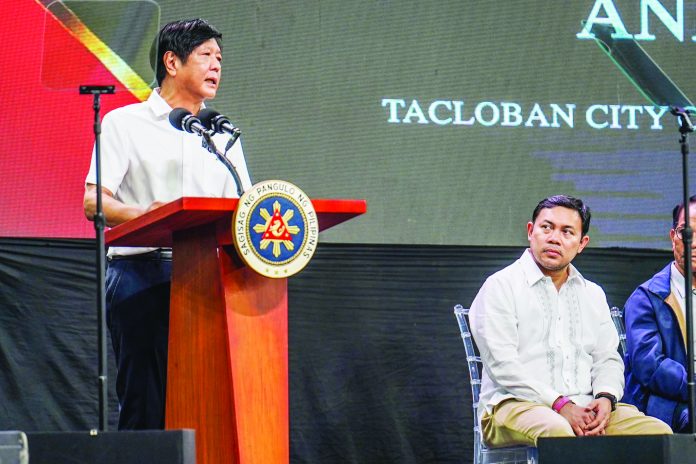
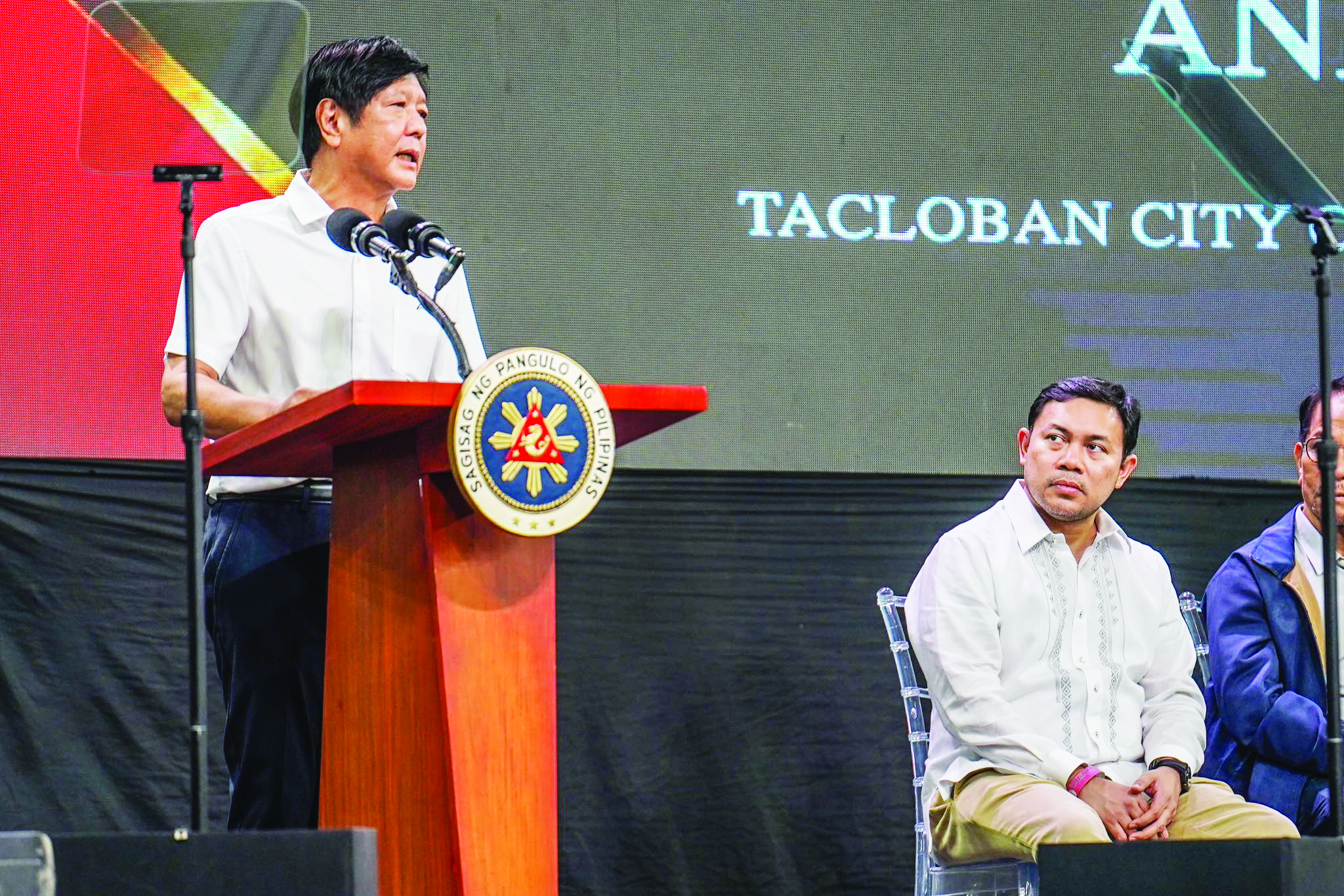
10th YEAR. President Ferdinand ‘Bongbong’ Marcos, Jr. graces the 10th year anniversary of the onslaught of Super Typhoon ‘Yolanda’ on Wednesday (Nov.8) with the commemorative program held at the astrodome, once home to thousands of people who lost their houses due to Yolanda. Among those present were Senator Mark Villar.(ALFRED ROMUALDEZ FACEBOOK)
On the 10th year ‘Yolanda’ anniversary
10th YEAR. President Ferdinand ‘Bongbong’ Marcos, Jr. graces the 10th year anniversary of the onslaught of Super Typhoon ‘Yolanda’ on Wednesday (Nov.8) with the commemorative program held at the astrodome, once home to thousands of people who lost their houses due to Yolanda. Among those present were Senator Mark Villar.(ALFRED ROMUALDEZ FACEBOOK)
TACLOBAN CITY-President Ferdinand Marcos, Jr. led in the 10th year anniversary of the onslaught of Super Typhoon ‘Yolanda’ on Wednesday (Nov. 8) here in the city, considered the ground zero of the world’s strongest typhoon to hit inland.
But due to bad weather, the President was not able to offer his prayers and flowers at the ‘Yolanda’ monument, where the names of the more than 2,200 people from the city who perished due to Yolanda were inscribed.
Still, the President urged those who perished due to Yolanda should not to be forgotten as he again expressed his doubt as to the real number of persons who died when Yolanda smashed its full fury to the city, in particular, 10 years ago.
“The devastation we suffered included over 6,000 lives lost, over 28,000 injured, over a thousand missing, and over three million families affected. And to this day, we still do not know the true scope of our loss because we grieve and we mourn those of our dead,” he said in his speech during the commemorative program held at the astrodome, which served as an evacuation center and temporary shelter for the typhoon victims.
“So, even if that is the case, let them not be unremembered. So, when we grieve and when we mourn for our dead, keep a special place in your heart for those who have not been known to have gone but we know in our hearts, we know the loss that we feel. Let us always pray for them,” he further added.
Mr. Marcos, in his speech, also acknowledged the pivotal role played by the international organizations, various governments, and local aid groups for coming to the city during those times as they extended the needed assistance to the typhoon survivors.
“I know that everyone here had a part to play in the recovery but we cannot overstate the importance of the efforts of the different countries who came to the Philippines to assist – the NGOs, the international NGOs, the local NGOs that came and helped with the rebuilding and the rehabilitation and the recovery,” he said.
“You stayed with us and stayed with us for years until you could see that we had recovered. And for that, we owe you a debt of gratitude that we will never be able to repay,” he added.
He further said: “So, to all the national leaders, all the local leaders, then and now, the private sector, the international [and] local organizations, volunteers, [and] donors: Accept our eternal gratitude.”
Among those present were representatives of different international and local humanitarian groups that came to Tacloban.
Chinese Ambassador Huang Xilian and Thailand Ambassador Tull Traisorat were among the dignitaries who also witnessed the commemorative program.
The President arrived at the venue at around 9:21 am and was welcomed by Leyte congressman and Speaker Martin Romualdez, and Tacloban City Mayor Alfred Romualdez.
Both local officials, cousins of the President, expressed their gratitude for Mr. Marcos coming to the event, the second time since he assumed the presidency in 2022.
Also present were Senators Mark Villar and Francis Tolentino, Special Assistant to the President Antonio Lagdameo, Environment Sec.Maria Antonia Loyzaga, Interior Sec.Benhur Abalos, and Housing Sec.Jose Rizalino Acuzar.
In his speech, the President also directed the Department of Human Settlements and Urban Development and the National Housing Authority ‘to accelerate the provision of housing units and land titles to our beneficiaries.”
“But the work is not done, there are still many who continue to await our assistance. So, we have engaged the Department of Human Settlements and Urban Development and the National Housing Authority to accelerate the provision of housing units and land titles to our beneficiaries,” he said”.
“I also urge the Yolanda Response Clusters to work closely with concerned local governments to address the lingering issues of the different affected communities. Let us continue to work hard so that we can provide them with the tools and the resources to rebuild their lives,” he said.
During the event, Mr. Marcos also led in the handing of certificates of ownership to nine housing beneficiaries.
Based on the records of the NHA regional office, out of the 69,969 housing units it was tasked to build in areas hit by Yolanda in Eastern Visayas, 51,857 units have been completed of which 40,393 are now occupied by the recipients or 77.89 percent.
Meantime, several local government units pummeled by Yolanda also observed the 10th year anniversary with masses and offering of flowers for the departed due to the monstrous typhoon.
But for Guiuan, Eastern Samar Mayor Annaliza Gonzales Kwan, the ‘mourning’ period is over adding that they are more concerned in development of their town.
“After the storm, the sun shines in Guiuan. Guiuan has recovered and built back better. We are better off now than before Yolanda-the lesson learned from that devastation is what makes us going,” she said.
It was in Guiuan that Yolanda made its landfall, killing 101 people with 16 missing and P7.6 billion estimated damages.
Survivors of the typhoon who lost their loved ones offered their prayers and flowers at the Holy Cross cemetery in Barangay Basper where the mass grave was put up by the Tacloban city government weeks after Yolanda unleashed its fury.
Nerissa Estrada and Juvilyn Tañega, who used to live in Sitio Alimasag in Barangay 88, San Jose, the hardest-hit village in the city, were among those who visited the mass grave.
Both said that while they were not able to find their loved ones who died due to Yolanda, they hoped that they were among the 2,200 persons buried there.
Estrada, who lost her mother, sibling, and son, offered her prayer and candles in a graveyard which she is not sure if her loved ones were actually buried there.
The mass grave was made hastily to avoid the possible spread of disease at that time reason there were no identifications of the dead persons.