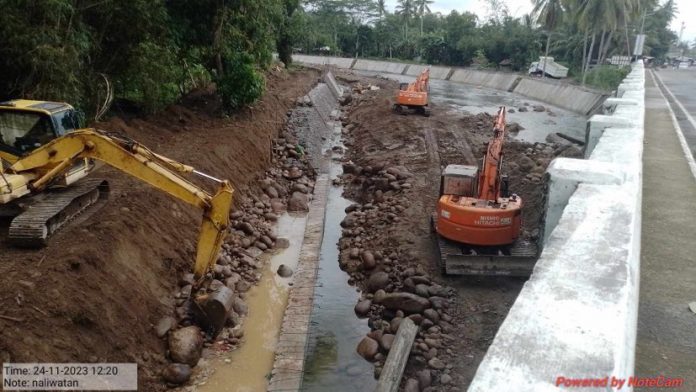
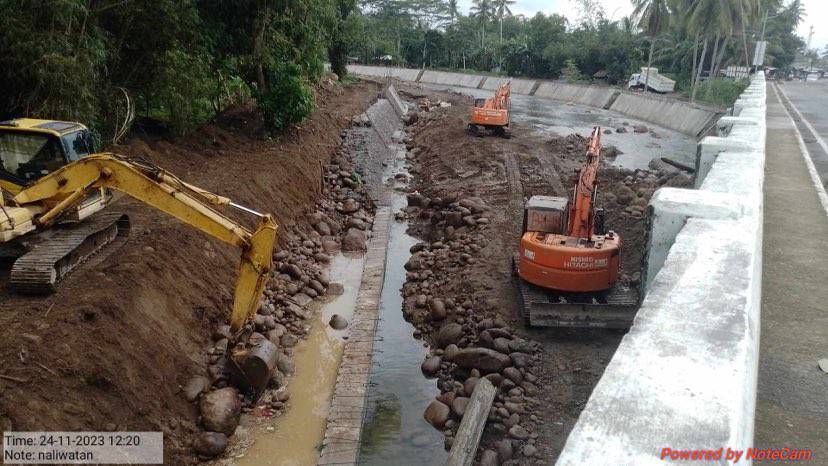
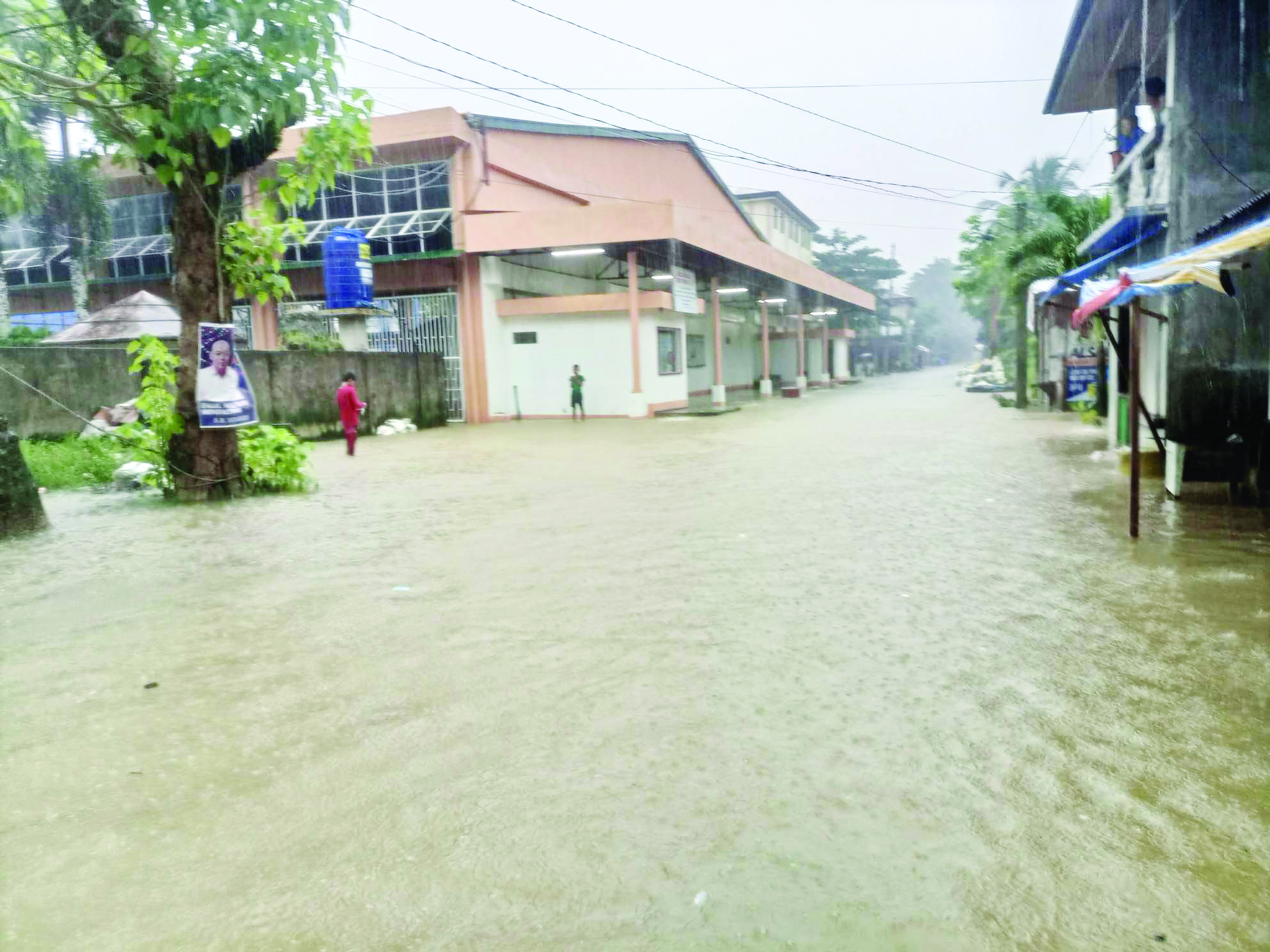
The construction of a flood control project in Tunga, Leyte is now underway. The P54.59 million worth project is being undertaken by the Department of Public Works and Highways in Leyte’s second district engineering office.
(DPWH-L2DEO)
The construction of a flood control project in Tunga, Leyte is now underway. The P54.59 million worth project is being undertaken by the Department of Public Works and Highways in Leyte’s second district engineering office. (DPWH-L2DEO)
TACLOBAN CITY– To ensure the protection of residents in Tunga, Leyte, during the rainy season, the Department of Public Works and Highways (DPWH)-Leyte 2nd District Engineering Office (L2DEO) is building a flood control structure and drainage system along the Naliwatan River Basin located in Barangay San Vicente in the said town.
According to District Engineer Leo Edward Oppura, during severe rains, the water level in the river channel tends to rise.
The ravaging water flow from the upper stream scours the riverbanks, causing them to erode. Thus, building flood control structures will safeguard the riverbanks by reducing the scour process, he said.
“Additionally, the flood control structure will serve as a defense along the river and assure the continuation of communities’ economic and social activities,” Oppura added.
The P54.95 million project is sourced from the department’s flood management program under the 2023 General Appropriations Act (GAA) involving the construction of 946 linear meters of revetment wall at 3 meters tall from the normal water level.
Upon completion, these flood mitigation structures will ensure safety against possible flooding in Brgy. San Vicente and its nearby communities, as well as their properties and sources of living. (LIZBETH ANN A. ABELLA)
TACLOBAN CITY-Investigator from Police Station 3 of Tacloban City Police Office (TCPO) formally filed robbery with homicide charges against two cousins and an accomplice friend for robbery and homicide at the City Prosecutor’s Office involving a public school teacher assigned in this city.
Charged were Mark Justine Conde, 23 and his cousin Yasser Ivan Yu, 18, and Darwin Versoza,18. All are residents of Barangay 68 Anibong of this city.
They were tagged as the primary suspects in the killing of Bernabe Basiano, legal age, a senior high teacher at the Antonio Balmes National High School who resided at Saint Francis Village here.
The police said that the two cousins were apprehended by the local police at about 3:45 pm Sunday (Nov.26) in Barangay 68 Anibong after a witness told police of witnessing what they did to their victim.
Their accomplice was also arrested an hour after the two cousins were arrested.
Police Captain Noeme Jordan, information officer of the Tacloban city police, in an interview, said that the victim was said to be missing two days before his cadaver was discovered in a vacant house in Knightsridge Village, Barangay 98, Camansihay last Saturday (Nov. 25).
Capt. Jordan said that robbery/hold-up was the motive of the suspects to their victim but this resulted in a complex crime after the suspects stabbed and slashed the throat of the suspect resulting in his instantaneous death.
She added that after the crime was committed the suspects dumped the cadaver of the victim to the uninhabited house.
The police said the victim lost his gold ring, money, cellular phone, and gold necklace. (ROBERT DEJON)
MATAG-OB,Leyte – The Department of Public Works and Highways (DPWH) Leyte 4th District Engineering Office (DEO) completes the construction of a multi-purpose building, specifically a covered court, in Barangay Mansalip, this town.
With a contract cost of P4,949,969.94, it features a concrete flooring spanning a total area of 479.48 sq. m. and is equipped with concrete bleachers, rafters, and a lighting system.
The primary objective of this project is to provide the community in Brgy. Mansalip a dedicated space for gatherings and other activities. Furthermore, it can also serve as evacuation area during calamities.
This accomplishment not only fulfills a crucial community need but also aligns with the Department’s vision of promoting local development through reliable and resilient infrastructure. (PR)
TACLOBAN CITY – The head teacher of a remote public school in Catarman town, Northern Samar province is calling for help for the school’s students who were affected when a massive flooding struck the province last week.
Harold Fabile, the head teacher of Hinatad Elementary School, said that all of the school’s 242 students have lost all their school materials due to the flood that reached up to the roofs of the houses and the school buildings.
He also disclosed that all the equipment and supplies of the school, located 15 kms away from the town proper, were also destroyed due to the flooding incident last week.
Two of the school’s classrooms were also destroyed due to the calamity, Fabile added.
And with all the learning and instructional materials damaged, they had initiated a fund drive to help their students, in particular, by accepting essential school supplies like pad papers, notebooks, pencils, ball pens, ruler, crayons, eraser, books, food packs and toys.
Fabile added that they also accept donations like bond papers, printers, TV and electric fans for their classrooms and printing of modules/activity materials.
At present, the school has implemented a modular mode of teaching due to the present condition of their school, the head teacher said.
Meantime, the Department of Education (DepEd) regional information officer Jasmin Calzita said most of the schools affected by the heavy downpour of rain due to shear line and low pressure area had already resumed their face-to-face classes.
“Those that are still under flood are advised to implement blended learning,” Calzita added.
At least 39 schools with a total of 10, 276 students and 352 personnel were affected by the flooding last week that hit Northern Samar, the northern part of Eastern Samar and Samar provinces according to Calzita.
Heavily affected school was in the municipality of Jipapad in Eastern Samar.
In the initial report from the Northern Samar school division, at least 43 classrooms in the province are totally damaged, 122 with major damage, and 422 with minor damage.
The report also stated that 88 temporary learning spaces were also needed in the province for students to temporarily use while waiting for the repair or construction of new classrooms. (ROEL T. AMAZONA)
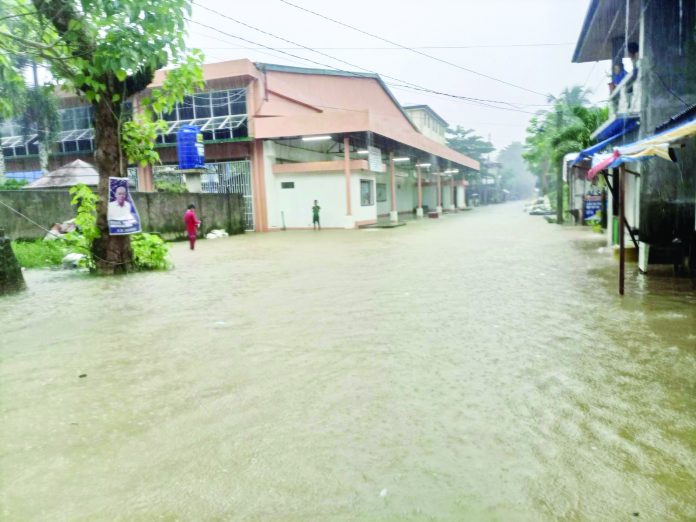
FLOODING. The bad weather being experienced across Eastern Visayas spawned by LPA and share line resulted in landslide and flooding incidents, displacing more than 9,900 families, the Department of Social Welfare and Development reported. Photo shows the town of Jipapad in Eastern Samar flooded with rain water with 46 families displaced.(VICKY ABESTROS,JIPAPAD MDRRMO)
Due to LPA, shear line-induced rain
FLOODING. The bad weather being experienced across Eastern Visayas spawned by LPA and share line resulted in landslide and flooding incidents, displacing more than 9,900 families, the Department of Social Welfare and Development reported. Photo shows the town of Jipapad in Eastern Samar flooded with rain water with 46 families displaced.(VICKY ABESTROS,JIPAPAD MDRRMO)
TACLOBAN CITY– Over 9,900 families in different parts of the region were affected due to the bad weather spawned by a low-pressure area and shear line that brought heavy rains which resulted in flooding and landslide incidents.
The inclement weather also resulted in the suspension of classes and work in various areas in the region.
As of Monday (Nov. 20), the Social Welfare and Development (DSWD) regional office reported that 9,905 families consisting of 39,369 individuals from 65 barangays in the provinces of Samar, Eastern Samar, Northern Samar, Biliran, and Southern Leyte were affected due to flooding incidents.
Lawyer Jonalynchie Chua, the DSWD regional information officer, said that of the affected families, 5,697 families consisting of 22,324 individuals were from Eastern Samar; 4,016 families(16,321 persons) were from Samar; 47 families involving 221 persons were from Northern Samar;139 families comprising 485 individuals were from Biliran; and six families(18 persons) from Southern Leyte.
She also reported that 190 families involving 712 persons are now in evacuation centers-139 persons(485 persons) in Biliran; 43 families or 201 persons in Northern Samar; six families or 18 persons in Southern Leyte; and two families (8 persons) in Samar.
In Jipapad town, 46 families involving 100 persons were displaced due to the rise of rainwater reaching up to six meters high, says its disaster risk reduction management officer Vicky Abestros.
The DSWD reported that it has prepositioned 128,836 food items and another 42,437 non-food items to families that could be displaced due to the bad weather.
Meantime, two fishermen from Capul, Northern Samar, Jenie Mente,57, and Lando Magdaraog,39, were rescued in the waters of Tagapul-an, Samar on Sunday(Nov.19) at about 8:30 am.
The motorized banca of the fishermen capsized due to big waves brought by the bad weather, the regional headquarters of the Philippine National Police based in Palo, Leyte reported on Monday.
Both Governors Sharee Ann Tan of Samar and Edwin Ongchuan of Northern Samar issued suspension of classes in their respective provinces Monday while several local governments in Leyte like Alangalang, Tolosa, Babatngon, and Tanauan, also suspended classes at all levels.
Here in Tacloban City, while Mayor Alfred Romualdez did not issue any suspension order, classes in mostly public schools in the city suspended their classes using the advisory of the National Disaster Risk Reduction Management Council placing Tacloban under the ‘orange’ alert category which could result to heavy rains.
The nonstop rain has resulted in flooding in some barangays in Calbayog City in Samar; Arteche, Oras, and Jipapad in Eastern Samar; Gamay, Lope de Vega, Palapag, and Catarman in Northern Samar.
The local Pagasa office based in Catarman has issued a flood advisory in Catarman, Pambujan, Catubig, Palapag, and Gamay towns. Residents of these areas are asked to be vigilant for possible occurrence of floods or landslides.
The Simora-Palapag Road in Laoang town, also in Northern Samar was rendered impassable due to a landslide but was immediately cleared of debris by the personnel from the Department of Public Works and Highways.
Meantime, the Paranas-Taft Road in Eastern Samar was also rendered closed for motorists and vehicles due to flood but was opened to traffic by afternoon.
A landslide was also reported in sitio Cabatilisan, Brgy. San Jose in Mondragon, Northern Samar. No one was reported injured or affected due to the incident.
Several towns in Northern Samar, notably, San Antonio, Mondragon, Silvino Lubos, Gamay, and San Isidro, have no power supply since Monday.
FIGHT AGAINST CLIMATE CHANGE. The provincial government of Samar is set to conduct the first-ever Samar Bamboo Project which aims to plant more than 110,00 bamboos in five selected towns in the province in the hope to fight against climate change and at the same time, provide livelihood among locals. (Photo Courtesy)
TACLOBAN CITY – In a bid to address climate change and promote sustainable practices, the provincial government of Samar is set to commence the Samar Bamboo Project on November 20.
FIGHT AGAINST CLIMATE CHANGE. The provincial government of Samar is set to conduct the first-ever Samar Bamboo Project which aims to plant more than 110,00 bamboos in five selected towns in the province in the hope to fight against climate change and at the same time, provide livelihood among locals. (Photo Courtesy)
Spearheaded by Governor Sharee Ann Tan, the initiative aims to boost the bamboo industry within the Samar Island Natural Park (SINP), simultaneously mitigating climate change impacts and fostering economic opportunities.
Implemented in collaboration with agencies like the Department of Social Welfare and Development (DSWD), Northwest Samar State University, Samar State University, and support from the Department of Environment and Natural Resources (DENR), Department of Science and Technology (DOST), and Department of Trade and Industry (DTI), the project focuses on reforesting degraded forestlands and watershed.
Giant bamboo, also known as dragon bamboo, will be planted across seven project sites in five identified towns, namely, Basey, Sta. Rita, Matuguinao, Gandara, and San Jorge, forester Wilfredo Lacambra of the Samar Provincial Environment and Natural Resources Office.
This effort will involve 1,154 residents from 26 villages, engaging in activities such as site preparation, planting, and documentation and a cash-for-work program under the DSWD.
The program targets to plant 550 hectares with 110,000 bamboo seedlings for the next five years with funding worth P43.98 million from the province and P3.93 million from the DSWD.
On its first year of implementation, the program will require P15.43 million fund wherein P3.93 million will be provided by the DSWD under its recovery and rehabilitation program while the P11.5 million will the province counterpart to fund the supply of farm inputs, farm tools, construction materials for the establishment of nursery among others.
A budget worth P8.12 million is needed for the next four years for the maintenance and protection expenses, which will be provided by the province.
The initiative not only seeks to combat climate change but also aims to generate employment, improve living standard, and empower women in the agriculture sector.
The project will also have a socio-economic impact to the community through the increase in income in every household, employment of the local labor force, and strengthening of the local economy through bamboo production.
The Samar Bamboo Project will not only focus on the five towns but can also be replicated and scaled up in other municipalities.
Moreover, during the Samar Bamboo Investment Forum held from November 14 to 15 at the DENR Regional Office and at the SINP Headquarter’s in Paranas town, Gov.Tan expressed her commitment to highlighting the potential for bamboo-based enterprises in the province.
The forum was participated by DENR Regional Executive Director Lormelyn Claudio, Taft Hydro Energy Corporation president Ruben Diego Picardo, Russel Smith of Rizome Philippines, aDryada business development head Matthieu de Louvier, Audax International founder and chairman Jeremy Knight, and several local chief executives from the Samar.
Taft Hydro Energy Corporation, currently involved in bamboo reforestation in Eastern Samar, aims to plant four million bamboos in collaboration with Samar Bamboo Corporation, Rizome Philippines, Magis Energy Holdings, Iraya Ventures, and aDryada, and aims to extend this effort to the provinces of Eastern and Northern Samar. (ROEL T. AMAZONA)