ORMOC CITY-A security guard of a known package courier yielded five sachets containing white crystalline substances suspected to be shabu during a buy-bust operation conducted by local police in Malitbog, Southern Leyte on Wednesday (Dec.13).
Police identified the suspect as Nelson Ongcada Jr., 29, married, security guard of the guard J&T Malitbog and a resident of Tomas Oppus, Southern Leyte.
He was arrested in a sting operation at about 5:59 pm in Barangay San Vicente, Malitbog.
Recovered from his possession were five sachets containing a white crystalline substance suspected to be shabu procured by an operative in the amount of P5,000.
A case of violation of section 5 (selling prohibited drugs) of Art. II of RA 9165, the Comprehensive Law against Illegal Drugs of 2002 was filed at the Provincial Prosecutors Office against the suspect who is temporarily detained at the locked-up cell of Malitbog municipal police station. (ROBERT DEJON)
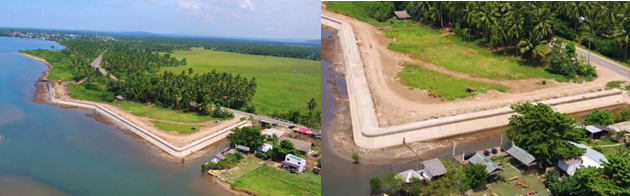
NSSDEO, Brgy. Burabud, Laoang, N. Samar– The inhabitants and properties along the Bantayan Bay, San Roque, Northern Samar is now guaranteed and protected against potential sea-level surge caused by destructive forces where the area is vulnerable to typhoons or other natural factors.
As an infrastructure arm of the government, the Department of Public Works and Highways Northern Samar 2nd District Engineering Office spearheaded by District Engineer Charlito S. Carlobos and OIC-Assistant District Engineer Atty. Arthur Eric L. Sabong has completed another coastal protection project with a contract amount of P50,411,055 contracted under CDU Construction.
Furthermore, this seawall project was funded under General Appropriations Act (GAA) of 2023 with a Contract ID No. 23II0017, intended to utilize RC piles to strengthen the shoreline stability and to reduce settlement at the site.
The construction of 320.00 meters seawall plays a crucial role in enhancing the community’s resilience to climate change impacts. They provide a barrier against storm surge flooding and contribute to the overall adaptation and mitigation efforts.
This coastal protection project provides numerous benefits beyond preservation coastlines. The economic success and community resilience was the consideration for a unique characteristic and desires of each coastal area.
On the other hand, this project supervised and monitored by Project Engineer Filoteo T. Delorino together with Project Inspector Engr. Ma. Luzyl P. Castillo and Resident Engineer Florando Emilio O. Moscare, while Engr. Justino E. Serafin, Jr., for the materials quality assurance of the project.
The completion of this project has a huge impact to the coastal residents and properties nearby preventing the loss of valuable land and infrastructure. Subsequently, the locality is likely promoting local tourism and has the potential to intensify the economic stability of the community. (RONEL L. GALUPO, PIO STAFF/PR)
ORMOC CITY– A man who was earlier imprisoned due to illegal drugs was arrested again in Naval, Biliran on Tuesday (Dec. 2).
The suspect, only identified as Jerico,24, was arrested in a buy-bust operation on that day in Barangay Atipolo, Naval at about 6:48 pm, local police said.
Recovered from his possession were four sachets containing suspected shabu.
The suspect is now detained at the detention facility of the naval municipal station and was charged for possession and selling of illegal drugs. (ROBERT DEJON)
TACLOBAN CITY – Lara Samar, Kadiwata Rock Island Experience, and Uswag Artesano were recognized in the first Philippines Creative Tourism Awards 2023, the three-day inaugural edition of the Philippine Creative Tourism Congress (PCTC).
The three were nominated via the Creative Tourism Network website in two of the six categories of the Philippines Creative Tourism Awards 2023.
Kandiwata placed 2nd in the Best Creative Destination category while Lara and Uswag placed sixth place under the Best Creative Experience.
Created by the Creative Tourism Network®, the Philippines Creative Tourism Awards 2023 recognizes initiatives and destinations worldwide that promote innovative and sustainable tourism practices.
Celebrating authenticity, creativity, and the involvement of locals and tourists in co-creating exceptional experiences.
Department of Tourism Secretary Christina Garcia Frasco handed the recognition to the winners during the event held in Bacolod City last December 6.
Sec. Frasco, in her message, hailed ‘Creative Tourism’ as the catalyst for a new era in travel, saying it is an innovative approach involving tourists and local communities in crafting unique and immersive travel experiences – a concept centered on co-creation noting that the first PCTC is aligned with the administration of Pres. Marcos, Jr.’s vision for the tourism sector to play an invaluable role in the promotion of the Filipino brand.
She added that the PCTC 2023 represents a cornerstone in the DOT’s commitment in amplifying the cultural richness and creative prowess of the Philippines on the global stage.
The holding of the event is in keeping of Republic Act 11904, also known as the Philippine Creative Industries Act of 2022 (PCIDA), which advocates for the establishment of the Philippine Creative Industries Development Council (PCIDC) where DOT seats as an ex-officio member of this council.
The law stands as a beacon for fostering the creative industries and mandates the safeguarding and fortification of the rights and capacities of creative firms, creators, and stakeholders in the country. (ROEL T. AMAZONA)
Amid the rising cases of influenza-like illness, the Department of Health in the region is conducting vaccination against flu and pneumococcal.
(DOH-Eastern Visayas)
Ask public to practice health protocol
Amid the rising cases of influenza-like illness, the Department of Health in the region is conducting vaccination against flu and pneumococcal. (DOH-Eastern Visayas)
TACLOBAN CITY– Cases of influenza-like illness (ILI) in the region have increased by about 25 percent compared to last year.
The surge of ILI in the region prompted the Department of Health (DOH) to recommend to the public to practice and observe health protocols which include the wearing of face masks.
The DOH reported of 10,186 cases covering January up to December 2 of this year, up by 25 percent compared to the same period of last year, or 8,130 cases.
Covering also the same period, 21 persons died due to the ILI, lower by two compared to last year of the same period.
In Catarman, Northern Samar where a massive flooding was experienced last month, ILI was recorded at 62, covering the months of January to November.
Last year, however, there were no ILI cases were monitored by its rural health unit.
In Tacloban City, about 126 ILI cases were also monitored by the DOH.
With the surge of cases in the region, the DOH is asking the public to take precautions to avoid catching the ailment.
“While there was an increase of cases, we somehow anticipated it as we have experienced heavy rains,” Jelyn Malibago, the regional information officer of the DOH-8, said.
Thus they are advising the public to wear face masks, proper handwashing, proper ventilation, and seek early medical assistance, if needed.
Among the symptoms of the ailment include fever, cough, body aches, sore throat, and headache, among others.
Malibago said that as part of their precautionary measures, they are also conducting flu and pneumococcal vaccinations.
She said that those who are 18 years and above are qualified to receive the flu vaccine while those 45 years old and above are qualified for the pneumococcal inoculation.
She said that they have 150,000 vials of the vaccine which is equivalent to 1,500 persons.
“So we hope our people will take advantage of this vaccination. We also distributed vaccines to rural health units. Let’s protect ourselves,” Malibago said. (JOEY A. GABIETA)