CALBAYOG CITY – A concreted road is recently completed in Barangays Geragaan to Panonongon, Calbayog City with a contract amount of P9.87 million under the Basic Infrastructure Program.
Inner roads build connectivity within the barangays allowing ease in mobility and transportation. Constructing roads provide access to employment, social, health and education services making road networks vital in fighting against poverty. Mr. Arturo Doinog a resident and farmer from Brgy. Geragaan said that it’s now easier and faster to travel and a good thing that its well-lit because they already feel safe.
In this regard, a 400-meter length (two lanes) of Portland Cement Concrete Pavement (PCCP) and a width of five (5) meters is constructed in place of the existing narrow (one lane) road in the area. Apart from that, a masonry canal of the same length is incorporated with Reinforced Concrete Pipe Culvert (RCPC) to divert water away from the road and serve as its drainage.
There are 20 solar LED lights that were also installed along the structure as part of its scope. (GISSELE G. PARUNGAO, PIO DESIGNATE/PR)
ORMOC CITY– Suspected sachets of shabu were confiscated by the police during a buy-bust in Palompon, Leyte last Friday (Feb.2).
Arrested during the operation was Marvin Omlero,38, who worked as a waiter during an anti-drug operation in Barangay Mazawalo of said town at about 9 pm.
Seized from the suspect were three sachets of suspected shabu with a commercial value of P450,000 weighing 70 grams.
Palompon town police chief, Capt. Realthur Tabernero, in an interview, said that they were conducting a drug operation and monitoring in the area when they chance upon the suspect who was a listed drug personality in their station.
He said that when the suspect saw the approaching police officers in front of him, the suspect panicked and threw away three plastic sachets containing a white crystalline substance believed to be shabu.
He said that one of the sachets contained 5 medium-sized sachets while another contained seven small sachets and the last sachet contained a big sachet all containing white crystalline substances suspected to be shabu.
Also recovered from the suspect were a black sling bag, one box carton, one small metal case, and one bicycle.
Capt. Tabernero went on that all drug evidence is estimated to weigh 70 grams with an estimated value of P450,000.
The suspect said that his supplies were from Manila and delivered to him through a courier.
The police filed a case of violation of Sec 11 (possession of illegal drugs) of Art. II of RA 9165, the Comprehensive Law against Illegal Drugs of 2002 at the Provincial Prosecutors Office here against the suspect who is temporarily detained at the locked-up cell of the local police. (ROBERT DEJON)
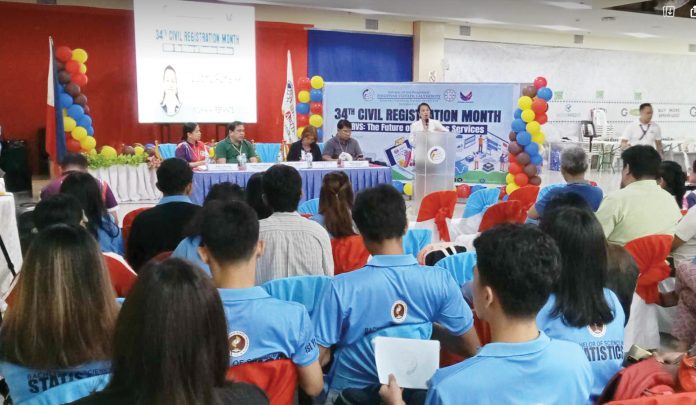
The Philippine Statistics Authority is marking the Civil Registration Month celebration with several activities. The month-long occasion kick off on Jan.31 with a motorcade across Tacloban City’s major streets. (PSA-8)
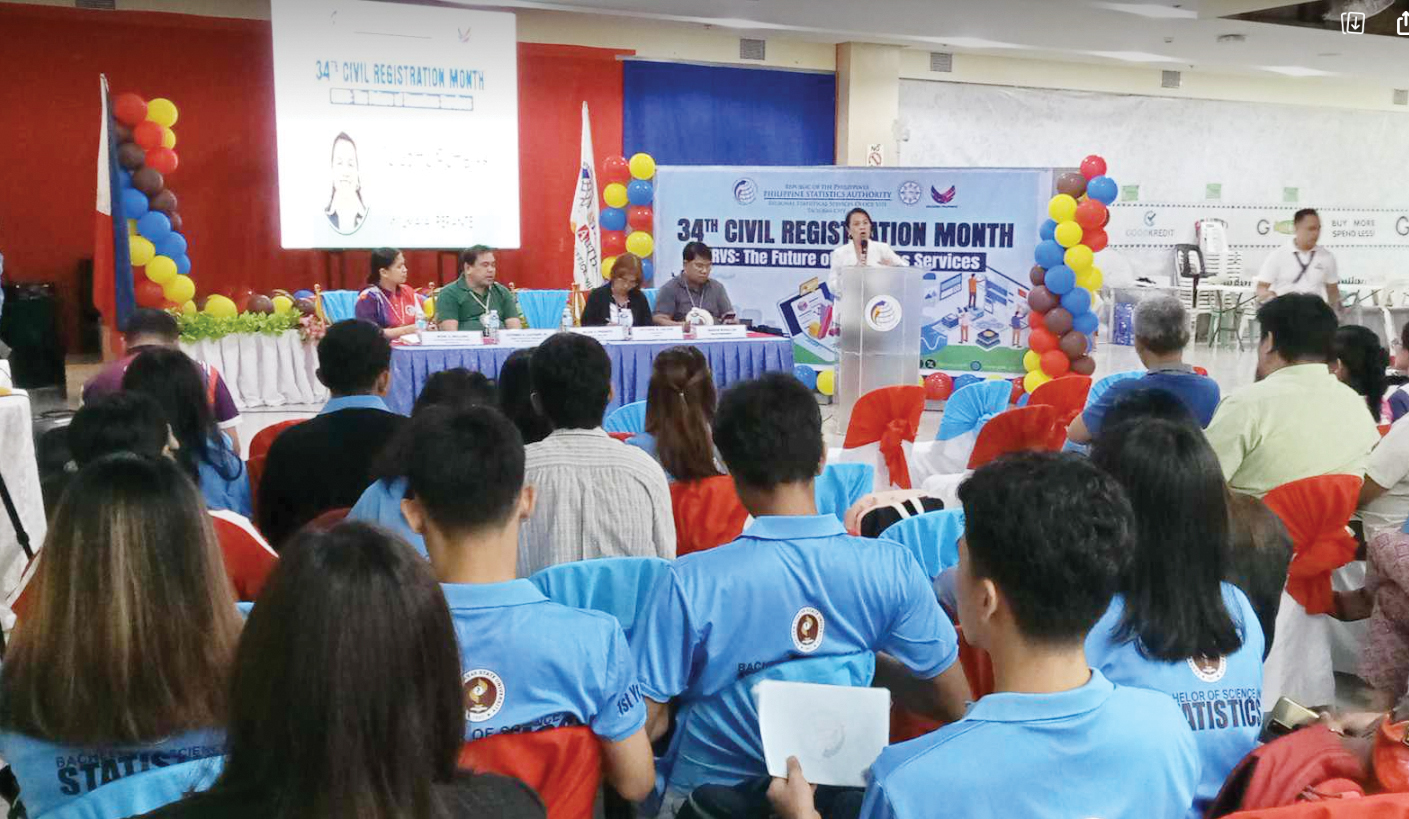
The Philippine Statistics Authority is marking the Civil Registration Month celebration with several activities. The month-long occasion kick off on Jan.31 with a motorcade across Tacloban City’s major streets. (PSA-8)
TACLOBAN CITY-The Philippine Statistics Authority (PSA) here in the region conducted the kick-off activities for the month-long celebration of Civil Registration Month (CRM) this month.
“The PSA envisioned to have seamless services because customers have needs and expectations that we stakeholders – national and local governments, private sector must be addressed collaboratively,” PSA Regional Director Wilma Perante said during the Jan.30 kick-off ceremony held at their office located at the Gaisano Capital, this city.
This year’s theme is ‘CRVS: The Future of Seamless Services.’
This annual celebration is part of the mandate of the PSA to enforce civil registration functions in the country and is conducted pursuant to Presidential Proclamation No. 682 signed on 28 January 1991 by former President Corazon C. Aquino, declaring February as the Civil Registration Month. (LIZBETH ANN A. ABELLA)
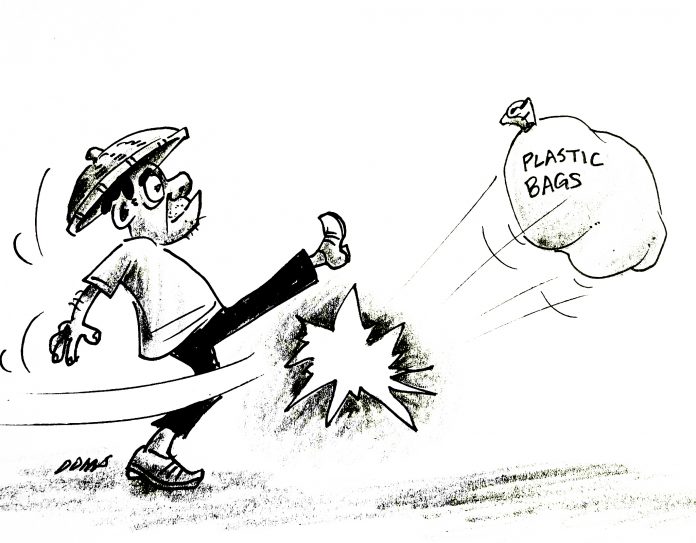
Plastic bags have long been used in stores across the Philippines, but a significant shift has occurred recently. Most stores have now taken proactive measures to eliminate their use, which is a positive decision, signaling a realization of the environmental consequences and a positive commitment to sustainable practices.
The realization exhibited by store owners is evident in their grasp of the detrimental impacts of plastic bags on the environment and the extensive pollution caused by the production and disposal of plastic bags. They recognize that plastic bags are non-biodegradable and often end up in landfills, rivers, and oceans, where they persist for hundreds of years, harming marine life and disrupting ecosystems. Furthermore, they perceived the energy-intensive processes in manufacturing plastic bags and the resulting greenhouse gas emissions.
Most Pinas stores’ decision to replace plastic bags with eco-friendly alternatives demonstrates their education and knowledge after the relentless campaigns of environmentalists. Not only did they see the environmental impact of plastic bags, but they also recognized the importance of collective action. They comprehend the need for collaborative efforts involving all stakeholders, including government bodies, businesses, and consumers, to tackle the plastic bag problem effectively.
Aware that sustainable solutions require the active participation of everyone, we believe that by eliminating or reducing their use, plastic bags can be phased out, and the environment can be protected. This is supported by research and evidence that showcases the positive impact of plastic bag bans or restrictions in numerous countries worldwide. The decision to cease using plastic bags aligns with this advocacy, presenting a unified front in the battle against plastic pollution.
This decision is not merely about reducing waste or conserving resources but also about fostering a sustainable and responsible society. By actively supporting businesses that have transitioned to alternative packaging materials, the government contributes to creating a consumer culture that values environmentally friendly practices. This cultural shift has the potential to inspire other nations and bring about a domino effect, as individuals and organizations worldwide witness the positive outcomes of eliminating plastic bags here in our country.
While sometimes deemed a necessary solution, divorce or separation often carries with it an undeniable heaviness, marked by a multitude of emotional consequences for all parties involved. Yes, there’s a great impact of parting ways, given the inherent sadness that accompanies such a life-altering decision. It affects not only individuals directly involved but also society at large.
Foremost, it brings about a sense of personal loss and grief. The dissolution of a marriage or partnership signifies the death of shared dreams, and unfulfilled aspirations, and the end of a once-chosen path. If only we can grasp the depth of sadness experienced by individuals, as they navigate through the stages of grief, mourning what could have been and what is forever lost. This emotional burden can lead to feelings of hopelessness, anxiety, depression, and even a decline in mental and physical health.
It also has an impact on an individual’s sense of identity. Shared memories, routines, and roles within the relationship are abruptly shattered, leaving a void difficult to fill. Navigating through this identity crisis can be especially trying. The sadness stemming from the loss of one’s identity as a partner, spouse, or parent can lead to a period of questioning and profound self-doubt, impeding personal growth and hindering future relationships.
Separation often results in new financial arrangements and responsibilities, leading to increased stress and uncertainty. Financial stability is crucial for individuals to regain a sense of security and rebuild their lives post-divorce. However, the aftermath of separation inevitably involves the division of assets, potential loss of income, and the added burden of managing individual finances. This financial strain, coupled with the emotional turmoil, can amplify the sadness experienced during divorce or separation.
One of its saddest consequences is its traumatic impact on children. Witnessing their parents’ separation generates feelings of confusion, sadness, and vulnerability among children. The emotional distress experienced by children can have long-lasting effects on their overall well-being and future relationships. The lingering sadness that accompanies a disrupted family unit can impede their emotional development and hinder their ability to form trusting relationships in the future.
This often leads to the disintegration of shared friendships and social networks. Family and mutual friends may feel compelled to choose sides, exacerbating the sense of isolation and abandonment experienced by the divorcing or separating individuals. We have yet to grasp the significance of this loss of social support and the subsequent sadness that can arise from this perceived abandonment, as it affects individuals’ mental health and impedes their ability to heal.
Sometimes, it also involves legal proceedings and lengthy court battles, a process that further intensifies the sadness experienced by those involved. The emotional toll of appearing in court, the financial implications of legal proceedings, and the extended period of unrest can be highly distressing. The overwhelming sadness and frustration stemming from these legal battles often hinder the progress of emotional healing and the ability to move forward toward a healthier and happier future.
The complexity of the emotional consequences highlights the need for the involved parties to comprehend the aspects of this challenging process. By acknowledging the immense personal loss, disrupted identity, financial insecurity, impact on children, loss of social support, and arduous legal battles, proactive interventions and support systems can be pursued to alleviate the sadness associated with divorce or separation, leading to healthier healing and eventual reemergence.
IN that gospel episode where Christ complains about the inconsistency and hypocrisy of the leading Jews at that time (cfr. Mk 7,1-13), we are reminded of the danger of being trapped in our earthly affairs and in our human ways while neglecting what is truly important for us.
“This people honor me with their lips, but their hearts are far from me; in vain do they worship me, teaching as doctrines human precepts. You disregard God’s commandment but cling to human tradition,” lamented Christ. (Mk 7,6-8)
We have to be most wary of this danger because especially these days we have to contend with powerful forces that can easily absorb us while desensitizing us from the most fundamental duty of ours to do everything with God and refer everything to God. Sad to say, many people these days do not anymore know what the real purpose of our life here on earth is. They are hooked in their self-indulgence.
How many people these days, especially the young ones, are addicted with their cellphones to such an extent that they lose sleep and proper rest and get exposed to many dangerous, unhealthy stuff like pornography? Getting distracted from their real duties seems to be the game of their life.
Seen from another angle, many of us seem to be simply playing the dynamics of materialism, consumerism, hedonism, etc. in our earthly and temporal affairs. God seems to have nothing to do with our life. The spiritual dimension as well as the supernatural goal of our life are practically thrown out of the window.
We have to recover the consciousness, sharpening it as much as possible, of the real and abiding purpose of our life. God wants us to be like him since he has created us to be his image and likeness. Our life here on earth is still God’s continuing creation of us. And he is testing us to see if what he wants us to be is also what we want ourselves to be.
Thus, we should see to it that everything we do, everything that happens to us should be seen, understood and reacted to in accordance to what God wants us to be. We have to follow what St. Paul once said, “Whether you eat or drink, or whatever you do, do it all for the glory of God.” (1 Cor 10,31)
Let’s always remember that we always have a choice of whether we want to follow God or to follow ourselves in everything that happens in our life. We should see to it that we are always conscious of how this choice should be made so we would be guided properly.
In a sense, we are meant to be always in contact with God, since in the first place our life is meant to be a sharing in the life of God, if not in his very own divine nature itself. That’s how our life ought to be.
Our natural life, and everything in it, is geared toward the supernatural life of God. Everything in our life and in this world is meant to lead us toward this end. We have to develop a taste and even an appetite for the supernatural life with God and of things supernatural in general.
In this we have to help one another, because in the end, this is our common ultimate end in life—how to live our life with God, how we can be immersed in God even as we are immersed also in the things of the world.