26.6 C
Tacloban City
September 18, 2026 - Friday | 6:27 PM
Home Blog Page 1060

‘Last mile schools’ bring hope to isolated Filipino students amid learning crisis

0
Father Loreno Robles officiated the blessing of a new school building under the education department’s “Last Mile Schools” program in San Miguelay Elementary School in Sta, Fe, Leyte on November 23, 2023. (Photos by Ronald O. Reyes)

STA.FE, Leyte– Jessie Creado, an 8-year-old student, could not contain his excitement upon seeing the new school building in their village of San Miguelay, an interior village of this town.

Father Loreno Robles officiated the blessing of a new school building under the education department’s “Last Mile Schools” program in San Miguelay Elementary School in Sta, Fe, Leyte on November 23, 2023. (Photos by Ronald O. Reyes)

“I am happy that we have a new building. It feels good to attend my classes,” the Grade 2 pupil said.

Epimaco Densing III, the undersecretary of the country’s Department of Education (DepEd), who traveled to the village from the capital Manila, emphasized how a school building becomes a symbol of hope to reverse the declining trend of education in the Philippines during the inauguration and turn-over of P13.3-million worth of two new classrooms equipped with solar panels at San Miguelay Elementary School on November 23, 2023.

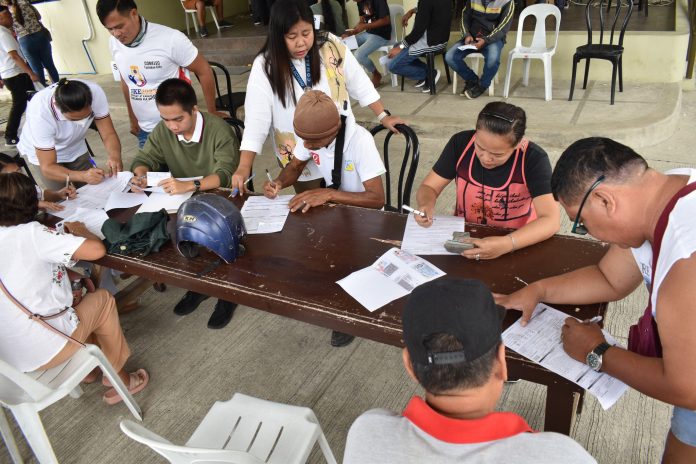
Education officials, villages, students, and teachers pose at the new school building under the education department’s “Last Mile Schools” program in San Miguelay Elementary School in Sta, Fe town in the central Philippines on November 23, 2023. (Photos by Ronald O. Reyes)

The said school became one of the recipients of the ‘Last Mile School Program’ of DepEd.
The program aims to solve the gaps in facilities of schools located in geographically isolated and disadvantaged areas and transform makeshift classrooms and other school infrastructures into standard ones.

“Having a building is important in the whole learning process. We must be very clear that the only way to solve the problem of poverty in our country is to make sure that every child gets to go to school,” said Densing III, who is in charge of the department’s school infrastructure and facilities.

Densing III disclosed that DepEd is short of 165,000 classrooms all over the country.
“It will take years to solve this crisis, and to be able to solve this, it should be all hands on deck. The support of the community, of parents, is also needed and not just the government alone solving this education crisis that we are facing,” he added.

Ricardo Abejo, a 43-year-old parent, said that the new school building was a big help to them, especially during the rainy season, when flooding also sets in in their village, as the school is located in a rice field and farm area.

“Before, we found so much inconvenience because the flood water reached the floor of the classrooms. This new building is much better because the design is elevated,” he said.
Abejo has a 10-year-old pupil at the said school.

“I am happy to see him inside his new school. Students usually get too lazy to attend their classes when there is a flood. Now, they always feel good,” he said.

“As a parent and village official, I am touched by the gesture of our government for providing our students a comfortable place to learn” he added.

He assured that he, along with other village officials, would help in maintaining the cleanliness and security of the new school building.

San Miguelay, which is some seven kilometers away from the town proper, has 74 students from Kinder to Grade 6.

Mariza Magan, the education superintendent of DepEd in Leyte province, who was accompanied by Sta. Fe District supervisor Ramil Bingco, lauded the school personnel and village officials for their services to the pupils despite the geographical isolation of their school.

“Your passion is the driving force behind the transformation we are witnessing today. To the students, the heartbeat of this institution, may this building inspire and empower our students to reach new heights in their lives,” she said.

“This new building will be an instrument with more convenience and peace to our learners, for education will pave the way for their personal growth and will help them achieve a bright future,” added the school head Clarissa Arejola.

Aside from poverty, family problems, lack of interest, and transfer of residence, the dearth of classrooms in remote villages also became the reasons why there are students who quit schools.

In Leyte Division alone, a total of 383,515 learners were enrolled before the start of the school year, but only 377,631 are currently attending classes.

“Let us look into our own municipality if there are children and teens who have not completed basic education,” Magan said. (RONALD O. REYES)

Challenges and Perils

0

The implementation of the K-12 program in the Philippines brought significant changes to the education system, particularly with the introduction of senior high school. While the additional two years of schooling aimed to enhance the quality of education, recent developments suggest that the senior high school system in the Philippines now finds itself in uncertain waters.

One major challenge plaguing the senior high school system in the Philippines is the inadequate allocation of resources and facilities. With the implementation of additional academic tracks and strands, schools struggle to provide the necessary tools, equipment, and learning materials necessary to effectively deliver quality education. The lack of updated textbooks, laboratory equipment, and facilities limited the opportunities for practical learning, hindering students’ comprehensive understanding of their chosen track. Hence, this resource shortfall poses a threat to the goal of honing well-rounded and competent graduates.

Another pressing issue in the senior high school system is the scarcity of qualified teachers across various specializations. The rapid expansion of the senior high school system created a need for teachers in specific academic tracks, such as sciences, engineering, and computer studies. Unfortunately, the limited supply of qualified professionals in these specialized areas created a gap in skill transfer. Consequently, students may not receive the requisite expertise needed to fully grasp and excel in their chosen disciplines, ultimately undermining the overall quality of education.

A critical aspect in assessing the efficacy of the senior high school system is its ability to adequately prepare students for their chosen career paths or tertiary education. However, recent assessments highlight a significant gap in aligning the skills developed at the senior high school level with the demands of tertiary education and employment. This disconnect jeopardizes the transition of students from senior high school to higher education or the workforce. The absence of a seamless transition resulted in wasted resources, time, and opportunities for the students, limiting their potential for success.

As the Philippine senior high school system continues to undergo challenges and perils, it is imperative to address key issues. To ensure the success of this educational milestone, policymakers, administrators, educators, and stakeholders must collaborate to develop sustainable solutions. The senior high school system should have fulfilled its potential by equipping students with the necessary skills to thrive in the dynamic socioeconomic landscape of the twenty-first-century Philippine society.

Competing for females

0
DOMS PAGLIAWAN

The connection between human behavior and animal instincts has long captivated scientists and scholars alike. One such parallel is the propensity for males to fight for the right to acquire a mate, which can be observed both in the animal kingdom and among human societies.

The notion that men, like animals, engage in combat for the pursuit of mating opportunities stems from the concept of sexual selection. Competition over reproductive resources is a principal driver of success, explaining why males tend to exhibit a greater inclination towards territoriality and aggression when it comes to acquiring a female partner. This phenomenon occurs in various animal species but manifests differently among human populations due to cultural and societal influences.

While the propensity for males to compete for females can be traced back to our ancestors, humans also display nuanced behaviors shaped by socio-cultural factors unique to our species. These cultural influences add complexity by moderating and shaping the fundamental instinctual drive. Social norms, values, and gender roles engrained within a society can both strengthen or, on occasion, alleviate the inclination for males to resort to physical confrontations in their pursuit of mates.

It would be remiss to analyze the phenomenon of male competition without acknowledging the crucial role of female choice. In many animal species, females actively select their mates based on the perceived traits of dominance, vitality, or resource acquisition potential. Similarly, human females have the power of choice to evaluate potential partners based on a wide range of factors, including physical attributes, socio-economic status, and personality. This power influences the extent to which men engage in competitive behavior to win over a desired mate.

Over time, cultural evolution has shaped the expression and regulation of male competitive behavior for potential mates. Contextual factors such as education, urbanization, and changes in societal norms have transformed the strategies employed by men to attract a female partner. Contemporary society provides alternative pathways for attracting a mate, emphasizing intelligence, humor, empathy, and shared interests over traditional displays of physical dominance or aggression.

Despite the existence of male competition in the realm of mating, it is essential to critically analyze its implications on individuals and society. Overly aggressive or violent manifestations can lead to conflicts, both personal and societal, and reinforce harmful gender stereotypes. Scholars should explore ways to redefine masculinity grounded in empathy and mutual respect, fostering a more inclusive and egalitarian society where cooperation transcends competition.

Humans, as cognitive beings, possess the ability to transcend primal instincts and adapt their behaviors based on complex socio-cultural structures that influence the expression of male competition in the mate acquisition domain. While similarities exist between animals and humans, the nuanced nature of human societies allows for a broader range of courtship strategies, emphasizing the importance of comprehensive analysis when examining male competition for mates. Society can strive to create an environment that supports healthy relationships rooted in respect, equality, and emotional connection.

And by the way, it’s not only the males that tend to engage in fierce rivalry; even females likewise end up in similar situations at times. You see, we live in a highly competition-based world where only those with exceptional traits can enjoy the most carved-for enjoyments.

Giving our body the proper spirit

0
FR. ROY CIMAGALA
FR. ROY CIMAGALA

WE are reminded of this very important concern of ours in that First Letter of St. Paul to the Corinthians where he said: “The body is not for immorality, but for the Lord, and the Lord is for the body; God raised the Lord and will also raise us by his power. Do you not know that your bodies are members of Christ? But whoever is joined to the Lord becomes one Spirit with him.” (6,13-17)

Let’s remember that man is always a unity of body and soul. He is not just pure body nor pure spiritual soul. And as our Catechism teaches us, the body, properly animated by the spiritual soul, shares in the dignity of the “image of God.” (cfr. CCC 364)

This is how the Catechism explains it: “The human body shares in the dignity of “the image of God”: it is a human body precisely because it is animated by a spiritual soul, and it is the whole human person that is intended to become in the body of Christ, a temple of the Spirit. Man, though made of body and soul, is a unity.”

The Catechism further teaches that, “Through his very bodily condition he (man) sums up in himself the elements of the material world…He is obliged to regard his body as good and to hold it in honor since God has created it and will raise it up on the last day.” (CCC 362 ff.)

We need to understand that our body is organically linked to our spiritual and the supernatural character of our life. While distinct, it cannot be separated from our integral human nature and condition, from our beginning and end, and from the plan and purpose God our Father and Creator has for us.

Given that dignity of our human body, we have to make sure that our piety and our devotion to God and everything related to him has to involve both the body and soul. It has to involve our whole person. It just cannot be purely spiritual or purely material. It just cannot be only a matter of knowing the doctrine, quite cerebral in approach, without some external manifestations, or of practicing all sorts of devotional exercises, without knowing the doctrine of faith.

If piety has to be authentic and consistent in all circumstances, then it has to be lived both in our spiritual soul whose main faculties are our intellect and will, and in our material body whose link to our soul, the principle of life, are the emotions and passions, the memory and the imagination, our temperament and psychological state, etc.

When piety is limited to one or the other essential element of our being, to either our spiritual soul or the material body, then it cannot be consistent. It cannot hold out against that anomaly for long. It sooner or later will fall into the tricks of hypocrisy and self-deception.

We need to see to it that our body is properly animated by the spirit of Christ, which is a spirit of love, a spirit of self-giving, willing to make sacrifices even up to death for love of God and of everybody else. This spirit of Christ should be felt in the body. And let’s convince ourselves that it is in this way that our body acquires its best condition.

It’s in this way that our body too will always look for Christ and for others out of pure love. We have to be wary of letting our body be animated by other spirits—like the spirit of the flesh, the spirit of world, or even the evil spirit.

Sound

0
AL ELLEMA
AL ELLEMA

The need for guidance on where to find the source of assistance is vital for those in need. One cannot waste time roaming around especially when the needed help is crucial for ones survival. A delay in finding critical help may be a matter of life and death. People need to be given direction and be able to know the source of assistance. This is so in biblical times when the sheep knows the voice of the shepherd and the shepherd knows his sheep.

Going through the tales in the sacred scripture will show us how the sheep recognizes his shepherd from whose graces the sheep depends. The relationship is too close that the shepherd is willing to offer his life for his sheep. In one episode, the shepherd left his flock just to find one lost sheep. The setting demonstrates God’s love for every sheep, ensuring that not one will go astray, and if lost, shall be searched and brought back to his flock.

In our present times, people obtain assistance from politicians acting as leaders of their constituents. There is help for the people in need once the person finds the source of assistance. One must learn to find the right direction in order to obtain the needed help.

The great difference in the recognitions of the source of assistance is the fact that the politician appears as the source when in fact it is the people’s taxes that serve as the real owner of the assistance. Here is where the people is deceived by the real source of the sound.
comments to alellema@yahoo.com

GCash, NBI sign agreement to run after cyber criminals

0

The National Bureau of Investigation (NBI) and GCash, the country’s number one finance super app, have signed a memorandum of agreement to further strengthen their collaboration to go after perpetrators of online fraud, scams, and other cybercrimes.

Under the partnership, GCash will assist NBI in preventing, detecting, investigating, and prosecuting cybercrimes that involve the use of the GCash mobile app or the transfer or receipt of proceeds from any crime or unlawful activity.

This will be done by providing relevant information and data under prevailing laws, rules, and regulations. The agreement also further solidifies the priority of GCash to secure the funds and data of its users.

The signing ceremony was graced by key officials from the government agency namely NBI director Atty. Medardo G. De Lemos, NBI officer-in-charge (OIC) of the Office of the Deputy Director for Operations Jose Justo Yap, G-Xchange, Inc. (GXI) chief executive officer Oscar Enrico Reyes Jr., and GCash Group Head of New Businesses and Corporate Affairs, Winsley Royce Bangit, together with other key leaders from the bureau and GCash.

“As more and more Filipinos embrace the digital space for their daily transactions and investments, it’s critical for law enforcement agencies to have an active partner like GCash with whom we exchange technical knowledge and expertise on the latest cybersecurity measures. This partnership is a big milestone in our shared fight against scammers, fraudsters, and other cybercriminals,” said De Lemos.

GCash is also working actively with the Philippine National Police Anti-Cybercrime Group (PNP-ACG), Anti-Money Laundering Council (AMLC), and other law enforcement agencies to further employ up-to-date security technologies, and strengthen security measures, through continuous threat and intelligence sharing, and better ensure safer transactions for its customers.

This also includes adhering to the strictest anti-money laundering, counter-terrorism financing, and anti-fraud standards. In line with this, GCash also reminds users to protect themselves when using digital wallets and become more attentive in the face of fraud.
“We’ve seen a concerning rise in online scams, investment fraud, and various cybercrimes in recent years. Now more than ever, it is crucial that we work together with authorities to protect Filipinos against perpetrators,” said Reyes.

As the country’s biggest digital ecosystem and a pioneer in inclusive digital finance, GCash continues to bolster its vision of “Finance for all” to allow Filipinos to have easy access to safe, secure, and convenient digital financial products and services – empowering communities across the nation.

Filipinos can download the GCash app for free on Google Play and the App Store. For more information, visit www.gcash.com.ph (PR)

Recent Posts

DALMACIO C. GRAFIL
PUBLISHER

ALMA GRAFIL
EDITOR-IN-CHIEF

ROMEO CEBREROS
OFFICE IN-CHARGE

OFFICE
BRGY. SONGCO, BORONGAN CITY

CONTACT NUMBERS
(055) 261 – 3319 | 0955 251 1533 | 0917 771 0320 | 0915 897 7439 | 0921 511 0010

DALMACIO C. GRAFIL
PUBLISHER

RICKY J. BAUTISTA
EDITOR

ALMA GRAFIL
BUS. MANAGER

OFFICE
RIZAL AVENUE, CATBALOGAN
(INFRONT OF FIRE DEPARTMENT, NEAR CITY HALL)

CONTACT NUMBERS
0917 771 0320 | 0915 897 7439 | 0921 511 0010

EMAIL
lsdaily2@yahoo.com

WEBSITE
www.issuu.com/samarweeklyexpress