(Borongan City Information Office)
TACLOBAN CITY — The city government of Borongan has secured a P1.4-million grant from the Department of Science and Technology (DOST) to expand its Smart City Borongan program, with satellite internet connectivity in remote communities identified as a priority for its fourth year.
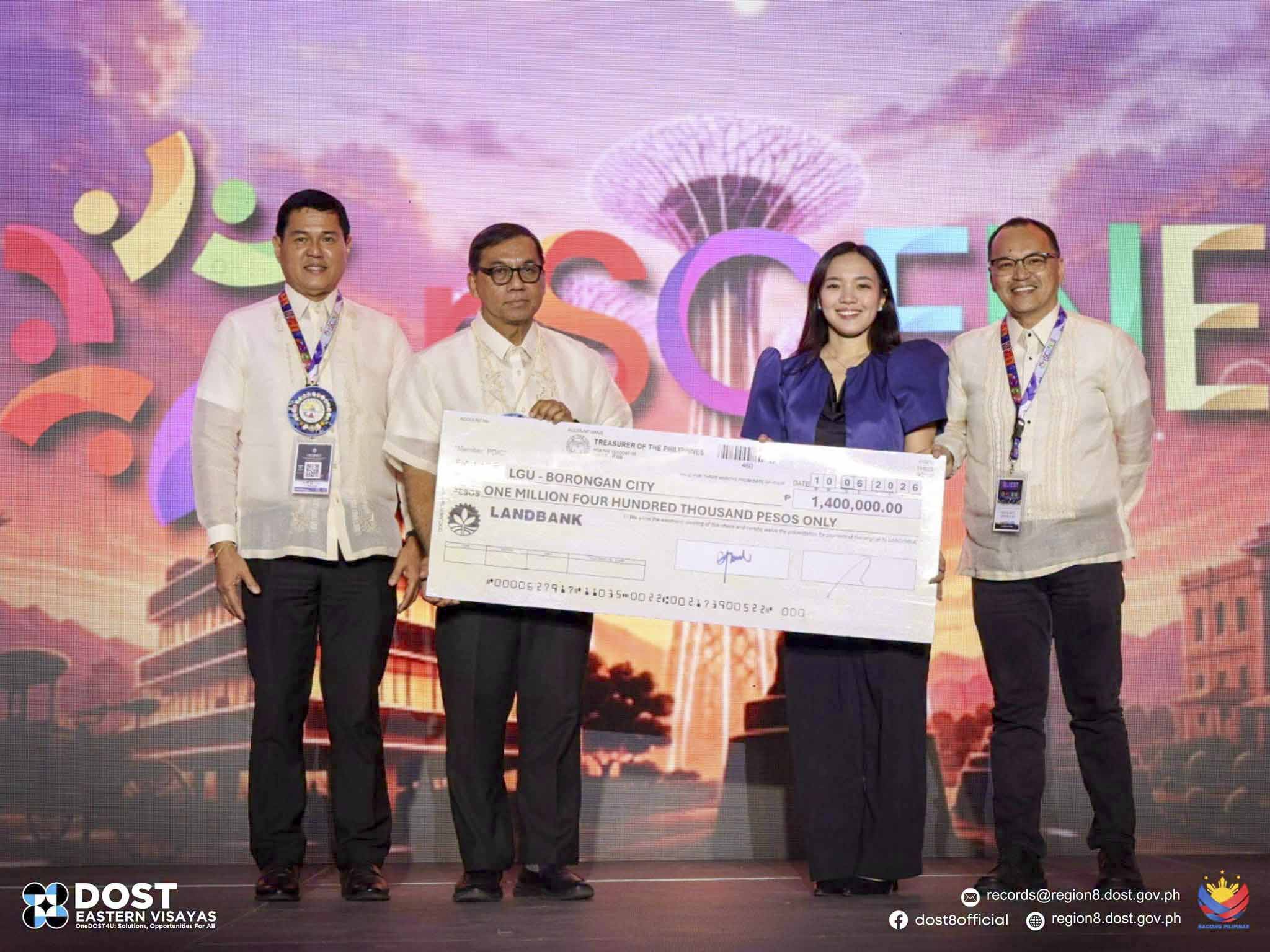
The grant was formally awarded on Oct. 6 during the opening of the Regional Smart Communities Exposition and Networking Engagement (rSCENE) in Catbalogan City under the DOST’s Smart and Sustainable Cities Program (SSCP).
Atty. Jamaila Aboy, who represented Borongan Mayor Jose Ivan Dayan Agda, received the grant together with DOST Eastern Samar Provincial Science and Technology Office Director Arnaldo Amosco.
For the program’s fourth year, the city government will focus on installing satellite internet connectivity systems in geographically isolated and disadvantaged areas (GIDAs), particularly communities where limited communication infrastructure has affected access to information and government services.
The city government said the project is expected to strengthen emergency response in communities affected by natural disasters by providing more reliable communication facilities.
The satellite connectivity will also support residents in accessing government social services through digital platforms and provide learners in interior barangays with improved internet access for education.
Borongan showcased its previous smart city initiatives during the rSCENE, including the use of digital technology to improve business registration, healthcare services and transport systems.
The Smart City Borongan program seeks to improve government service delivery and make public utility systems more efficient through the use of science and technology.
The initiative is also intended to help the city address challenges in delivering essential services to communities that are difficult to reach because of geographic and infrastructure limitations.
The DOST grant will allow Borongan to build on its previous smart city initiatives while expanding digital connectivity to more communities, particularly those most vulnerable during emergencies.
(ROEL T. AMAZONA)