TACLOBAN CITY — Long before Tacloban became the bustling regional center it is today, the city was already at the crossroads of one of the most defining chapters in Philippine history.
On Oct. 20, 1944, Gen. Douglas MacArthur, President Sergio Osmeña and Gen. Carlos P. Romulo came ashore on Leyte, marking the beginning of the liberation of the Philippines from Japanese occupation.
Tacloban soon became a temporary seat of government, while the homes of prominent Taclobanons opened their doors to national leaders, Cabinet officials and military commanders helping rebuild a country emerging from war.
It was during this period of uncertainty and rebuilding that a group of Leyteños began to envision another kind of force for recovery—not through politics or military action, but through service.
That vision eventually gave birth to the Rotary Club of Tacloban.
Born from a call to serve
In 1946, as the country struggled to recover from the devastation of war, President Osmeña called on Leyteños to help confront some of the most urgent problems facing their communities: poverty, illiteracy and malnutrition.
The appeal resonated with Tacloban’s business and civic leaders.
On Sept. 12, 1946, Judge Antonio Montilla became the first president of the newly organized Rotary Club of Tacloban. The organization later received its official recognition from Rotary International on Aug. 20, 1947, with the support of the Rotary Club of Cebu, becoming the ninth Rotary club established in the Philippines.
Federico “Diloy” Larraga served as its first chartered president.
The club’s beginnings were closely intertwined with the city’s postwar recovery. Many of its founders were among the prominent citizens who had witnessed the return of the Philippine government to Leyte and had played roles in the city’s social and economic life.
They brought with them a simple but enduring idea: that those with the ability to help had a responsibility to do so.
Service beyond politics
From the beginning, the Rotary Club of Tacloban established itself as a non-political organization, choosing instead to work with government agencies, civic groups and other organizations to address community needs.
Its early programs reflected the realities of postwar Leyte.
Literacy initiatives sought to give children and adults better opportunities. Deworming campaigns addressed health and nutrition concerns, particularly among children. Job creation and livelihood efforts aimed to help families regain their footing at a time when many were still struggling to rebuild their lives.
These were not grand solutions to the enormous challenges facing a recovering province. But they represented something equally important—a willingness among citizens to roll up their sleeves and help rebuild their community one project at a time.
Eight decades later
Much has changed in Tacloban since those postwar years.
The wooden and war-damaged city has grown into a major urban center in Eastern Visayas. Its economy has expanded, generations have come and gone, and the needs of its people have evolved.
Yet the Rotary Club of Tacloban has remained.
Many of its members have also become leaders in business and civic organizations, including the Philippine Chamber of Commerce and Industry. This connection between business leadership and community service has helped the club maintain its role not only in charitable work but also in initiatives that support local economic development.
Its history has also been shaped by the same resilience that defines the people of Leyte—a quality tested repeatedly by war, natural disasters and economic challenges.
A legacy carried forward
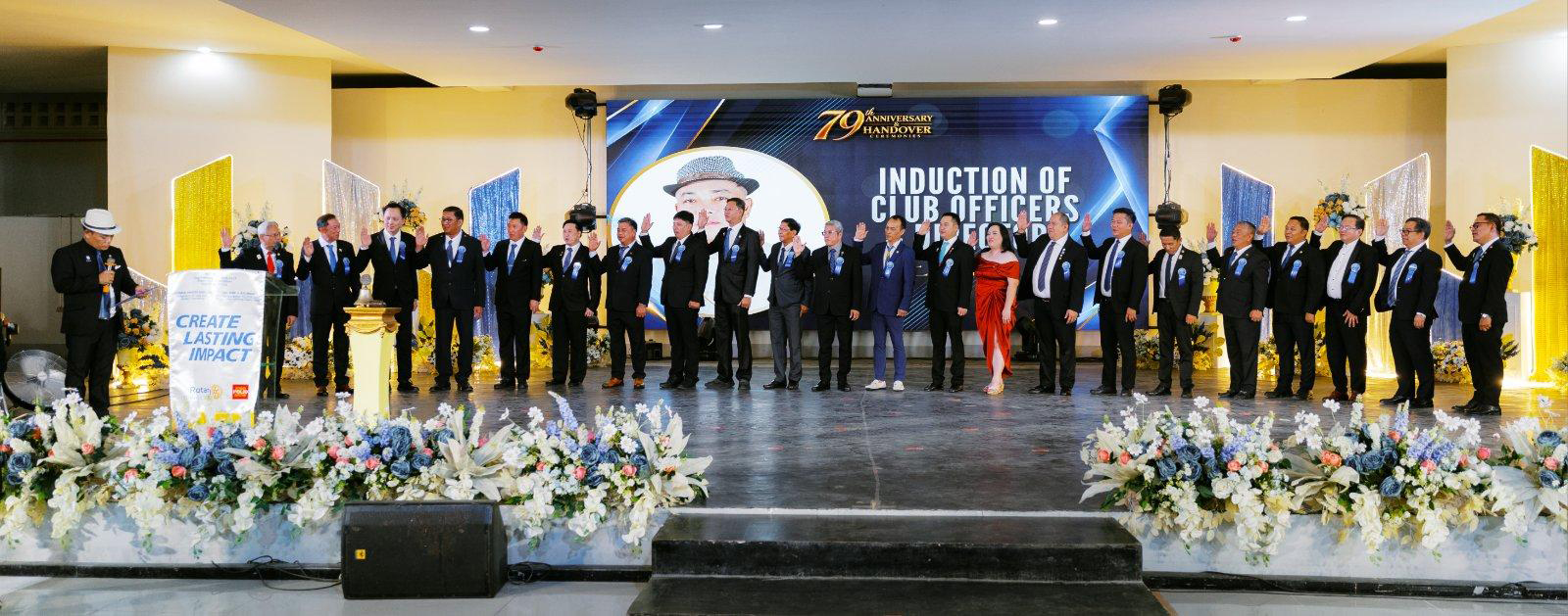
On Aug. 22, the Rotary Club of Tacloban marked its 79th Charter Anniversary, an occasion that also saw the formal induction of lawyer Niel Sia as the organization’s 80th president.
(JOEY A. GABIETA)