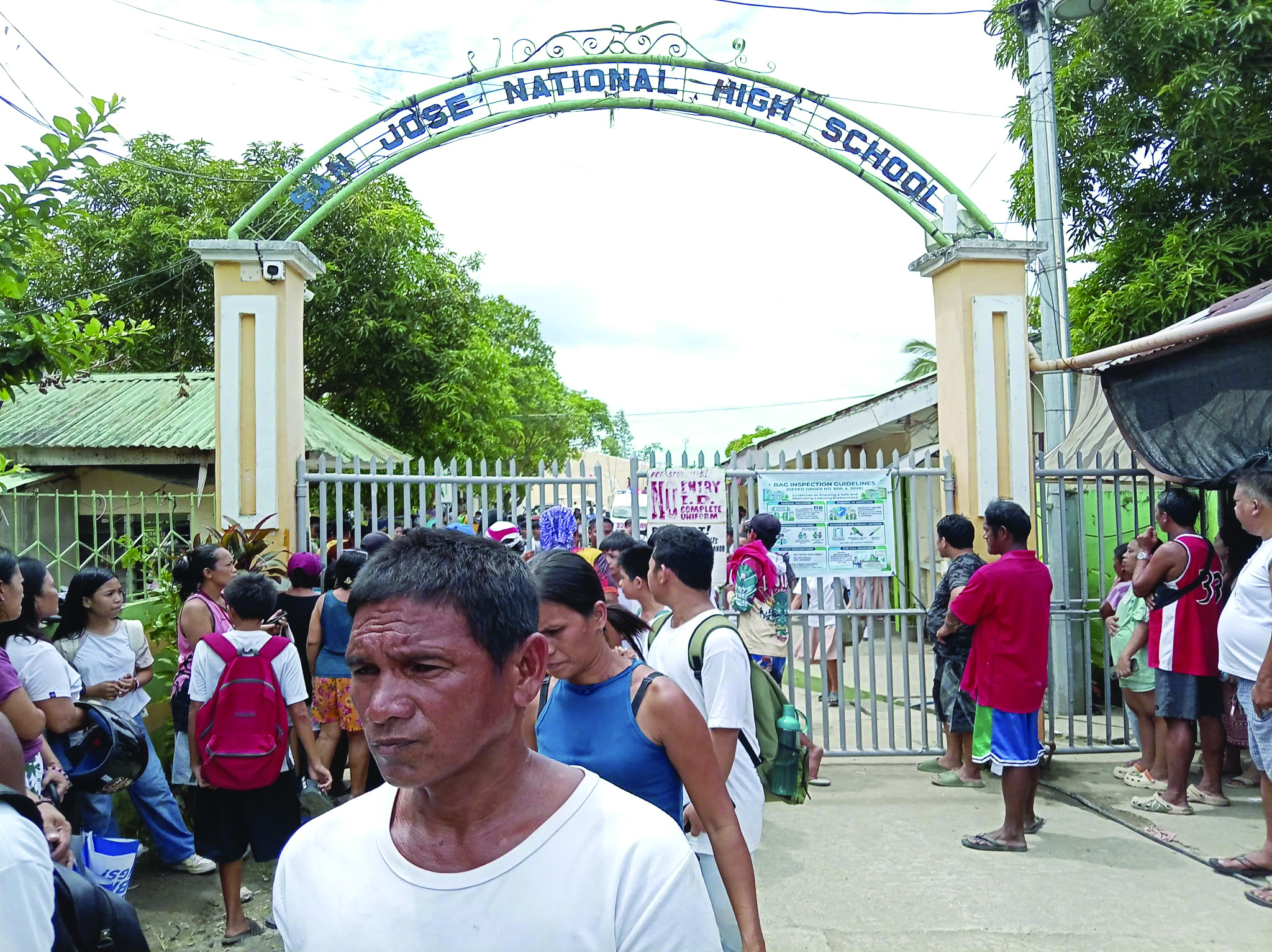
TACLOBAN CITY — Four students are facing complaints under the country’s anti-bomb joke law after authorities identified them as suspects in a series of school threat incidents reported across Eastern Visayas following the June 22 shooting at San Jose National High School here.
The Police Regional Office 8 (PRO 8) said it has recorded 16 school threat incidents in the region since the shooting, including bomb threats.
Lt. Col. Annaliza Armeza, chief of the PRO 8 Regional Public Information Office, said authorities have identified 10 suspects, while six others remain unidentified.
Four of the identified suspects have been subjected to appropriate complaints because they are children in conflict with the law (CICL) and are above 15 years old, Armeza said.
The complaints involve alleged violations of Presidential Decree No. 1727, or the “Anti-Bomb Joke Law.”
The other identified suspects were referred to their respective municipal social welfare and development offices, Armeza said.
The school threat incidents came amid heightened security concerns following the June 22 shooting at San Jose National High School, which left three students dead and 20 others injured.
Schools across the region subsequently received a series of fake shooting and bomb alerts, prompting authorities and education officials to strengthen security measures and warn students against making threats, even as jokes.
Department of Education (DepEd) Eastern Visayas Regional Director Salustiano Jimenez said the agency is coordinating with the National Police Commission, Philippine National Police and other agencies on appropriate action against students who make threats of violence on school campuses.
“Hindi ito biro, because isang biro may cause damage na hindi nila naisip na ganun pala kalaki,” Jimenez said.
“Dapat maintindihan ng mga bata na every action na ginawa nila, may kaakibat na consequence,” he added.
Among the schools that received alerts were Kapuso Village Elementary School, Sto. Niño SPED Center, Holy Infant College and Leyte National High School in Tacloban City; Eastern Samar National Comprehensive High School in Borongan City; Calubian National High School and Kananga National High School in Leyte; Allen National High School in Northern Samar; Samar National School and Eastern Visayas Regional Science High School in Samar; and Liloan National Technical-Vocational High School in Southern Leyte.
DepEd has also warned that students who make bomb threats, including those made as jokes, may face serious disciplinary consequences.
Under DepEd Order No. 006, s. 2026, signed by Education Secretary Sonny Angara in March, bomb threats and bomb jokes are classified as third-level offenses, the highest category under the department’s guidelines for a safe learning environment.
Other acts classified as third-level offenses include carrying firearms, drug possession, hazing and homicide.
For a first offense involving a bomb threat or bomb joke, a student may be allowed to finish the current school year but will not be readmitted the following school year. The student will also be referred to appropriate agencies, including the PNP and social welfare authorities.
A second offense may result in exclusion, or the immediate removal of the student from the school’s class list.
The warnings come as schools and authorities continue to address security concerns following the deadly shooting in Tacloban City and seek to prevent further threats that could disrupt classes and cause alarm among students, teachers and parents.
(ROEL T. AMAZONA)