
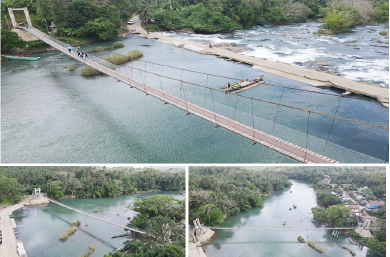
Catarman N. Samar– Residents of five remote barangays in the municipality of Victoria Northern Samar no longer have to rely on the existing overflow pathway on their way to their communities with the recent completion of a hanging bridge project of the Department of Public Works and Highways (DPWH)-Northern Samar 1st DEO.
The project involves the construction of a 105-meter hanging bridge, including two portals, floor framing, and cable works. It also includes the construction of slope protection structures at each abutment, supported by a 6-meter-deep sheet pile foundation at both portals.
DPWH-NSFDEO District Engineer Alvin A. Ignacio said that the hanging bridge greatly benefits not only the residents of Brgy. San Roman where it is located, but also those residing in the nearby Barangays of the said municipality.
Prior to its construction, locals used to cross the river through the existing overflow pathway which was difficult especially during rainy days where strong currents and rapid water flow in the river.
“Pag-nagbabaha talaga nagtatabok sira pero nakukurian sira pero kung hataas na talaga an tubig deri na sira nakaka-agi” said Rhodora T. Enecillio, one of the residents.
The completion of the bridge has also facilitated easier access to the town proper for the residents’ basic necessities and it also provides an efficient access route that significantly reduces the risks of crossing during weather disturbance.
“An akon masusugad yana sine nga amon hanging bridge nga masyado gi-upaya gud san ngatanan,dako an nabubulig sa katawhan”, Ms. Enecillio further stated.
DPWH Northern Samar First District Engineering Office (DEO) implemented the P14.42-million project with funding sourced from the General Appropriations Act (GAA) of 2024.
(ANALIZA A. PABIA/PR)
Beyond the Noise of Trial
“An tawo nga ginugutom, diri interesado hin mga diskurso!.”
(A person without food cannot listen to rhetorics.)
A country burdened with poverty, inequality, and social challenges must not allow itself to be distracted by the noise of high-profile trials. While justice is essential, governance and service to the people cannot be placed on pause. The International Criminal Court is tasked to handle the legal process; our nation’s leaders and citizens must continue the work of building livelihoods, strengthening social welfare, and ensuring progress.
In Waray, there is a saying: An Tawon ga ginugutom, diri interesado hin mga diskurso! (A person without food cannot listen to justice.) This reminds us that while accountability is important, hunger and poverty demand immediate attention. The courts will deliberate on the case, but the government must feed its people, educate its youth, and protect its workers.
Similarly, in Tagalog we say: “Habang may buhay, may pag-asa.” (As long as there is life, there is hope.) This hope is nurtured not in courtrooms but in farms, factories, schools, and communities. The trial must not paralyze the nation’s resolve to provide opportunities and dignity to its citizens.
The noise of politics and trials can easily drown out the cries of the poor. Yet, the true measure of a nation is not only in how it pursues justice but also in how it sustains its people. “An bista han kaso, para han korte; an panginabuhi, para han katawhan.” (Justice belongs to the court; life belongs to the people.) This balance is crucial: let the judges weigh evidence, while the nation continues to sow seeds of progress.
In the end, the path forward is clear. The trial will run its course, but the country must not falter in its duty to serve. Justice and livelihood are not enemies; they are parallel pursuits. By allowing the court to handle the case and focusing our collective energy on welfare and development, we honor both the rule of law and the dignity of life, in Waray it also declares may mga bout naman ini hira!.