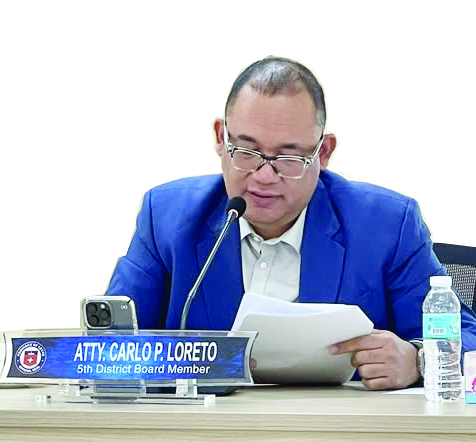
TACLOBAN CITY — House Committee on Higher and Technical Education Chairperson and EDCOM II Co-Chair Rep. Jude Acidre welcomed the proposed P1.38-trillion budget for education in 2026, calling it a “historic investment” and a clear indication of the government’s commitment to prioritizing education.
The allocation—about 4.5% of the country’s GDP—is the largest in Philippine history and aims to address critical challenges such as learning recovery, facility upgrades, governance improvements, and enhanced support for teachers and school leaders.
Acidre credited the Second Congressional Commission on Education (EDCOM II), led by Executive Director Karol Mark Yee, for advocating evidence-based reforms that influenced the proposed budget.
He highlighted that a significant portion of the funds will go to the Department of Education, supporting initiatives like the ARAL learning recovery program, classroom construction, school-based feeding, teacher hiring, and modernization of the basic education system.
For higher education and technical-vocational training, the budget will strengthen reforms under the Committee’s legislative agenda, including CHED governance modernization, expanded student access programs, digital transformation, micro-credentialing, and stronger partnerships between institutions and industry.
“Every peso must translate to real improvements in learning outcomes,” Acidre stressed, emphasizing careful fund management, inter-agency coordination, and efficient program implementation.
Describing the P1.38 trillion allocation as more than a number, he said, “It is a statement of national resolve. Education remains the country’s most important investment for inclusive growth and long-term prosperity.”
Acidre affirmed his commitment to work closely with education agencies and EDCOM II to ensure the historic funding yields meaningful progress for Filipino learners across all levels.
(LIZBETH ANN A. ABELLA)


“Blessed are the eyes that see what you see”
THAT’S in the gospel of St. Luke (10,23) where Christ said these words to his disciples in private. What Christ was trying to tell them was that the true knowledge of God is a gift of divine mercy, not a reward for human wisdom. It is granted to those who receive it with childlike humility.
Only when we are simple and humble like little children that we open ourselves to God’s grace. It’s when we make ourselves receptive and responsive to the God’s abiding providence over our life.
We really need to remain childlike even as we grow in age and stature, and even as we accumulate already quite a significant amount of knowledge with our exposure to the world and the life in general.
Yes, children and heaven are almost synonymous to each other. No wonder we feel like we are in heaven every time we see children around. Every time a baby is born, we are very happy because we somehow know that he just did not come out of his mother’s womb, but rather from the very hands of God who created him before the parents procreated him.
In spite of the many limitations of children, what makes them always desirable is their pure, innocent heart, incapable of malice, ambition, pride and haughtiness. They are a source of many other good things.
Their heart is always trusting in the Lord always, just like a little kid is always confident with his father. Faith and hope easily grow and acquire strength when nurtured in a child’s heart. It’s this attitude that leads them to go on and move on no matter what, for life to them could only be an adventure of discoveries.
Obviously, the privilege of seeing and hearing what the prophets could not should make the disciples, and now, us, to be ever grateful and to be more committed to carry out the mission now entrusted to the Church. That’s the only way to keep ourselves seeing and hearing what God wants us to see, hear and know.
And so, let us realize ever more deeply that we are meant to do apostolate, since that is in the very heart of Christ’s mission which should also be ours. Therefore, we need to sharpen our awareness of our apostolic duty, since left to our own devices, we would rather give our complete attention solely to ourselves. This tendency is a consequence of our sinfulness. But originally, before man’s fall, we tend to love and care for one another.
To develop this apostolic concern therefore entails sacrifice. We should not be surprised if in pursuing it we are challenged, faced with difficulties and asked to do self-denials and other forms of sacrifice.
We just have to hold firm on our Christian conviction, together with the continuing petition for God’s grace and the generous discharge of our human effort, that to do apostolate is the will of God. He is bent in accomplishing it. It’s his first concern to contend with the difficulties. Ours is simply to cooperate.
We have to continually ask ourselves if our thoughts and desires bear an eminently apostolic character. If not, let’s immediately do the necessary adjustments and corrections.
We have to embark also on a life-long effort to acquire apostolic skills—how to make friends and deepen that friendship, how to pursue full blast the supernatural apostolic goal of our life while respecting our natural conditions, etc.
The apostolic zeal should be revved to the max!