TACLOBAN CITY — A 21-year-old man listed as the No. 6 regional most wanted person for murder was arrested by police during a joint law enforcement operation in Albuera, Leyte on March 4.
Authorities identified the suspect as Reymart Celedio Camugao, also known as “Bata,” a farmer and resident of Sitio Tinago, Barangay Binulho, Albuera.
Camugao was apprehended at around 1:30 p.m. in Barangay Poblacion, Albuera by joint elements of the 1st Leyte Provincial Mobile Force Company, Provincial Intelligence Unit-8, Albuera Municipal Police Station, Regional Intelligence Unit-8 City Intelligence Team Ormoc, and the Anti-Kidnapping Group–Visayas Field Unit Ormoc Satellite Office.
Police served the warrant of arrest for murder issued by Judge Carlos Arguelles, presiding judge of the Regional Trial Court in Baybay City.
The court did not recommend bail for the accused due to the seriousness of the charge.
Authorities said the suspect was arrested without incident and was immediately taken to the Albuera Municipal Police Station for proper documentation and detention.
Under Philippine law, murder is a non-bailable offense when the evidence of guilt is strong, meaning the accused will remain in custody while awaiting further court proceedings.
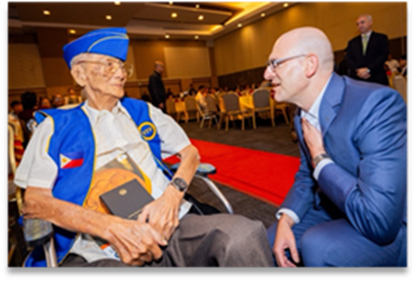
Chargé d’Affaires, a.i., Y. Robert Ewing speaks with Sgt. Alfredo de Leon del Rosario at the Congressional Gold Medal awarding ceremony in Tagum.)
Chargé d’Affaires, a.i., Y. Robert Ewing speaks with Sgt. Alfredo de Leon del Rosario at the Congressional Gold Medal awarding ceremony in Tagum.)
DAVAO CITY– As the United States and the Philippines celebrate 80 years of diplomatic ties, U.S. Embassy Chargé d’Affaires, a.i., Y. Robert Ewing honored Filipino war veterans at a Congressional Gold Medal awarding ceremony, the first of its kind in Tagum and second time in Mindanao. In Davao, he deepened economic and people-to-people ties in meetings with public and private sector leaders as well as students.
In Tagum, Chargé d’Affaires Ewing joined Philippine Defense Undersecretary Pablo Lorenzo, Philippine Veterans Affairs Office Administrator Reynaldo Mapagu, and Davao del Norte Governor Edwin Jubahib at the 45th presentation of the Filipino Veterans of World War II Congressional Gold Medal. It is the highest civilian honor conferred by the U.S. Congress. The awards delivered in Tagum were signed into law with the Filipino Veterans of World War II Congressional Gold Medal Act of 2015. These Congressional Gold Medals recognize the valor and sacrifice of Filipino veterans who fought shoulder-to-shoulder with U.S. forces to turn the tide in the Pacific during World War II. The first-ever Congressional Gold Medal was approved by the Continental Congress in 1776 and awarded to George Washington, a remarkable example of the deeply interwoven history of the United States and the Philippines as we celebrate America’s 250th anniversary in 2026.
“When their nation called, they stepped forward. They answered,” said Chargé d’Affaires Ewing. “And in doing so, they not only shaped the course of history but also forged the enduring friendship between the Philippines and the United States – a relationship built on shared sacrifice, mutual trust, and deeply held values.”
“The number of living Filipino World War II veterans continues to decline with each passing day, but through commemoration activities and recognition such as the awarding of the U.S. Congressional Gold Medal for Filipino World War II veterans, their heroic legacy will live on,” said Undersecretary Mapagu.
In Davao, Chargé d’Affaires Ewing toured the National Museum of the Philippines-Davao in the People’s Park with City Councilors Rachel Zozobrado and Ragde Niño Ibuyan, Davao City Investment Promotion Center Officer in Charge April Marie Dayap, and a group of Philippine alumni of U.S. government exchange programs. The visit was an opportunity to gain a greater understanding of the rich heritage and natural resources of Davao City and Mindanao while also discussing partnership opportunities to promote U.S.-Philippines prosperity. The Davao City officials expressed interest in exploring trade and investment opportunities, education and exchange programs, and revitalizing sister city relationships.
Chargé d’Affaires Ewing also took a moment for a group photo with the City Councilors in front of the iconic Davao City Hall, which celebrates its 100th anniversary, sharing a connection with the U.S. Embassy in Manila, as both buildings were designed by renowned Filipino architect Juan M. Arellano.
At a General Membership Meeting of the Mindanao chapter of the American Chamber of Commerce, Chargé d’Affaires Ewing spoke about efforts to enhance supply chain resilience and expand energy cooperation, and underscored opportunities for two-way trade and investment including the upcoming SelectUSA Investment Summit, a Trump Administration priority initiative to promote investment into the United States.
Chargé d’Affaires Ewing placed a spotlight on U.S.-Philippines education partnerships when visiting Filipino participants in the U.S. Embassy’s English Access Scholarship Program, a two-year, intensive after-school program that enhances academic and employment opportunities for public school students aged 13 to 15 through American excellence in English language instruction.
“Chargé d’Affaires Ewing’s visit to the 50 English Access Scholarship Program students highlights the strong commitment to youth development and educational partnership. His presence affirms the scholars’ potential and inspires them to strive for excellence, leaving a lasting impact,” said Davao City Schools Division Superintendent Dr. Reynante Solitario.
“The United States and the Philippines share more than an ironclad Alliance,” said Chargé d’Affaires Ewing. “We share a deep and enduring friendship and a commitment to partnerships that deliver concrete benefits for the American people while strengthening the bonds between our two nations.” (PR)
TACLOBAN CITY — Eastern Visayas has posted a strong showing in the government’s campaign against illegal drugs, with the majority of its local government units (LGUs) earning high-functionality status in the latest Anti-Drug Abuse Council (ADAC) Performance Audit.
Out of 149 LGUs in Region 8, a total of 129 — or 87 percent — were rated “high-functional” in the 2025 audit, signaling robust local implementation of anti-drug programs and sustained commitment to building drug-resilient communities.
The ADAC Performance Audit, spearheaded by the Department of the Interior and Local Government (DILG), evaluates how effectively local Anti-Drug Abuse Councils carry out their mandates.
These councils are tasked with leading prevention campaigns, coordinating rehabilitation efforts, and supporting law enforcement operations at the grassroots level.
Under the audit, LGUs are assessed based on key performance indicators, including executive leadership support, functionality of the local ADAC, strategic planning, budget allocation, and implementation of programs on drug prevention education, community-based rehabilitation, and enforcement assistance.
LGUs that achieved high scores demonstrated active council operations, clear action plans aligned with national policies, and dedicated funding for anti-drug initiatives.
The ADAC audit was institutionalized to ensure that anti-drug efforts are not limited to enforcement alone but are complemented by preventive education and recovery programs. It also promotes accountability among local chief executives in addressing drug-related concerns within their jurisdictions.
The strong performance of Region 8 LGUs underscores the critical role of local governments in sustaining the country’s broader anti-illegal drug campaign. While national agencies set policy directions, it is the LGUs that translate these into community-based actions — from barangay-level awareness drives to rehabilitation referrals and monitoring mechanisms.
Officials said the high compliance rate reflects strengthened coordination among local officials, law enforcement, health workers, schools, and civil society partners.
By maintaining functional and well-supported ADACs, Eastern Visayas LGUs are helping foster safer neighborhoods and more resilient communities.
The 2025 results, authorities noted, set a benchmark for continued improvement in local anti-drug governance — reinforcing that the fight against illegal drugs requires consistent leadership, adequate resources, and active community participation.
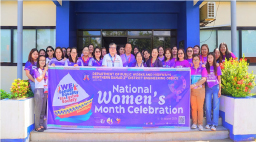
The Department of Public Works and Highways Northern Samar Second District Engineering Office (DPWH NSSDEO), spearheaded by District Engineer Atty. Arthur Eric L. Sabong and OIC-Asst. District Engineer Francisco Y. Tañala, reaffirms its commitment to women’s empowerment by joining the nation in celebrating National Women’s Month this March 2026. The annual observance of Women’s Month is in line with the Philippine Commission on Women’s theme for 2028: “WE for Gender Equality and an Inclusive Society”. The theme underscores DPWH’s commitment to acknowledging women’s significant contributions to the development of the nation and fostering a community and work environment that is equal and inclusive.
The theme, “WE for Gender Equality and an Inclusive Society”, is about gender equality as a shared responsibility of everyone. It signifies that “WE”- pertaining to women and everyone – must work together to achieve a community where all individuals, regardless of gender, have equal opportunities and are given the chance to thrive. The DPWH NSSDEO firmly recognizes that a strong and progressive society is one that upholds, honors, and empowers women.
The DPWH’s participation on this National Women’s month is a manifestation of its belief that this is not just a women issue but a societal significant involvement. By embracing this principle, the agency strengthens its capacity to deliver inclusive public service that contributes to national development while deliberately considering women’s rights. The Department of Public Works and Highways (DPWH) has always recognized the empowerment of women as the core of a resilient and progressive nation-building process. Gender-inclusive infrastructure planning and implementation, that is, designing safe public spaces, accessible transportation, and water sanitation systems which address womens particular needs, have a direct impact on community well-being and economic productivity.
The DPWH encouraged its employees to wear purple every Wednesday throughout the month of March as a symbol of unity and active participation in the celebration. This gesture signifies solidarity with the advocacy for women’s empowerment and gender equality.
The Department likewise enjoins all its employees, stakeholders, and the public to participate in the various activities and discussions organized throughout the month, fostering a deeper understanding and commitment to advancing gender equality and and promoting an inclusive society
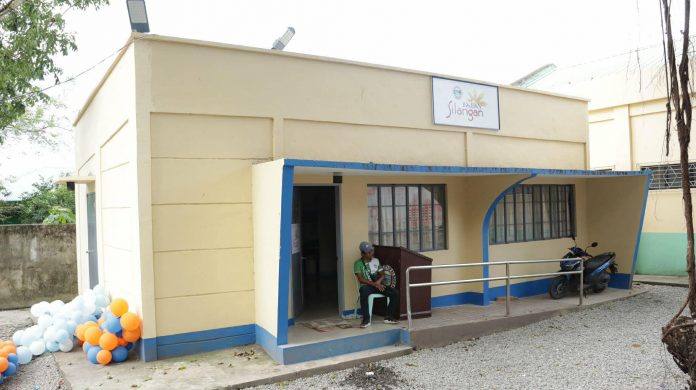
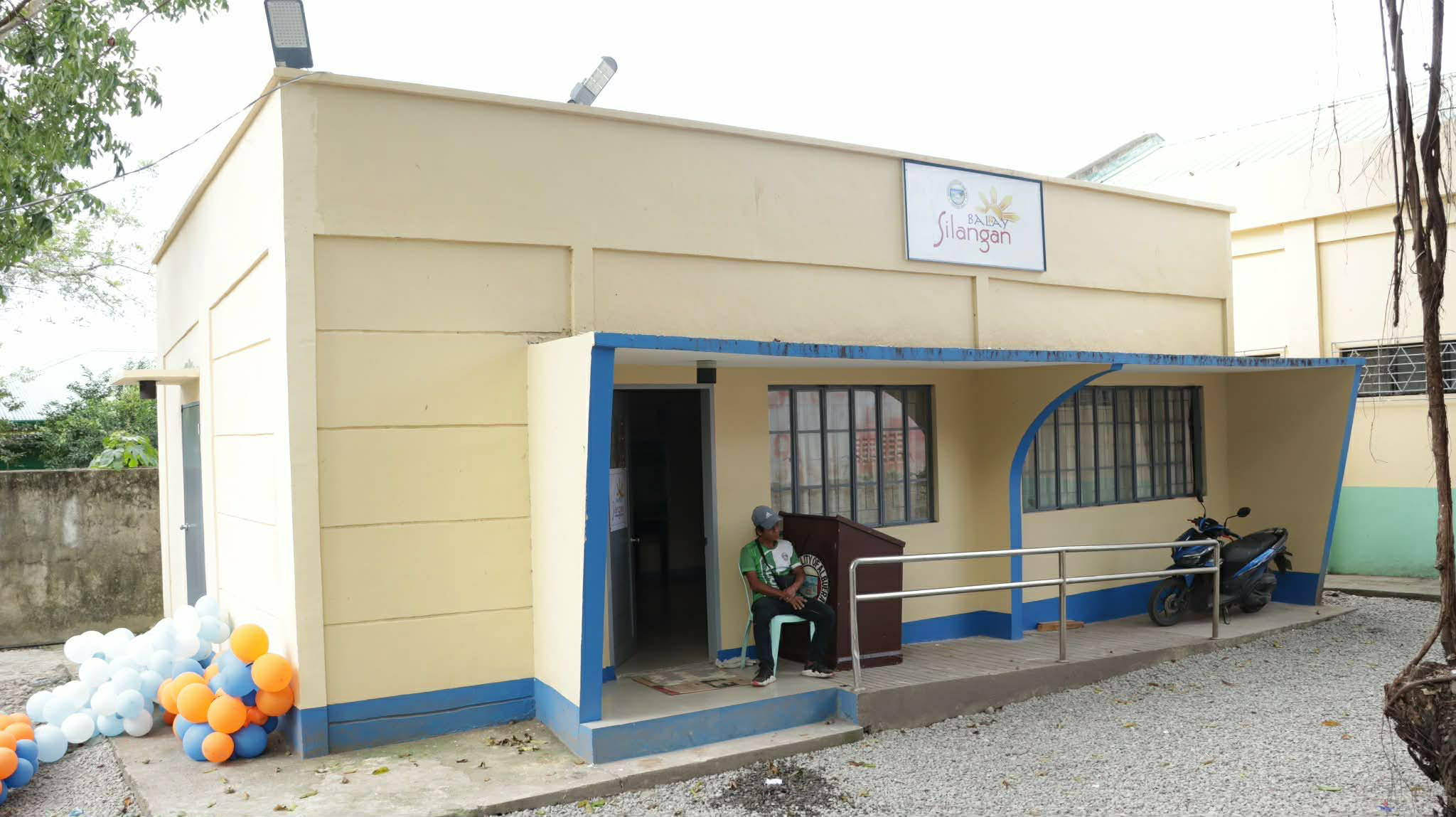
BALAY SILANGAN. A rehabilitation facility intended for those who are into illegal drug use was opened in Albuera, Leyte, dubbed as Balay Silangan Reformation Center. The inauguration of the facility was graced by town officials led by Mayor Rolan ‘Kerwin’ Espinosa and several representatives of different government offices like PNP and PDEA.(PHOTO COURTESY)
BALAY SILANGAN. A rehabilitation facility intended for those who are into illegal drug use was opened in Albuera, Leyte, dubbed as Balay Silangan Reformation Center. The inauguration of the facility was graced by town officials led by Mayor Rolan ‘Kerwin’ Espinosa and several representatives of different government offices like PNP and PDEA.(PHOTO COURTESY)
TACLOBAN CITY– Strengthening its response to illegal drugs through rehabilitation rather than punishment alone, the Municipality of Albuera on March 3 formally opened its own Balay Silangan Reformation Center, becoming the sixth town in Leyte to establish the facility.
The launch and signing of the memorandum of agreement were held in Canlalin 1, Poblacion, gathering local officials, law enforcement units, and partner agencies in a unified push for community-based recovery programs.
Mayor Rolan Espinosa led the ceremony alongside Vice Mayor Mariel Marinay and Sangguniang Bayan Member Rolando Ebcas Jr., chair of the Committee on Public Order, Safety and Human Rights.
They were joined by Eleanor Tamse, focal person of the Municipal Anti-Drug Abuse Council (MADAC) and Community-Based Drug Rehabilitation Program (CBDRP), who will serve as the center director.
The Balay Silangan program, initiated by the Philippine Drug Enforcement Agency (PDEA), provides a structured intervention for drug reformists, focusing on values formation, spiritual enrichment, life skills training, and livelihood development.
Representing PDEA Leyte during the event was IAV Bryan Ponferrada on behalf of Regional Director Levi Ortiz, reaffirming the agency’s support for local government-led rehabilitation efforts.
Also present were Major Franklin Romeo Parangan, acting chief of the Albuera Municipal Police Station, and SFO3 Romulo Mascariñas, municipal fire marshal, underscoring the collaboration of public safety sectors in the initiative.
Education and skills development partners — including the Department of Education’s North and South Districts, the Alternative Learning System, the Technical Education and Skills Development Authority (TESDA) Region VIII, and Brightspark International Training and Assessment Center, Inc. — pledged support to help reformists gain competencies for employment and reintegration.
Local officials emphasized that the center is envisioned as more than a rehabilitation facility. It will serve as a safe space where recovering individuals can address substance dependency while receiving psychosocial support and vocational training to rebuild their lives.
With the opening of the Balay Silangan Reformation Center, Albuera reinforces its commitment to a balanced anti-drug strategy — one that promotes accountability but also offers healing, dignity, and a second chance.
CRUISE TOURISM ROADMAP. The Department of Tourism (DOT) headed by Regional Director Karina Rosa Tiopes is pushing for the creation of a regional cruise tourism roadmap aimed at boosting Eastern Visayas potential as a cruise tourism destination.
(DOT-EASTERN VISAYAS)
CRUISE TOURISM ROADMAP. The Department of Tourism (DOT) headed by Regional Director Karina Rosa Tiopes is pushing for the creation of a regional cruise tourism roadmap aimed at boosting Eastern Visayas potential as a cruise tourism destination. (DOT-EASTERN VISAYAS)
TACLOBAN CITY — The Department of Tourism (DOT) is pushing for the creation of a regional cruise tourism roadmap aimed at guiding the sustainable development of the growing cruise industry in Eastern Visayas.
The initiative was discussed during a presentation of key findings on the impacts of cruise tourism in Eastern Visayas held on February 27 at the Summit Hotel, this city.
Tourism officers and local chief executives from municipalities and provinces that have hosted cruise ship visits attended the event, where stakeholders examined opportunities and challenges facing the emerging tourism sector.
Resource speaker John Paolo Rivera presented an overview of the current cruise tourism landscape in Eastern Visayas, highlighting the industry’s economic potential while pointing out operational and sustainability concerns.
Rivera said cruise ship visits provide direct economic benefits to coastal communities, stimulate the growth of micro, small, and medium enterprises, and help boost the region’s visibility in international tourism markets.
He noted that Eastern Visayas has increasingly become a preferred stop for expedition-style cruise itineraries, with repeat visits recorded in destinations such as Kalanggaman Island and Cuatro Islas.
Other sites that have begun attracting cruise tourism include Capul Island, Biri Island, Lavezares, Maripipi, Sambawan Island, Higatangan Island, and Limasawa Island.
According to DOT-8, interest from international cruise operators continues to grow. For the 2027–2028 season, a French luxury cruise line has already conducted site assessments in several locations in the region as part of its evaluation for possible inclusion in future itineraries.
Participants in the meeting also discussed ways to strengthen community-based tourism, develop sustainable shore excursions, and promote collaborative destination marketing among local government units and tourism stakeholders.
The situational analysis presented during the activity underscored the need for strategic planning, strong community participation, and environmental stewardship to ensure that cruise tourism development benefits host communities while protecting natural and cultural resources.
The proposed Eastern Visayas Cruise Tourism Roadmap will be developed based on survey results and consultations with stakeholders to guide the long-term and sustainable growth of cruise tourism in the region.