
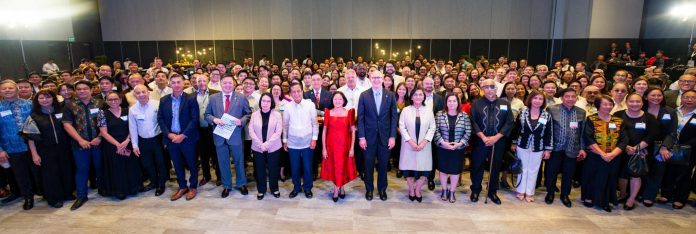
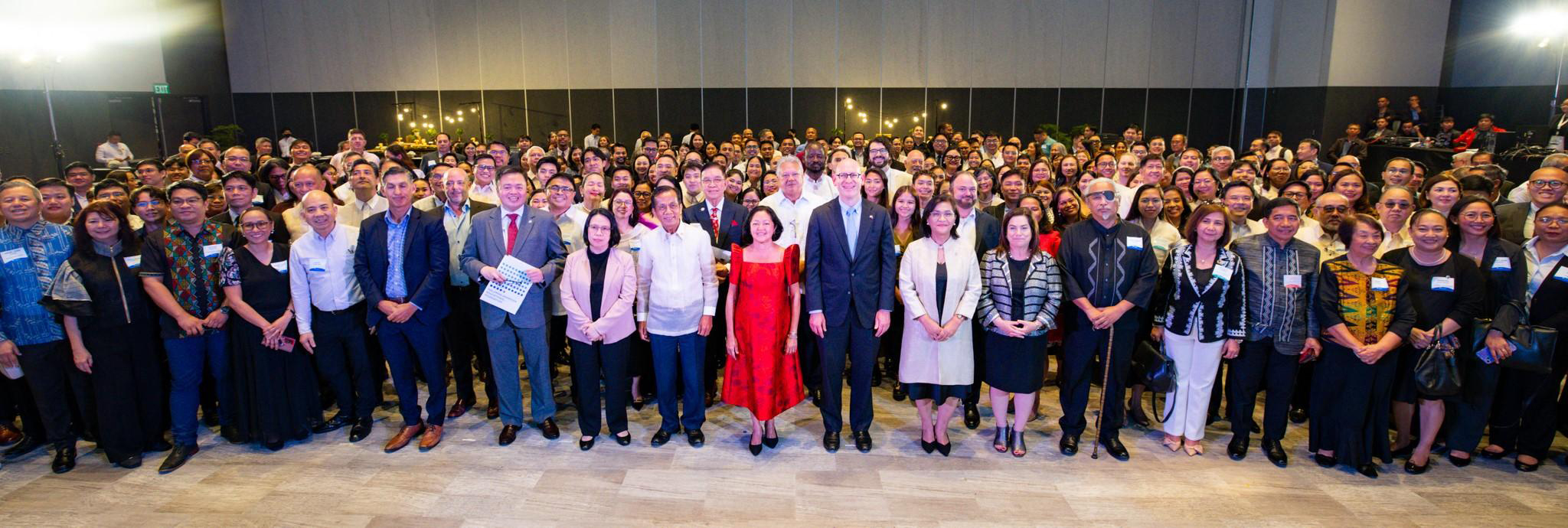
MAKATI CITY– The Philippine-American Educational Foundation (PAEF), also known as the Fulbright Commission in the Philippines, celebrated its 78th anniversary on March 24, marking nearly eight decades of strengthening educational exchange and mutual understanding between the Philippines and the United States.
The reception, held at SPACE at One Ayala, gathered more than 300 partners, alumni, scholars, and representatives from the business community and the Philippine and U.S. governments – First Lady Louise Araneta-Marcos, U.S. Embassy Chargé d’Affaires, a.i., Y. Robert Ewing, Department of Economy, Planning, and Development Secretary Dr. Arsenio Balisacan, Commission on Higher Education Chairperson Dr. Shirley Agrupis, Department of Tourism Assistant Secretary Christine Joy Cari, and Ayala Corporation President and CEO Mr. Cezar Consing – to celebrate the enduring impact of the Fulbright Program and recognize the individuals and institutions that have contributed to its legacy.
2026 marks several milestones for the United States and its longstanding ties with the Philippines: the 78th anniversary of PAEF, the 80th anniversary of U.S.-Philippine diplomatic relations, the 80th anniversary of the global Fulbright Program, and the 250th founding anniversary of the United States. Together these milestones underscored PAEF’s transition from managing scholarships to forging strategic, high-impact partnerships.
“For 78 years, PAEF has supported generations of scholars and innovators – a network of more than 4,000 U.S. and Filipino alumni – who have returned home to shape their societies. These individuals prove that enduring alliances are sustained by people-to-people connections,” said Chargé d’Affaires Ewing. “The Fulbright mission – rooted in innovation, academic freedom, and the pursuit of knowledge for the benefit of all – reflects the enduring American ideals that we celebrate and uphold, especially this year as we mark the 250th anniversary of U.S. independence,” he added.
Consing, PAEF Board Member and President and CEO of Ayala Corporation, made a compelling case for deeper private sector engagement with Fulbright. “Fulbright represents excellence, intellectual rigor, global exposure and impactful leadership — these are precisely the attributes that companies look for when we hire technical specialists, middle managers or senior leaders,” he said.
Balisacan, PAEF Board Member and Secretary of the Department of Economy, Planning and Development, delivered the closing remarks on behalf of the Philippine government, affirming the state’s deepened commitment to the Fulbright partnerships. “Academic exchange is far more than a privilege or a fleeting opportunity – it is a strategic investment in human capital, institutional strength, and the country’s long-term development,” Balisacan said. He noted that through the combined efforts of the Department of Economy, Planning, and Development and the Department of Foreign Affairs, the Philippines has doubled its annual contribution to PAEF’s budget, reflecting the government’s belief that merit-based opportunities are among the most effective means of building world-class institutions.
The presence of First Lady Louise Araneta-Marcos lent special significance to the occasion, reflecting the high level of support from the Philippine government for the Fulbright Program and the broader U.S.-Philippines partnership in education and human capital development.
The anniversary highlights the continued commitment of Fulbright Philippines to expanding educational opportunities, fostering academic excellence, and promoting people-to-people connections through international exchange. Through its programs, Filipino and American scholars have engaged in graduate studies, research collaborations, teaching, and professional development across a wide range of disciplines.
Established in 1948, PAEF administers the Fulbright Program in the Philippines in partnership with the Philippine and the United States governments. Over the past 78 years, the foundation has supported thousands of Filipino and American scholars, researchers, students, and professionals in pursuing academic and cultural exchange opportunities that have contributed to leadership development, research advancement, and cross-cultural collaboration.
Fulbright Philippines operates in cooperation with the U.S. Embassy in the Philippines, the Department of Foreign Affairs, the Department of Economy, Planning and Development, and the Commission on Higher Education. Partner government agencies include the Department of Agriculture, the Philippine Space Agency, and the Technical Educational Skills Development Authority.
As the world’s longest-continuing Fulbright Commission, PAEF continues to serve as a cornerstone of bilateral educational cooperation between the two countries. Honoring the past while strategically designing the future of the Philippine-American excellence. (PR)
The cornerstone of trust: Corporate governance, transparency, and accountability
In today’s complex and interconnected business landscape, the concepts of transparency and accountability have risen to the forefront, becoming indispensable pillars upon which trust and sustainable growth are built. At the heart of these principles lies corporate governance, the system of rules, practices, and processes by which a company is directed and controlled. Effective corporate governance serves as the compass guiding organizations toward ethical conduct, responsible decision-making, and ultimately, long-term value creation.
The Essence of Corporate Governance
Corporate governance refers to the system of rules, practices, and processes by which a corporation is directed and controlled. It fundamentally concerns the relationships and accountability structures among a company’s senior management, its board of directors, its shareholders, and its broader stakeholder community. It defines the distribution of rights and responsibilities, ensuring that the board is accountable to the shareholders, while management is accountable to the board. This framework is designed to prevent conflicts of interest, promote fairness, and safeguard the interests of all parties involved.
Transparency: Illuminating the Path
Transparency, a key tenet of corporate governance, entails the open and honest disclosure of information relevant to a company’s performance, financial health, and ethical conduct. By providing stakeholders with access to timely and accurate data, transparency enables informed decision-making, fosters trust, and reduces the potential for fraud and mismanagement.
Examples of transparent practices include:
• Financial Reporting: Regular and detailed financial statements, prepared in accordance with established accounting standards, provide insights into a company’s revenue, expenses, assets, and liabilities.
• Disclosure of Material Information: Companies are obligated to disclose any information that could materially affect their stock price or investment decisions, such as significant contracts, mergers, or regulatory changes.
• Executive Compensation: Transparent disclosure of executive salaries, bonuses, and other benefits ensures that compensation packages are aligned with performance and shareholder interests.
• Environmental and Social Impact: Increasingly, companies are disclosing information about their environmental footprint, social initiatives, and ethical sourcing practices, demonstrating a commitment to sustainability and corporate social responsibility.
Accountability: Taking Ownership
Accountability complements transparency by ensuring that individuals and entities are held responsible for their actions and decisions. In the context of corporate governance, accountability means that directors and managers are answerable to shareholders and other stakeholders for the performance of the company and the consequences of their choices.
Key mechanisms for promoting accountability include:
• Independent Board of Directors: A board composed of independent directors, free from conflicts of interest, is essential for overseeing management and ensuring that decisions are made in the best interests of the company.
• Audit Committees: These committees, typically composed of independent directors, are responsible for overseeing the company’s financial reporting process and ensuring the integrity of its financial statements.
• Shareholder Rights: Empowering shareholders with the right to vote on key decisions, such as the election of directors and executive compensation, strengthens accountability and encourages responsible corporate behavior.
• Whistleblower Protection: Establishing channels for employees and other stakeholders to report suspected wrongdoing without fear of retaliation promotes ethical conduct and helps to uncover potential problems.
The Benefits of Strong Corporate Governance
The benefits of robust corporate governance, transparency, and accountability extend far beyond mere compliance with regulations. Companies that embrace these principles are more likely to:
• Attract Investment: Investors are increasingly seeking out companies with strong governance practices, viewing them as less risky and more likely to deliver sustainable returns.
• Enhance Reputation: A reputation for transparency and ethical conduct can enhance a company’s brand image, attract customers, and build trust with stakeholders.
• Improve Performance: Effective corporate governance can lead to better decision-making, improved operational efficiency, and enhanced financial performance.
• Reduce Risk: By promoting transparency and accountability, companies can identify and mitigate potential risks, such as fraud, corruption, and environmental damage.
In an era of heightened scrutiny and increasing stakeholder expectations, corporate governance, transparency, and accountability are no longer optional extras but essential ingredients for success. By embracing these principles, companies can build trust, attract investment, enhance performance, and create long-term value for all stakeholders. As businesses navigate the complexities of the 21st century, a commitment to ethical conduct and responsible decision-making will be the compass guiding them toward a sustainable and prosperous future.
————–
If you have any questions or would like to share your thoughts on the column, feel free to send an email to jca.bblueprint@gmail.com. Looking forward to connecting with you!