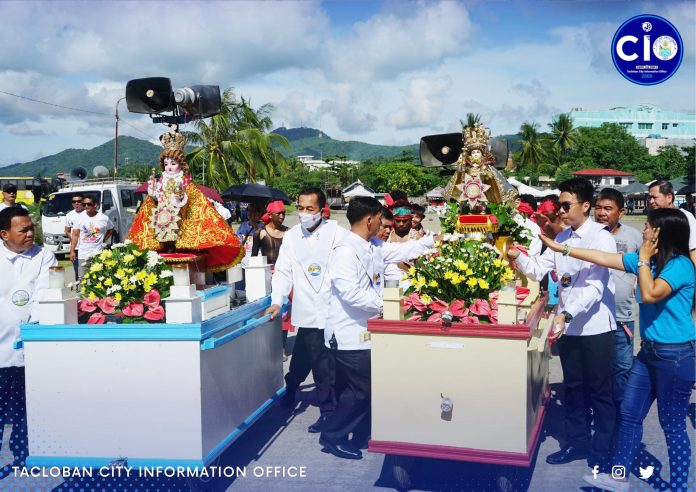
BALYUAN RITES. The exchange of images of Señor Santo Niño of Tacloban City and Basey town, known as Balyuan rites, was held on Tuesday(June 20), 10 days before Taclobanons marks its annual fiesta with the Child Jesus as its patron.
(TACLOBAN CITY INFORMATION OFFICE)
TACLOBAN CITY– On Tuesday, June 20, Taclobanons and Baseynons celebrated the 49th Balyuan Rites, which relieved the historic exchange of Sto. Niño images between Tacloban and Basey, Samar.
BALYUAN RITES. The exchange of images of Señor Santo Niño of Tacloban City and Basey town, known as Balyuan rites, was held on Tuesday(June 20), 10 days before Taclobanons marks its annual fiesta with the Child Jesus as its patron. (TACLOBAN CITY INFORMATION OFFICE)
City Administrator Atty. Anacleto Rei Lacanilao III, who represented Mayor Alfred Romualdez, and Basey Mayor Luz Chu-Ponferrada led the yearly observance with government and church officials and devotees, including Raymund Romualdez, HIraya president and son of Mayor Romualdez.
The image of El Teniente, a replica of Sto Niño de Tacloban, arrived in a fluvial procession from Basey and was met by city government officials and devotees at the Balyuan wharf.
A procession with the image of Sto. Niño de Basey proceeded to the amphitheater, where the rites were solemnly held in the presence of local officials and devotees.
The ceremonial exchanging of the images and the brief messages made by the officials during the occasion, which emphasized the continuous fellowship between Tacloban and Basey in upholding their common history and heritage were the event’s highlights.
On June 16, El Teniente was rendered in a motorcade to Basey town, 8 kilometers away from the city, for the Pre-Balyuan rites.
A floral offering to the two images capped the event.
The Balyuan rites likewise signaled the start of the nine-day novena mass for the City’s 134th Fiesta Celebration. (H.ROCA/TACLOBAN CITY INFROMATION OFFICE)
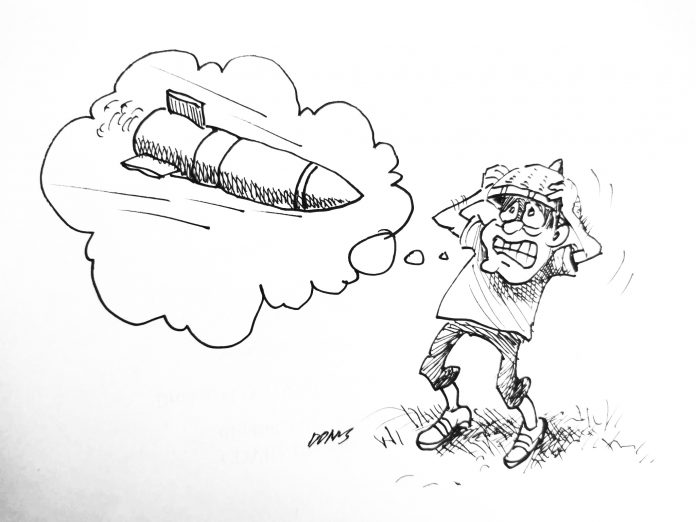
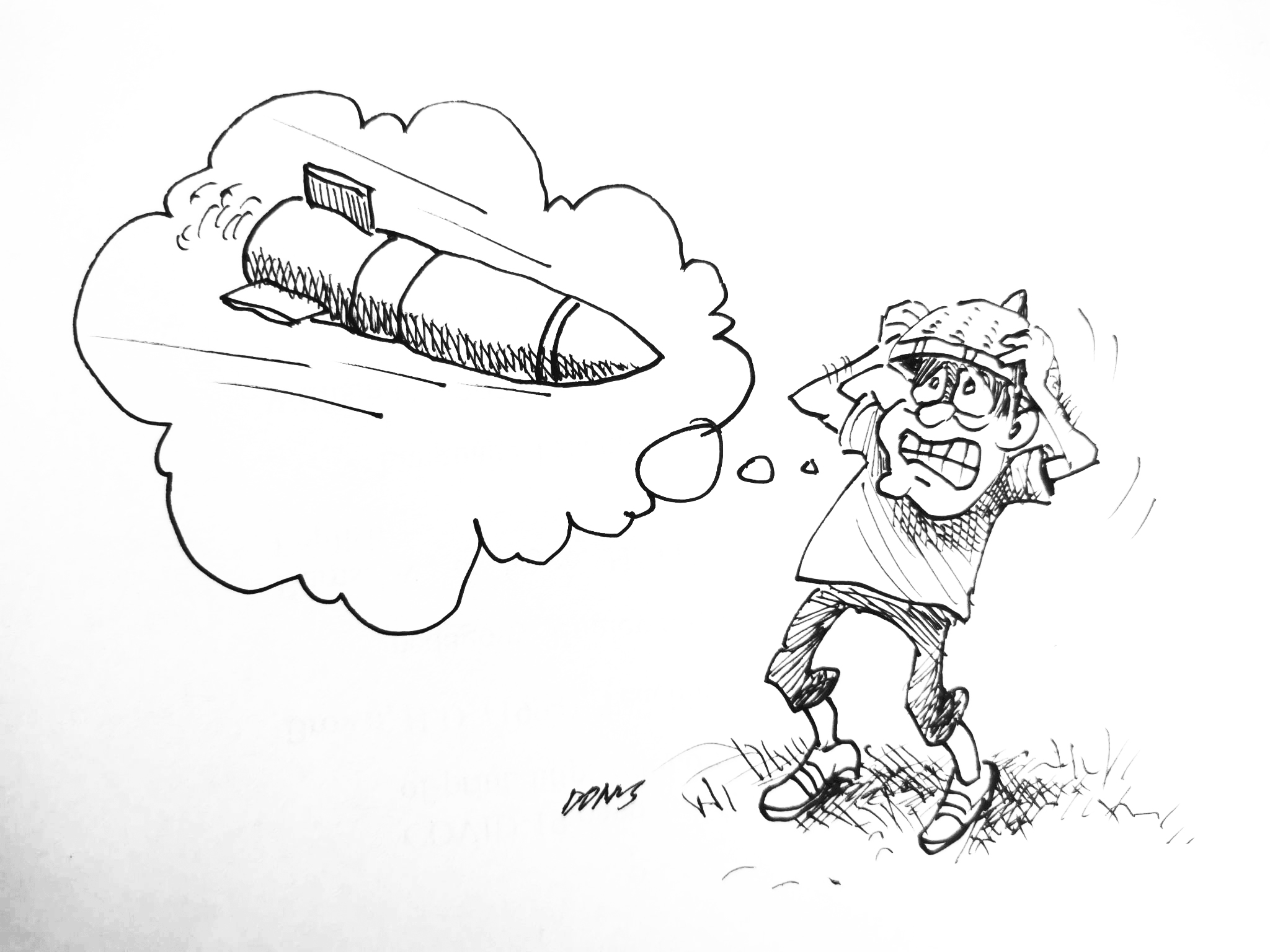
Rumors of war have been the source of human fear, speculation and anxiety throughout history. With the advent of modern communication technology, rumors have become even more pervasive, widely spread and difficult to verify or refute. These rumors are particularly troublesome because they can fuel tensions, trigger conflicts and undermine confidence in peaceful solutions.
Said rumors of war can be caused by various factors, including misunderstandings, propaganda, deliberate falsehoods and genuine concerns. Tensions arising from territorial disputes, ideological differences, economic competition, religious conflicts or historic enmities can easily generate rumors of impending war. Modern media platforms, such as social media, can amplify and spread rumors at a faster pace and with greater reach, often without regard for accuracy or context. Furthermore, governments, political groups, and other actors may deliberately spread rumors to advance their agendas or manipulate public opinion. In some cases, rumors of war may be rooted in genuine fears and anxieties, as people try to make sense of complex and uncertain situations.
The consequences of rumors of war can be serious and far-reaching. At the individual level, rumors can cause fear, panic, and anxiety, leading to emotional and physical harm. At the societal level, rumors can fuel tensions, exacerbate conflicts, and undermine confidence in peaceful solutions. Rumors can also increase military spending, trigger arms races, and lead to real military deployments and actions. When rumors are spread irresponsibly, they can have long-lasting repercussions, such as stigmatizing ethnic or religious groups, perpetuating stereotypes, and promoting hate speech. As such, it is essential to address these rumors with a sense of urgency and responsibility.
Dealing with this misinformation requires a multi-faceted approach. Governments, civil society organizations, and media outlets can play a crucial role in promoting peace, intervening to prevent conflicts and addressing misinformation. One way to combat rumors is to increase transparency and communication channels, providing clear and accurate information to the public. Another method is to build trust among communities that may distrust each other, by promoting dialogue, negotiation, and cooperation. Additionally, strengthening legal frameworks, such as hate speech and defamation laws, can help to counteract malicious rumors and propaganda. Finally, education on critical thinking and media literacy can help to empower individuals to recognize and question rumors, using their judgment and cognitive abilities to seek the truth.
By raising awareness, promoting dialogue, increasing transparency, and strengthening legal and educational frameworks, we can create a more peaceful and informed society, capable of reasoning and rational thinking. Ultimately, our collective efforts in countering rumors of war can contribute to building a world where conflicts are resolved through peaceful means, mutual respect, and understanding.
In the evolution of education, it is becoming increasingly important for students to be exposed to research as early as possible. There is a growing recognition of the immense benefits of introducing students to research at a young age, a pursuit that helps them develop analytical and critical thinking skills, as well as other valuable academic abilities. Why should the students be exposed to it, and what are the implications of such exposure on their academic journey?
Exposing students to research helps them develop analytical and critical thinking skills. Indeed, research requires students to undertake proper analysis, critically evaluate evidence, draw conclusions, and communicate their findings effectively. These skills are essential in any academic field and are particularly valuable for students pursuing graduate degrees. By bolstering their analytical and critical thinking capabilities, students will find that they are better able to navigate complex academic and professional challenges.
Also, exposure to research introduces students to wider perspectives and areas of knowledge. Engaging in research allows students to explore new fields and expand their understanding of familiar ones. Through their findings, students gain a deeper appreciation for the complexities of the world around them, while also becoming better equipped to identify and address pressing social, economic, and political issues. This broader perspective can be beneficial throughout their academic and professional lives, giving them the tools they need to become more well-rounded individuals.
This exposure to research likewise enables students to develop technical skills that are essential to their academic success. By engaging in research, students learn how to use a variety of software applications and other specialized tools that are necessary for data collection, analysis, and dissemination. This technology literacy can position students to better succeed in their future work, as many of the jobs that await them will require technical abilities that they will acquire while undertaking research.
Moreover, exposure to research provides students with hands-on experience, which can be a great way to prepare them for their future careers. Through their research projects, students can learn how to apply principles and theories learned in the classroom to real-life scenarios. This approach helps them gain practical knowledge that can be highly beneficial when they enter the workforce as they already possess some real-world experience in their specialized field or industry.
Research exposure can also provide opportunities for students to engage in collaborative work. Collaboration and communication are essential skills that students need to succeed academically and professionally. Research projects provide a platform for students to work with others who have different perspectives and skills that can help them achieve their goals much faster as they have the chance to divide the work among the group and take advantage of each other’s strengths.
What more, exposure to research helps students develop self-confidence and motivation. Engaging in research necessitates the development of certain leaderships and decision-making abilities, which can provide students with a sense of purpose and direction. Through their research work, students learn how to take ownership of their work, become self-driven and motivated. This self-motivation and belief in oneself go a long way in achieving academic and personal success.
The need for students to be exposed to research cannot be overstated. In essence, research promotes lifelong learning and equips students with a range of diverse tools and skills that they can apply to different situations throughout their academic and professional journeys. Universities, educators, and policymakers, therefore, need to prioritize research and ensure that students have ample opportunities to undertake research activities.
CHRIST exhorts us to be so. “So do not be afraid of them,” he said. “Everything now covered up will be uncovered, and everything now hidden will be made clear. What I say to you in the dark, tell in the daylight; what you hear in whispers, proclaim from the housetops. Do not be afraid of those who kill the body but cannot kill the soul; fear him rather who can destroy both body and soul in hell.” (Mt 10,26-28).
If we believe in Christ, we know that we have nothing to be afraid of, as long as we carry out his will. He will take care of everything. Yes, some effort, even extraordinary effort would be needed. And we can expect all kinds of challenges and difficulties along the way. We would not be exempted from suffering. But then again, Christ takes care of everything.
In another part of the gospel, he clearly gave us this assurance. “In this world you will have trouble. But take heart! I have overcome the world,” he said. (Jn 16,33) We need to etch these words indelibly in our mind and heart as we carry out our Christian duty to evangelize and to do apostolate.
Truth is the world, especially these days when it is spiralling out of control in a sophisticated web of attractive errors and confusion, is in great need of God’s word and spirit. We have to follow what St. Paul once said, “Preach the Word; be prepared in season and out of season; correct, rebuke and encourage–with great patience and careful instruction.
“For the time will come when men will not put up with sound doctrine. Instead, to suit their own desires, they will gather around them a great number of teachers to say what their itching ears want to hear. They will turn their ears away from the truth and turn aside to myths.” (2 Tim 4,2-4).
Let’s also keep in mind what Christ said about when we are faithful to his will and when we are not. “If anyone declares himself for me in the presence of human beings, I will declare myself for him in the presence of my Father in heaven,” he said. “But the one who disowns me in the presence of human beings, I will disown in the presence of my Father in heaven.” (Mt 10,32-33).
If we want to be truly and consistently Christian, we would give no place in our heart for fear other than that wonderful gift of the Holy Spirit that is the healthy fear of the Lord. That fear of the Lord is the fear of offending God that would lead anyone to prefer to die for Christ rather than to sin.
About the only reason to fear, worry and be sad is when we lose our faith, when we lose touch with God. We have to pray and pray so that our doubts and fears would not undermine our faith.
Let’s not waste time and energy by falling into the grips of fears, worries and sadness. When we notice that we are having some languid moments, it can be a sign that our faith is not working, and that we are succumbing to the laws of the flesh and the world, if not, to the tricks of the devil.
Especially in our dark and difficult moments, which these days are not anymore uncommon, when we feel so miserable that we can think that we have been deserted by God, we need to react immediately and reassure ourselves strongly that God never fails us.
The Philippine government has scheduled on July 2023 the launching, through the Department of Agriculture (DA), of a World Bank (WB) funded rural development program for farmers and fishers.
The WB country director stressed to the DA officials during its recent meeting, the significance of designating July as timeline for the launching of the PRDP Scale-Up project – costing $827.48 million. Of these, the WB will provide $600 million financing through the International Bank for Reconstruction and Development (IBRD), while $227,48 million will be financed by the Philippines.
According to the WB “. . . the PRDP Scale-Up project “would bring a strategic shift through a greater emphasis to bring transformative changes in value chains to improve farmers and fisherfolks profitability and enhance value chain efficiencies.” Considered as a build-up to an existing 8-year old PRDP, the latest Scale-Up version “will focus more on public infrastructure interventions to improve value chain connectivity and efficiencies, as well as support private sector-led common service facility development and operations. Likewise, the program will focus on catalyzing the start-up, expansions and business orientation of micro to medium-scale agri-fishery enterprises.
MY COMMENT
It’s a gratifying to note that recent events have shown compassion to the marginalized farmers and fishers who break their backbones in order to bring food to the Filipino families’ tables, send children to schools, etc. The shabby treatment felt by the lowly agricultural workers is more or less reduced when opportunities like the WB funded project has identified the farmers and fishers as beneficiaries.
It is hoped that more assistances are extended to the agricultural workers, viz, restore, accelerate higher production of farm products, rice, corn, coconut, etc. I would be most grateful to the Lawmakers should they shift from quantity to quality legislation-making, Instead, especially focusing on agriculture crops production and showing concerns to the farmers and fishers, among others.
ooo000ooo
NEXT TOPIC : “DOE ACCELERATES R E GROWTH WITH SECOND G E A”
SHARE S & T THOUGHTS through E-Mail: drpacjr@yahoo.com.
We know too well that rice is the staple food of many people. It is considered as one primary source of energy for our body. That is why many of our people, particularly those engaged in manual labor, would look for rice more than any other food. Farmers and laborers are sustained by the staple even with less viand for their meals. This group of workers could not withstand a day’s labor without eating ample amount of the staple. But other workers or even those who are not engage in productive occupation are similarly dependent on rice as basic food. It may be because we are made to grow on rice beginning from infancy that we develop dependency on rice. It seems tough to depart from what we have grown and lived with all our lives. It is the primary food that had been implanted in our consciousness to the point that we starve for it and remain feeling hungry without it.
The greatest irony is while we have been trained to grow by rice, many of us had not been trained to grow rice. It is being implanted in our consciousness as the basic food is not coupled with the consciousness to plant that food. We had in short been engrossed in a culture that depends on rice as our staple food but production seems not part of the culture. In fact, those engaged in the production of the staple are exploited in many ways and hardly reap the fruits of their labor. The people who live by the sweat of their brows and the mud on their feet are unwilling victims of an unjust social order where they remain captives living on the bondage of the soil. The exploiters among the rich and powerful, those who have the capital needed to produce rice, are the ones getting the huge chunk of the profits from the rice industry.
While faced with this real inequity, many of our farmers are realizing the difficulty of their living, pushing them to aim or just dream from being freed out of the chains of their impoverishment. This explains why they work too hard to see their offspring who are to succeed them, earn education and acquire other skills that would bring them financial freedom. The trend of farmers’ children trying to take painstaking sacrifices to be educated and be at par in the global competition is epic. That has been so in so many decades and we have success stories of professionals reaping the best the world can offer for their once impoverished situation. We take pride and are happy with such inspiring tales but we miss so much of the most important message it sends to all and sundry aside from the lessons of hard work and the proving of the adage that poverty is not a hindrance to success.
But the trend is alarming than inspiring as many of us would like to believe. The departure of many from the bondage of the soil and cruel exploitation of such unjust social order had actually been gradually depleting the working hands that till our lands. Efforts of government to reclaim so much land or find compensation from those lost to land conversions would be futile due to the bitter reality that the work force in the farms had dwindled significantly over the years. Many of our productive generation, those within the working-age population, had been pushed by poverty to become domestic and blue collar workers in foreign shores. We have lost so much to the rich countries of a powerful workforce that could potentially augment rice production to dirty jobs like caring for the old and sickly that commands high wages that our government cannot afford to match both in pay and opportunity. comments to alellema@yahoo.com