At least 50 families whose houses were razed down in Barangay 42 in Tacloban City received sacks of rice from the Leyte II Electric Cooperative (Leyeco II) on July 12. (Leyeco II)
As part of its corporate social responsibility, the Leyte II Electric Cooperative (Leyeco II) donated 91 sacks of 5kg rice to residents of Brgy. 42, Tacloban City who were victims of a fire incident last month which affected around 50 families.
At least 50 families whose houses were razed down in Barangay 42 in Tacloban City received sacks of rice from the Leyte II Electric Cooperative (Leyeco II) on July 12. (Leyeco II)
This token, albeit small compared to their suffering of losing their belongings and rebuilding their homes, is our aid to these victims to provide food to their families.
Present during the distribution held on Wednesday (July 12), were officials of the said barangay headed by its barangay chairman, Federico L. Binghoy, and representatives of the Leyeco II board of directors, management, and staff. (LEYECO II)
Globe reminds its subscribers that fully-verified GCash users have the convenience of registering their SIMs directly through the GCash app, with the added incentive of receiving 1GB of data upon successful registration.
Republic Act (RA) 11934, also known as the SIM Registration Act, requires all SIMs to be registered with local telecom providers. It aims to bolster consumer security and protection against malicious activities such as mobile scams, smishing, and fraud.
With the July 25, 2023 deadline for SIM registration fast approaching, Globe encourages its fully-verified GCash users to utilize the streamlined registration process available through the GCash app, among other channels.
“As a leading mobile service provider in the nation, Globe is steadfastly dedicated to safeguarding our customers from potential security threats. By opening registration through the GCash app, we hope to facilitate a seamless process that keeps our users protected, connected, and compliant with the law,” said Globe Group President and CEO Ernest Cu.
Upon opening the GCash app, unregistered fully-verified users will receive a prompt to register their SIMs. After following and completing the instructions, they can expect a reward of 1GB of free data.
Failure to comply with the SIM Registration Act may result in SIM deactivation, leading to disruption of mobile services, including sending and receiving texts, making calls, internet browsing, video streaming, financial transactions and deliveries among others.
In addition to the GCash app, non-verified GCash customers and other Globe subscribers can register via the GlobeOne app or the Globe microsite https://new.globe.com.ph/simreg. In-person assistance is also available at Globe Stores and EasyHubs across the nation.
“To avoid any service disruptions, we urge all our users to register their SIMs at the earliest. This reminder is part of our broader commitment to customer service and cyber security,” said Cu. (PR)
An photo from one of the performances of LDT in USA.
CALIFORNIA, USA – Clad in vibrant color of costumes bespoken to express the Filipino culture and heritage, the performers of the famed Leyte Dance Theater of Jess De Paz Foundation Inc. (LDT) stole the hearts of the spectators of their shows in their two-and-a-half month’s stint in the United States of America.
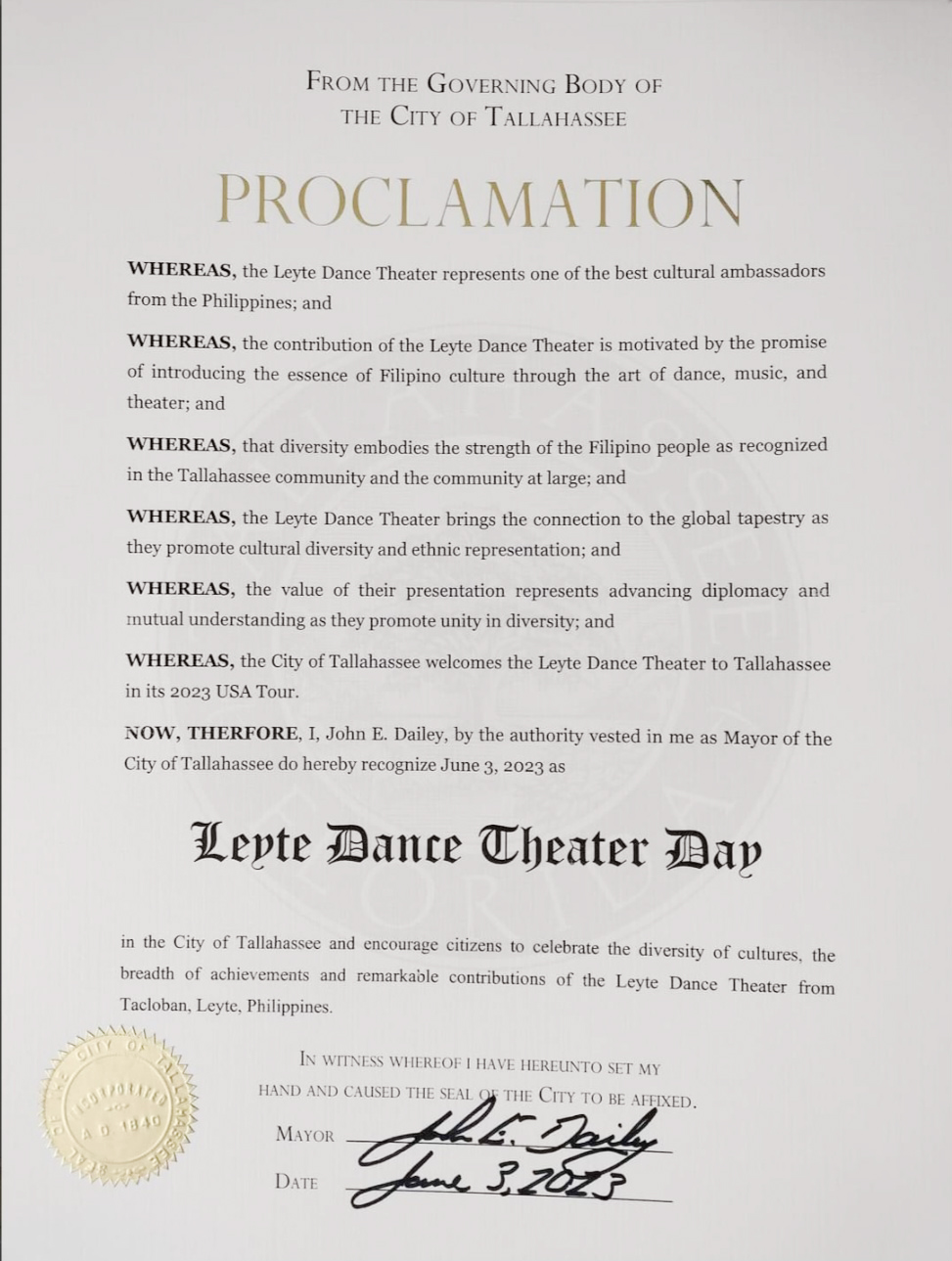
The Proclamation passed by the governing body of Tallahassee, Florida signed by Mayor John Dailey.
Their US tour called “Padayaw” short for Padayon Pagsayaw: The USA Tour 2023, their first since 2018, was also made part of the 12th Annual East Valley Filipino Festival in Chandler, Arizona celebrating the 125th Philippine Independence Day in said state. It ran from May till early July, mesmerizing guests and audience, especially when they got invited to dance upstage the traditional Filipino courtship dance or “Kuracha”.
LDT of Jess De Paz Foundation president Lowe Taña along with Charmel dela Cruz of the Filipino Festival in an appearance at a Filipino Channel in Arizona.
Among the states the LDT performed in the USA were New Jersey, Washington DC, Virginia, North Carolina, Connecticut, Florida, Texas, and California. Their spectators weren’t just the Fil-Ams in the state but those belonging to other races.
Philippine Deputy Consul-General Adrian Cruz of New York at the performance of LDT in New Jersey.
Such diversity in the racial spectrum did not seem to alter the guests and spectators’ cheers and applause to the performances of Eastern Visayas’ very own cultural dance troupe.
Lowe Taña, president of LDT of Jess de Paz Foundation Inc., described their tour shows as a “breathtaking experience”, giving him a “sense of being free and independent because this is the first time of travel without Sir Jess.”
LDT Choreographer Jerry Mores in one of LDT’s shows in the USA.
Leading a group of 18 dancers and three staff, was not a simple walk in the park for him.
From the time they conceived this plan for a US tour till they finally stepped on the land of milk and honey, the LDT leaders have gotten off a rough sail through the rapids.
Since the inception of LDT, one name has been ingrained in its existence, the late dance guru Jess de Paz. He has showcased the culture of Eastern Visayas to the whole world by way of aesthetic dance performances.
A free dance tutorial conducted by LDT to residents of Tallahessee, Florida.
Taña now assumes the responsibility to lead since the demise of the legendary organizer of LDT.
“After the artistic director, choreographer, and founder of the LDT Jess de Paz passed away last September 28, 2018 and the studio got burned from a fire last November 13, 2018, we planned after pandemic the US travel.”
It took the LDT one year to prepare the grand plan. And blessing came this year, the visa for the whole dance troupe was granted.
However, the plan was not easy does it to put into fruition.
“We encountered a lot of challenges of this travel financially, airline, etcetera,” adding, “We were able to overcome those with the help of LDT alumni and sponsors.”
Among those institutions that greatly supported the LDT’s Padayaw were St. Paul School of Professional Studies, Eastern Visayas State University and Leyte Normal University and Leyeco II. Individuals who assisted them significantly are numerous to name coming from the cross section of society, so to speak.
Taña attributed mainly the success of the Padayaw US Tour 2023 to the Filipino-American community they met, the sponsors, benefactors, and definitely the excellent performances of the dance troupe.
Indeed, these performances earned raves from various audiences.
In LDT’s social media site, California Commissioner of Library and Education Ana Rita Reyes congratulated the LDT “for the best performances of our dancers from the Philippines that I ever watched in my entire life”.
She added, “I am so happy and proud that I’m Filipino American Commissioner that I could (be) able to witness these incredible dance performances in honor to our Filipino culture, heritage, and roots.”
“You did an amazing job to show the world the beautiful Filipino folk dance and show,” she remarked further.
Another netizen Gladys Portillo stated in her post, “I have never witnessed more talented and amazing performers.” Portillo identified herself as an alumni of LDT.
In a decree signed by Mayor John Dailey, the Governing Body of the City of Tallahassee (Florida) proclaimed June 3, 2023 as the Leyte Dance Theater Day in recognition of LDT’s being one of the best cultural ambassadors from the Philippines.
An photo from one of the performances of LDT in USA.
The Proclamation encouraged the citizens “to celebrate the diversity of cultures, the breadth of achievements and remarkable contributions of the Leyte Dance Theater from Tacloban, Leyte, Philippines.”
Besides doing stage performances, the LDT conducted dance tutorials for free.
On July 27, the LDT, according to Taña, will be performing in Palo at the opening events for the fiesta of Palo in August.
The LDT is being choreographed now by Jerry Mores, who in his social media page gave the group’s acronym a definition Legacy, Dedication, and Triumph.
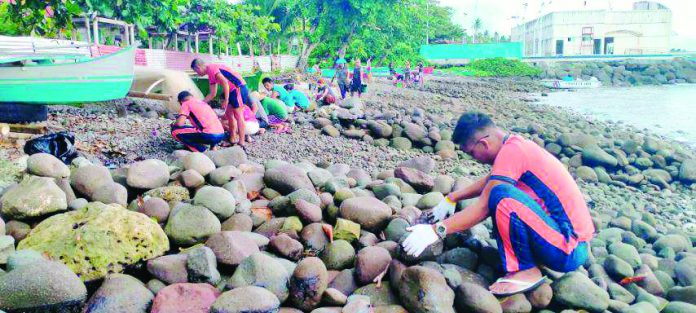
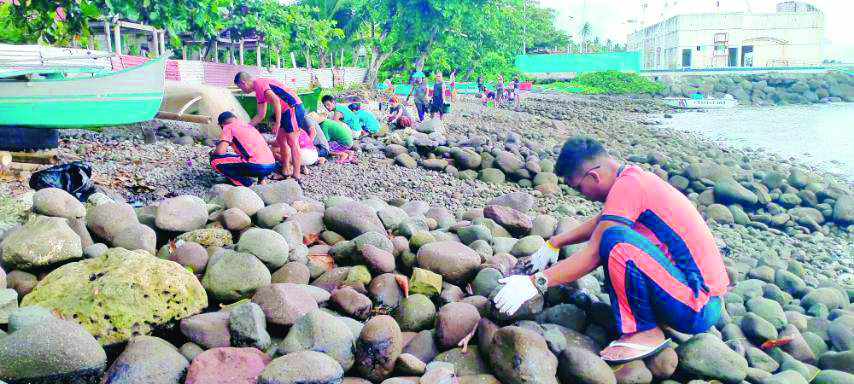
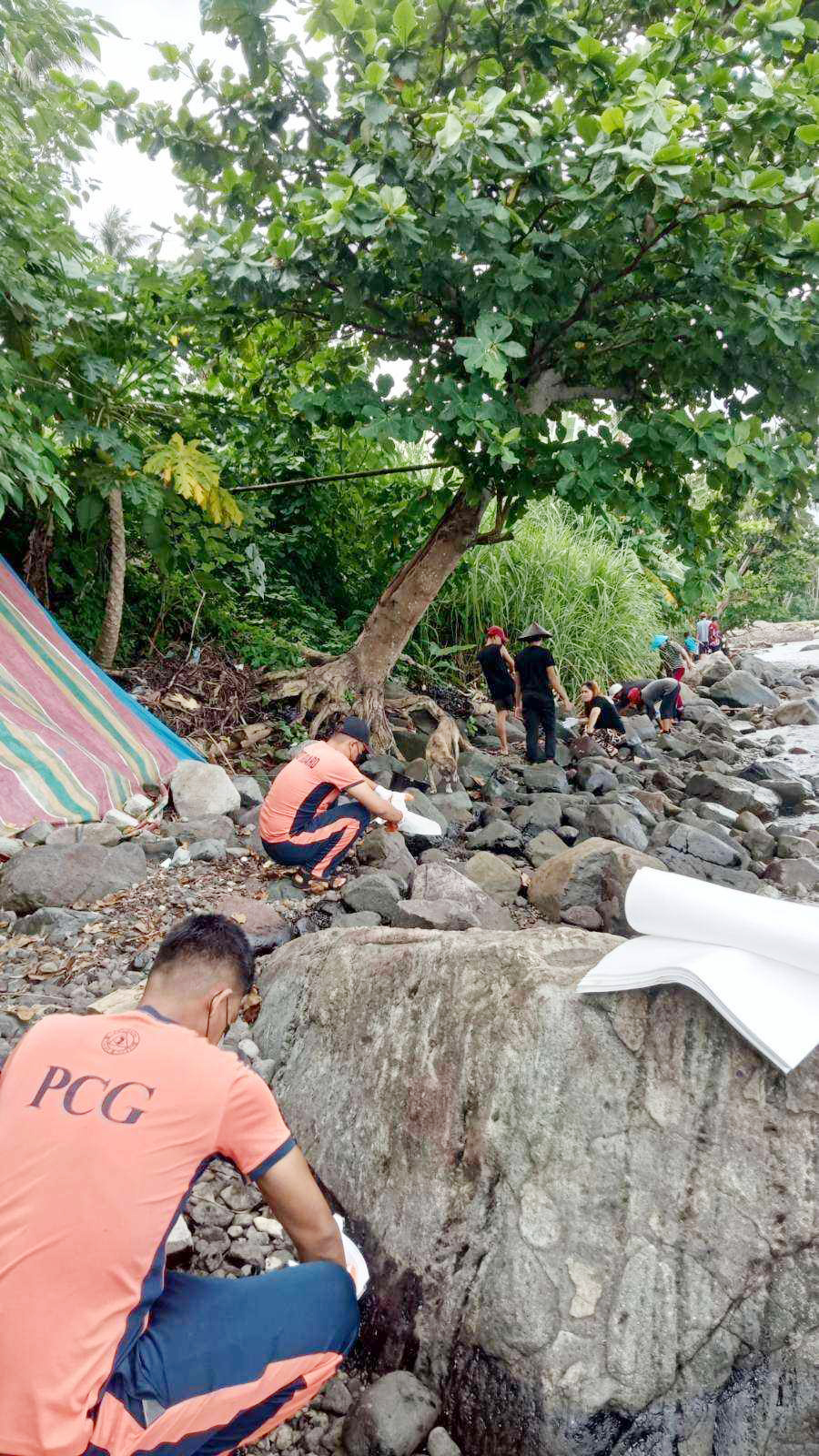
CONTAINED. The oil slick that hit the waters of San Ricardo in Southern Leyte is now contained, says the Coast Guard on Monday (July 10). During the three-day cleanup, 20 liters of oily water mixture were collected in the waters, particularly in Barangay Benit. (COAST GUARD)
Coast Guard says 20 liters of oily water mixture collected
CONTAINED. The oil slick that hit the waters of San Ricardo in Southern Leyte is now contained, says the Coast Guard on Monday (July 10). During the three-day cleanup, 20 liters of oily water mixture were collected in the waters, particularly in Barangay Benit. (COAST GUARD)
TACLOBAN CITY-The oil spill that affected the shore of San Ricardo in Southern Leyte has been declared as contained by the Coast Guard although investigation as to the cause remains.
The oil spill, which affected the coastal villages of Benit and Tambo, resulted in the collection of 20 liters of oily mixture, Lt. Commander Donna Liza Duran, Southern Leyte provincial Coast Guard commander, said in a phone interview on Monday (July 10).
“The oil spill has been contained already with the last cleanup ending at about 1 pm today (Monday). We have to credit this to the immediate response by the Coast Guard as well as by the local residents and officials,” she said.
“The Department of Environment and Natural Resources has conducted its water sampling and declared the water as clear and safe,” Duran added.
The oil spill was first noticed on Friday (July 7) coming from a private port in Benit which affected Benit and the adjacent barangay of Timba.
Duran said that while they have declared the incident as over, covering 500 meters in all, their investigation as to who was responsible is still ongoing.
She, however, declined to provide further details as the probe is still underway.
“But what we can guarantee is that somebody will be held accountable for this oil spill incident. Otherwise, this could happen again,” Duran said.
According to her, those found viable could be sanctioned for environmental violations.
“The local government unit of San Ricardo may seek damages for environmental violations and our environmental protection unit could also look at how they dispose their oil waste,” Duran said.
She said that oil samples were taken from two vessels, LCT Georgia-1 and MV San Ric Ferry 20, which are to be compared and match with the oil that spread on the water.
It was learned that prior to the incident, the two ships were docked at the said port.
As early as Sunday, Mayor Roy Salinas said that the situation has been under control.
“There is also no need to declare any state of calamity due to the oil spill. Cleanup drive was immediately conducted to ensure that it would not further spread,” he said in a phone interview.
Salinas has earlier directed residents of the affected villages not to venture to the water either to swim or to fish due to the cleanup drive.
The affected villages are all in the coastline where many of its residents were said to be into fishing as their main source of income.
Meantime, the regional office of the Department of Social Welfare and Development (DSWD) has provided relief assistance to the affected villagers of Benit and Timba.
At least 297 families or 1,118 individuals were affected by the oil spill.
Of this number, 196 families or 782 individuals were from Benit and 101 families or 335 individuals were from Timba.
“(The mayor) recommended food-for-work as they initially hired people to clean the seashores with their limited budget,” DSWD Regional Director Grace Subong said in a press statement.
TACLOBAN CITY– The governors of the Visayas have signed a manifesto of support to Tourism Sec. Christina Garcia Frasco and its controversial ‘Love Philippines’ tourism campaign.
The manifesto of support was released by the Office of the Presidential Assistant for the Visayas which is headed by Usec. Terence Calatrava.
Of the 16 governors of Visayas, two have not or failed to sign the manifesto which was posted on the social media account of the OPAV on Sunday (July 9).
The two governors whose names and signatures did not appear in the manifesto were Jose Miraflores of Aklan and Eugenio Lacson of Negros Occidental.
In Eastern Visayas, all six governors have signed the manifesto, namely, Gerard Roger Espina of Biliran; Damian Mercado of Southern Leyte; Carlos Jericho Petilla of Leyte; Ben Evardone of Eastern Samar; Edwin Ongchuan of Northern Samar, and Sharee Ann Tan of Samar.
In the wake of the controversy, local government units in the region used the logo of the ‘Love Philippines’ on their respective tourism promotional campaign, showing their support for Frasco and her tourism campaign.
Jhon Allen Berbon, the information officer of the provincial government of Northern Samar, said that as a proof that they are supportive of the campaign they have invited Sec. Frasco to attend the provincial launching of the ‘Love Philippines’ campaign next month.
“The Office of the Presidential Assistant for the Visayas, together with the governors of the different local government units in the Visayas Region, declares our full and unwavering support to the DOT’s rebranding of the Philippine tourism campaign,” part of the manifesto said.
“It is our firm belief that the DOT, under the leadership of Sec. Christina Garcia Frasco, poses no other interest than to bolster the tourism framework of the country despite of the setbacks and adjustments that we, as a nation, had to unfortunately encounter during the pandemic,” it added.
It further said, “We are confident that as soon as the matter fades into insignificance, the superior intentions of the good Secretary and her commitment to developing and promoting the Philippines to the world will prevail.”
The officials then urged the public to be with the mission and vision’ of the DOT and ‘be our country’s beloved envoy of goodwill…and how we Love the Philippines.’
The “Love Philippines’ campaign came under fire after it was discovered that it used stock footage from other countries.
TACLOBAN CITY– Ormoc City Mayor Lucy Torres Gómez praised Department of Budget and Management (DBM) Secretary Amenah Pangandaman for helping the city government fund its new slaughterhouse.
MAYOR LUCY TORRES GOMEZ
The DBM allocated P35 million for the construction of the facility, located at the Valencia satellite public market which had its groundbreaking last Friday(July 7) which was attended by Pangandaman.
Torres-Gomez said that local government like Ormoc has difficulties in looking for funds to help them realize their projects.
“In my job as a representative before and as mayor now, I’ve met a lot of Secretaries who say ‘No,” Cannot be,” “No budget yet,” she said.
“But in the world of many “Nos,” thank you, Sec Mina, for being a “Yes” and for making this happen for us,” Mayor Gomez added.
She then vowed that they will ensure that the funds allocated by the DBM on this project will be spent accordingly.
Sec. Pangandaman, for her part, emphasized that President Ferdinand Marcos Jr. prioritizes the agriculture sector which has a huge impact on food security, yet has been lagging compared with Asian counterparts.
According to Pangandaman, the construction of the new slaughterhouse in Ormoc will revitalize the meat industry and ensure the quality of meat for the Ormocanons.
“So with the construction of the new slaughterhouse, we hope po to revitalize the meat industry of Ormoc. It will also ensure the standard of meat na nanggagaling dito sa Ormoc,” she said.
Designed to be a progressive meat-processing hub in Ormoc City, the facility will feature technologically advanced equipment. Upon completion, it will operate in compliance with regulations by national and international regulatory agencies.
The construction of the facility is a significant step for the community’s development and reflects the national government’s ongoing commitment to socioeconomic development. (LIZBETH ANN A ABELLA)