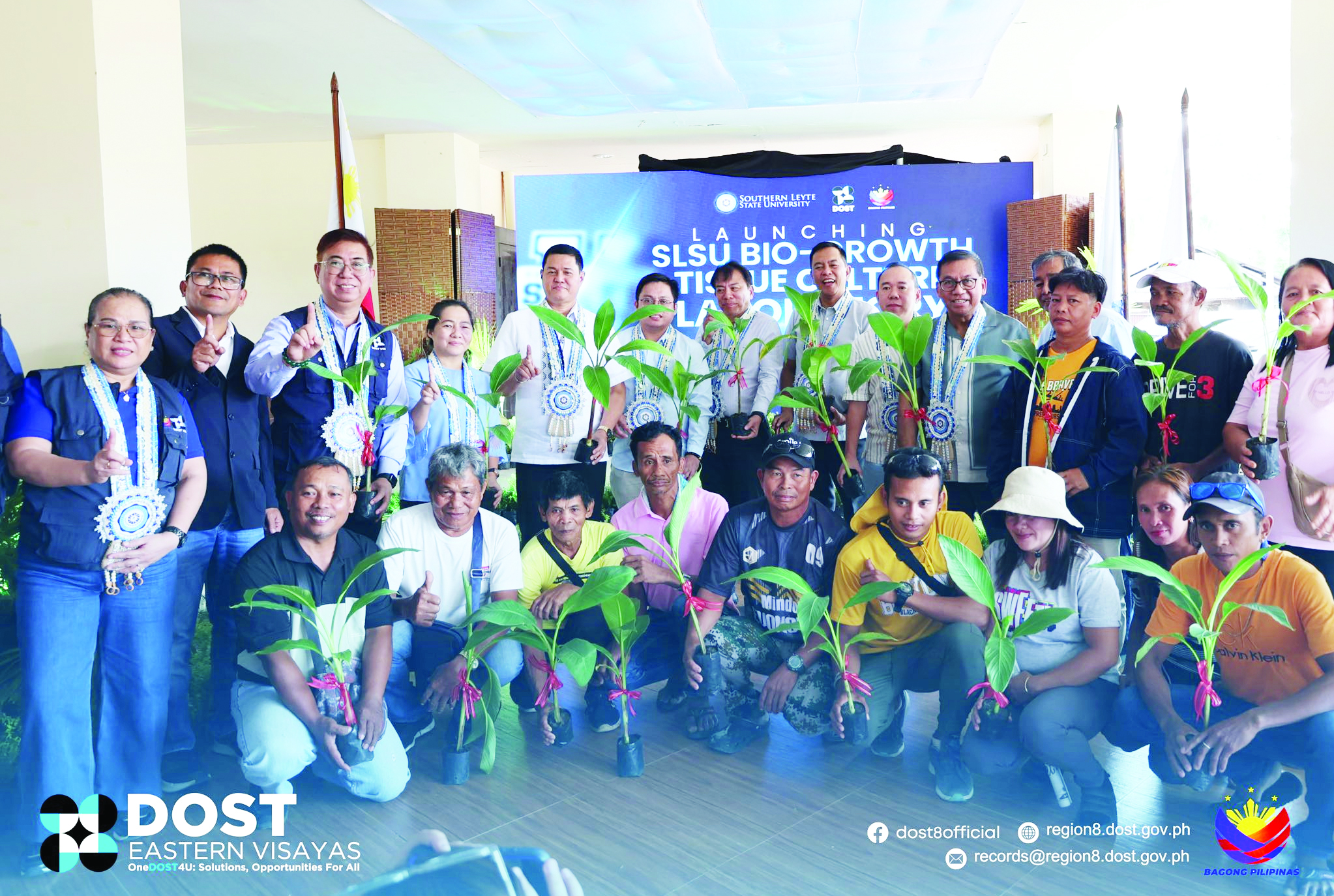
TACLOBAN CITY — In a move aimed at strengthening science-driven agriculture and supporting farmers in Southern Leyte, the Southern Leyte State University (SLSU)–Hinunangan Campus has formally opened its BIO-GROWTH Tissue Culture Laboratory, a facility expected to enhance agricultural research and improve the supply of high-quality planting materials in the province.
The laboratory was launched on January 22 in a ceremony led by Department of Science and Technology (DOST) Secretary Renato Solidum Jr., together with DOST Undersecretary for Regional Operations Sancho Mabborang, DOST Regional Director John Glenn Ocaña.
Also present were Southern Leyte 2nd District Representative Christopherson Yap, and Hinunangan Mayor Ymard Joseph Tocmo.
University officials present included SLSU Vice President for Research, Innovation, and Extension Services Francis Ann Sy, SLSU–Hinunangan Campus Director Ian Navarrete, and John Paul R. Gapasin, faculty dean and project leader of the tissue culture laboratory.
The BIO-GROWTH Tissue Culture Laboratory will focus on the production of disease-free and high-quality planting materials, particularly for abaca, one of Southern Leyte’s major agricultural commodities and a key source of livelihood for many farmers in the province.
SLSU officials said the facility is intended to help improve farm productivity and strengthen the local abaca industry through the application of modern biotechnology.
In his message, Solidum said tissue culture technology plays a critical role in enhancing agricultural resilience, improving yields, and addressing production challenges brought about by pests, diseases, and climate-related risks.
“With this tissue culture laboratory, we hope to further empower farmers, modernize agriculture, and help transform communities here in Hinunangan and across Southern Leyte. Leyte is proving that when science reaches the grassroots, progress truly takes root—and when it takes root, it bears fruit,” Solidum said.
He added that the facility is a strategic investment not only in research but also in the country’s broader agribusiness sector. “We ensure that our farmers stay in profit while promoting agricultural diversification. The tissue culture laboratory is not merely a facility—it is a strategic investment in the country’s agribusiness sector,” he said.
Local officials and university leaders expressed support for the project, citing its potential to generate long-term benefits for farmers, researchers, and the local economy.
SLSU said the establishment of the BIO-GROWTH Tissue Culture Laboratory underscores the university’s commitment to research-based solutions and its partnership with the DOST in advancing inclusive and sustainable agricultural development in Southern Leyte.
(ROEL T. AMAZONA)