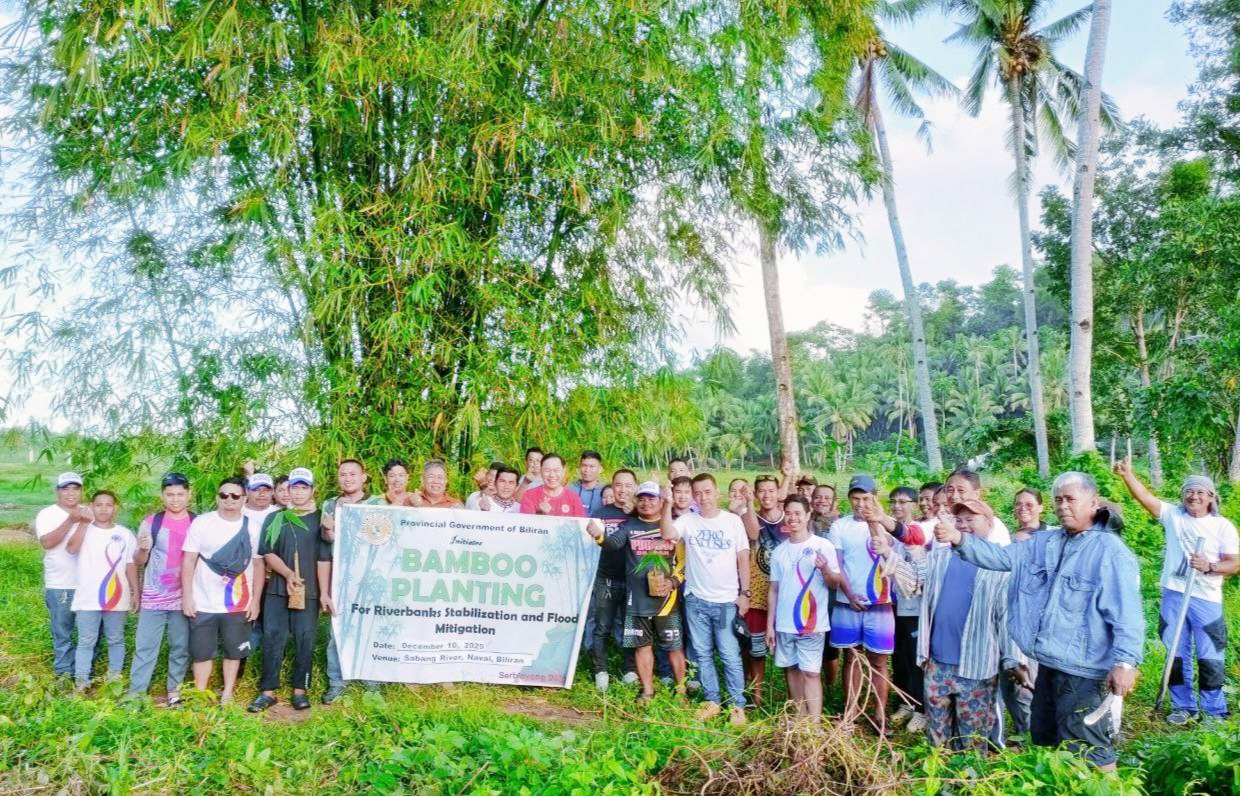
TACLOBAN CITY — Biliran province has taken another step toward strengthening its natural defenses against erosion and flooding as the provincial government completed the 3rd round of its Bamboo Rehabilitation Program on Wednesday(Dec.10), planting 100 bayog bamboo seedlings in Barangays Agpangi and Sabang,both in the provincial capital of Naval.
The initiative, led by Governor Rogelio Espina and Provincial Environmental Officer Sofronio “Jun” Dacillo Jr., aims to build a continuous bamboo greenbelt along major river systems—an effort that supports both disaster resilience and long-term environmental sustainability.
Officials selected the bayog variety for its durability and suitability for riverbank protection. Known for its deep root system and strong culms, bayog bamboo helps stabilize slopes, reduce soil erosion, and minimize scouring around bridges and essential structures. It also acts as an efficient carbon sink, absorbing carbon dioxide and releasing oxygen, while slowing water flow during heavy rains to lessen flood risks.
Beyond its environmental benefits, the program is designed to promote community involvement. Local residents and provincial workers—including job order and contract of service personnel—joined the planting activity to demonstrate a whole-of-government and whole-of-community approach to protecting Biliran’s natural resources.
Governor Espina said the seedlings serve as “guardians of our riverbanks and foundations of our green economy,” adding that the province is committed to expanding bamboo planting along all major waterways.
He also revealed that aside from the 100 seedlings planted this week, the province is currently propagating 3,000 more bayog bamboo seedlings for future transplantation.
Through the Bamboo Rehabilitation Program, Biliran hopes to inspire landowners, youth groups, environmental advocates, and civic organizations to participate in broader greening initiatives and help build a more climate-resilient province.
(ROEL T. AMAZONA)